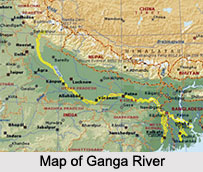
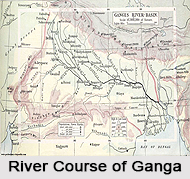
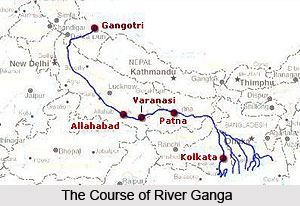
The Ganga River basin is affluent with perennial rivers and streams having special significance in the region it flows. Some of the important rivers in the Ganga River Basin are as follows -
Hooghly River
The Hooghly River is an approximately 260 km long distributary of the Ganges River in West Bengal, India. The river divides from the Ganges as a canal in Murshidabad District at the Farakka Barrage. The town of Hugli-Chinsura was formerly known as Hooghly. This town is located on the river, in the Hooghly district of West Bengal. The origin of the name of Hooghly River is not known, whether the city or the river derived the name first.
Damodar River
The Damodar River rises near Chandwa village in the Palamau district of Jharkhand. This region is the Chota Nagpur Plateau region of India. The river flows through the states of Jharkhand and West Bengal for nearly 592 kilometers and then merges with the Hooghly River, which is in the south west of Kolkata. The Damodar River has a number of tributaries and distributaries. They are Barakar, Konar, Guaia, Jamania, Usri, Bokaro, Haharo, Khadia and Bhera. The Barakar is the most important tributary of the Damodar River. This River arises near Padma in Hazaribagh district, flows through Jharkhand, and meets the Damodar River in Dishergarh in West Bengal.
Rupnarayan River
The Rupnarayan River is a river in eastern India. It begins as the Dhaleswari (Dhalkisor) in the Chhota Nagpur plateau foothills northeast of the town of Purulia. It then follows a tortuous southeasterly course past the town of Bankura, where it is known as the Dwarakeswar River.
Meghna River
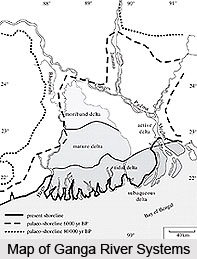
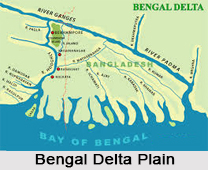
The Meghna River is an essential river in Bangladesh, one of the three that forms the Ganges Delta, the largest on earth. The Meghna River is formed within Bangladesh by the merging of different rivers originating from the hilly areas of eastern India. The river converges with the Padma River in Chandpur District. The river finally flows into the Bay of Bengal in Bhola District.
Padma River
The Padma River is a major trans-boundary river between Bangladesh and India. It is the main distributary of the Ganges that originates in the Himalayas. The Padma enters Bangladesh from India near the place called Chapai Nababganj. The river meets the Jamuna near Aricha and retains its name. However, it finally meets the Meghna River near Chandpur and takes up the name ‘Meghna’ before emptying into the Bay of Bengal. Rajshahi, a major city in western Bangladesh lies on the north bank of the Padma.
Koel River
The origin of Koel River is in the Palamu Tiger Reserve and flows in the western part of Palamu District. The river divides into two - the North Koel River and the South Koel River.
Rihand River
The Rihand River flows in east-central India and is a tributary of the Son River. The Rihand’s headwaters originate in the Bagelkhand region of Madhya Pradesh state, and flow towards the north into Sonbhadra District of Uttar Pradesh.
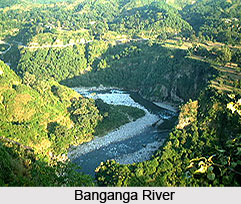
Ban-Ganga River
Ban-Ganga River is a prominent river in the Bharatpur district of the Indian state of Rajasthan. Betwa river is a north Indian river and a tributary of the Yamuna originating in the Vindhya Range just north of Hoshangabad in Madhya Pradesh. In Sanskrit ‘Betwa’ is called ‘Vetravati’ which means containing reeds. The Dhasan River is a distinguished tributary of the Betwa River.
Chambal River
A principal tributary of the Yamuna River is the Chambal River (also known as Charmanwati, or Charmawati), which is an important river of the Malwa Plateau. Banas river flows in Rajasthan and a major confluent of the Chambal River, which flows into the Yamuna, which is again a tributary of the Ganges. A major tributary of the Banas River is the Berach River, which flows in Rajasthan. Ahar River is considered as a significant river in India, since the cradle of Udaipur Civilization was built. Kali Sindh river flows in the Malwa region of Madhya Pradesh and joins the Chambal River at downstream of Sawai Madhopur in Rajasthan. An important river in the Indian state of Himachal Pradesh is the Parbati River. This river rises from the Man Talai Glacier below the Pin Parbat pass.
Shipra River
The Shipra River, also spelt, as Kshipra is a river in that flows in the state of Madhya Pradesh, which is located in central India. The Gambhir River rises in the hills near Karauli village of Sawai Madhopur District in the western state of India, Rajasthan. The Gomti River originates from the east of Pilibhit town at a height of 200 meters. The river is also known by the names as Gumti or Gomati.
Rivers in Madhya Pradesh
The Halalai River is an Indian river, flowing across the state of Madhya Pradesh. Kaliasote River is a prominent river flowing in Madhya Pradesh. The Sindh river flows in the state of Madhya Pradesh of central India. Kwari River is also spelled as Kuwari or Kunwari River. This river flows in Morena, Bhind districts of Madhya Pradesh in central India. Pahuj River is an Indian river flowing in Bhind District of Madhya Pradesh in central India.