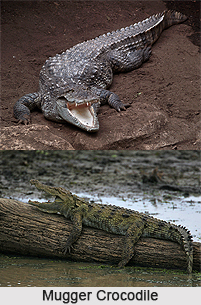
 Mugger crocodile, considered a medium sized species, is found throughout the Indian subcontinent and the surrounding countries, like Pakistan. It is one of the three crocodiles found in India, the others being the gharial and the saltwater crocodile. It mostly inhabits freshwater lakes, ponds, sluggish rivers and marshes. It is generally considered to be occasionally dangerous to human beings.
Etymology of Mugger Crocodile
The term "mugger" is derived from the Hindi word magar which in turn derived from the Sanskrit word makara meaning mythical water monster. It is also known by names like Indian, Indus, Persian, marsh crocodile or simply mugger.
Physical Features of Mugger Crocodile
The mugger crocodile is said to grow up to 4-5 m long. The males are larger than females. Adults are dark grey or brown, while hatchlings are tan colored. Sexual maturity is obtained at around 1.7-2 m and 2.6 m for females and males respectively. This species has 19 upper teeth on each side; scales on limbs keeled, fingers webbed at the base and outer toes extensively webbed. Mugger crocodiles can swim much faster than they can run.
Habitat of Mugger Crocodile
These crocodiles are freshwater species and are comfortable in slow-moving shallower water bodies. Although they prefer to live in lakes, rivers and marshes, they can also live in man-made reservoirs and irrigation canals. They can also tolerate saltwater therefore is occasionally reported from saltwater lagoons.
Muggers are ecologically most similar to the African Nile crocodile and are adapted to terrestrial life like the Cuban crocodile. They are more mobile on land and can chase prey on land for short distances. They can migrate considerable distances over land in search of a more suitable habitat.
It is said that in 1980s, the largest population of wild crocodiles lived in the Amaravathi Reservoir of Tamil Nadu and in the Chinnar, Thennar and Pambar rivers that drain into it. At that time the total number of muggers was estimated to be 60 adults and 37 sub-adults. The Amaravati Sagar Crocodile Farm, established there in 1975, is the largest crocodile nursery in India.
Diet of Mugger Crocodile
Mugger crocodile prefers to eat fish, snakes, turtles, birds and mammals. The young muggers usually eat small to medium-sized mammals such as monkeys, squirrels, chital and otters and the large muggers prey on larger mammals, such as large deer, like sambar, and large bovines, like cattle and domestic water buffalo. They often hunt in the night and steal kills from other predators, such as leopards.