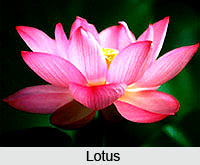
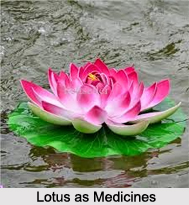
 Lotus, scientifically known as `Nelumbo Nucifera` is the National Flower of India. The flower Lotus is regarded with divinity and grace. The lotus holds additional significance for Hindus, as it is a symbol of God and used often in religious practices. Then in Indian thought, there is the last and final lotus - Charan Kamal or lotus feet of the Almighty. They are found in white and pink colors in general. Some blue colored flowers are also sighted. The pink one is regarded as the National Flower of India.
Often, the Hindu Goddesses Laxmi and Saraswati are associated with the flower lotus. Even Lord Shiva, who wanted to escape the anger of the Lord Saneeswaran, transformed himself into the shape of a bee and took shelter inside a lotus. Buddhists regard this flower as a sacred one. The Lotus symbolizes divinity, fertility, wealth, knowledge and not to forget enlightenment.
Lending to its uniqueness, the flower grows in muddy waters and rises on a long tail above the surface to bloom gloriously. It is also a symbol of victory. Since the lotus is rooted in the mud and can survive to regerminate for thousands of years. It represents long life, health, honour and good fortune. Untouched by the impurity, lotus symbolizes the purity of heart and mind. Human beings are instructed by Indian scripture to live a life of non-attachment, which is very hard.
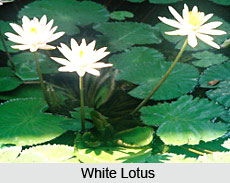 These flowers enjoy a warm sunlight and intolerant to cold weather. This is why; they are not seen blossoming in the winter. The floating leaves and flowers have long stems, which contains air spaces to maintain the good spirit. The genus Lotus contains approximately 150 species distributed world-wide. Lotus is a genus of legume and its members are adapted to a wide range of habitats, from coastal environments to high altitudes. Most species have leaves with three leaflets, but also two large stipules at the base roughly equal in size to the leaflets, thus appearing to have five leaflets; some species have pinnate leaves with up to 15 leaflets.
The flowers are in clusters of 3-10 together at the apex of a stem with some basal leafy bracts, pea-flower shaped, vivid yellow or orange, occasionally red. Lotus species are used as food plants by the larvae of some Lepidoptera. It was this depth of thought that made the founding fathers of modern India enshrine the `Lotus` in the Constitution as the `National Flower`.
 Lotus has the title of India"s national