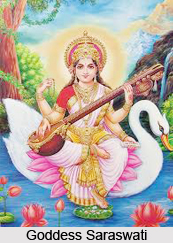
Goddess Saraswati

Goddess Saraswati, also known as Vaakdevi, is the Goddess of knowledge and art. She represents consciousness and wisdom.

About Saraswatidevi

Goddess SaraswatiGoddess Saraswati according to Hindu mythology is considered to be the Goddess of knowledge and the art. She represents awareness and astuteness. She is also worshipped as the goddess of sound and speech. Saraswati is depicted as a goddess who is clothed in white, seated on a white lotus and playing the instrument Veena. Four Vedas are considered to be her progeny. The swan symbolizes pure knowledge. Generally any institution of education is observed as temple of Goddess Saraswati. Musical instruments symbols of Saraswati.

Saraswati is worshipped as the consort of Lord Brahma the creator. Legend has it that Brahma the creator acquired the power to think and create only through the power of Saraswati and that it was Saraswati that enabled Brahma to listen to the naadabhrahmam the primordial sound that is revered as the source of all creation. Saraswati is also referred to as Sharda the fountainhead of knowledge who leads seekers from darkness to light and from ignorance to spiritual upliftment.

The extinct river Saraswati is associated with Saraswati the Goddess of knowledge. Legend has it that when Shiva opened his third eye, the flame that emanated threatened to destroy everything in its path. Only Saraswati the source of wisdom was unperturbed by the potency of the flame, owing to her firm understanding that the flame would only destroy what was impure. She thereby took the form of a river, carried the flame into the sea and changed it into a fire. She declared that any creature of destruction would stay underground as long as wisdom was sought after.

She is Lord Brahma`s consort. In Buddhism she is known as the deity who supports the teachings of Lord Buddha. In Bengal, Goddess Saraswati is considered to be the daughter of Goddess Durga who is depicted along with her sister Lakshmi and her brothers Ganesha and Karthikeya. Saraswati is in the trinity of Maha Kali, Maha Lakshmi and Maha Saraswati in Devi Mahatmya and is depicted as eight-armed. She is offered honey it represents perfect knowledge. Saraswati Vandana Mantra is one of the hymns dedicated to her.

In West Bengal, Orissa, Bihar and Assam, Saraswati Puja is celebrated in the month of Magha month. In Maharashtra, parts of Gujarat, Saraswati Puja is celebrated on Maha Saptami and ends on Vijayadasami. In the southern India, Saraswati Puja is celebrated during the Navaratri.
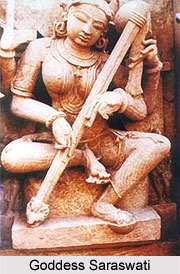
Iconography of Goddess Saraswati

Iconography of Goddess Saraswati, KhajurahoGoddess Saraswati according to Hindu mythology is regarded to be the Goddess of knowledge and the art. She has been given due importance in Khajuraho Temples. The goddess also finds her presence among both the sects of the Jains from ancient times. She is also famous among the Brahmanas and the Buddhists. The earliest image of Goddess Saraswati was acquired from the Kankali Tila, Mathura. It was carved by the Jains.
Forms of Goddess Saraswati
There are various forms of Goddess Saraswati namely, the two armed, the four armed and the multi armed. However, in different sculptures she is also carved with six, eight and sixteen hands which are not according to the iconographic texts.

The various symbols held by Saraswati are veena, pustaka i.e. a manuscript, lotus, rosary and the varada or abhaya mudra. The three symbols are seen more frequently. She rides a swan, occasionally replaced by a peacock. She mostly appears as seated on a lotus in lalitasana but sometimes she is also seen standing on a lotus. Goddess Saraswati has been given much importance at Khajuraho. The images are mainly found on the door lintels, but two images are also seen carved on the adhisthana of the mandapa of the Parshvanatha Temple. Another image of the goddess is also visible above the right shoulder of the figure of Goddess Laksmi. This is located on the south facade of the Parshvanatha Temple. In one of the images Goddess Saraswati has been represented possessing six arms. In total there are eight figures including the ones carved on door lintels. However, the figures at Khajuraho do not match with the religious scriptures. Her vahana, the swan cannot be seen carved anywhere except the one located on the north adhisthana of the Parshvanatha Temple. Saraswati is represented as seated in lalitasana in all the instances.

The northern adhisthana of the Parshvanatha Temple houses the four armed image od Goddess Saraswati. She is seen holding lotuses in the upper pair of arms. Her lower arms are damaged. On the left side close to her feet her vehicle, swan is carved. On two sides there appear three devotees with folded hands. Three small Jina figures are carved above the head. Another four armed figure image of the goddess has been carved on the doorway of the sanctum of the Parshvanatha Temple. She is seen holding a spiral lotus and a manuscript respectively in her right and left upper hands. The image of the goddess bearing the same symbols can be seen on the door lintel of the back of the shrine of the Parshvanatha Temple. The door lintels have been carved with two similar figures. One if the images are datable to the modern time. It is located in the north jagati of the Parshvanatha Temple. The other image is visible in the Modern Temple No. 11. These door-lintels are datable to the 11th century A.D. On the back shrine of the Parshvanatha Temple another beautiful figure of the goddess is carved on the door lintel. The goddess is seen bearing a lotus and a manuscript in upper right and left arms, while the lower ones show the varada mudra and a kamandalu. In some other figure she has been carved along with Goddess Lakshmi and is seen on the south facade of the mandapa of the Parshvanatha Temple. She holds a lotus and a manuscript in her upper right and left hands while the lower hands show the abhaya mudra and a matulinga.

In the south adhisthana of the Parshvanatha Temple a six armed figure of Goddess Saraswati is visible on a rathika. The goddess is seated in bhadrasana and holds a half bloomed lotus in her right and a manuscript in her left upper hands. In the middle pair of hands she is engaged in playing the veena. The lower right and left hands show respectively the varada mudra and a kamandalu. Her vehicle, the swan is absent here. The goddess id flanked by an attendant on either side carrying a flywhisk in the inner hand. They are standing in tribhanga posture. Three worshippers with folded hands can be seen close to her feet. A small Jina figure along with a couple of flying figures has been carved above her head. Below these figures there appear two hovering figures.

Recently updated articles in Religion in India

Maheswara
Maheswara Thumbnail

Maheswara

Maheswara, meaning “the Great Lord,” is a revered name of Lord Shiva in Hindu tradition. It represents Shiva’s supreme authority over creation, preser...

Anganyasa and Karanyasa
Anganyasa and Karanyasa Thumbnail

Anganyasa and Karanyasa

Anganyasa and Karanyasa are preparatory rituals in Hindu worship that sanctify the body and hands through the recitation of sacred mantras and symboli...

Kumbhakar / Kumhar Caste
Kumbhakar / Kumhar Caste Thumbnail

Kumbhakar / Kumhar Caste

Kumbhakar or Kumhar caste is a traditional artisan community in India known for pottery making. Derived from Sanskrit word Kumbhakar, meaning potter,...

Dhimar Caste
Dhimar Caste Thumbnail

Dhimar Caste

The Dhimar caste, predominantly residing in the Central Provinces of India, is a distinct Hindu community with a rich heritage and diverse occupationa...

Barhai Caste
Barhai Caste Thumbnail

Barhai Caste

Barhai Caste is a traditional Hindu artisan community historically associated with carpentry in India. Known for their craftsmanship, Barhais contribu...