Kusumayudha

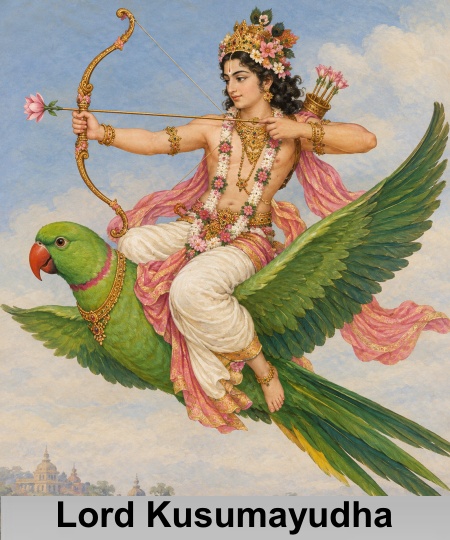
Kusumayudha is a name of Kamadeva, the Hindu God of Love. Depicted with a sugarcane bow and flower-tipped arrows, he represents attraction and longing. Ancient traditions associate him with Vasant Panchami and spring.

Introduction

KusumayudhaKusumayudha is another name of Kamadeva. Kamadeva is the ancient god of love and sexual desire in Hinduism. Kusumayudha is one of the epithets used for Kamadeva. Other epithets of Kusumayudha are Manmatha (mind agitator), Manobhu and Manasija (mind-born), Madana(passion), Puspa-dhanva (one with floral arrows), Pancasayaka (holder of five arrows), Minaketana (one whose banner is marked with a fish) and Kandarpa. 

The name “Kusumayudha” was popularised through the works of the legendary poet Kalidasa, particularly in his celebrated epic poem “Kumarasambhava.” Considered one of the greatest works of classical Sanskrit literature, Kumarasambhava features the name “Kusumayudha” five times, highlighting its association with Kamadeva.
Etymology of Kusumayudha

The word “Kusumayudha” comprises of two separate words “Kusuma” and “Yudha”. The word “Kusuma” means flower in Sanskrit and “Yudha” means a weapon. So, the word “Kusumayudha” literally means the one who strikes with flowers or He whose weapons are flowers.

Origin of Kusumayudha

According to the Taittiriya Brahmana, Kama or Kusumayudha is described as the son of Dharma, the god of justice, and Sraddha, the goddess of faith. However, the Harivansa presents a different account, identifying Goddess Lakshmi as his mother. Another tradition states that Kusumayudha emerged directly from the heart of Brahma.

Appearance of Kusumayudha

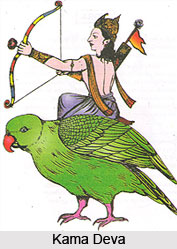
Kusumayudha is regarded as the lord of the Apsaras, or heavenly nymphs. He is depicted as carrying a bow and arrows, with his bow made of sugar cane and its string represented by a line of bees. Each of his arrows is tipped with a different flower. He is commonly portrayed as a handsome youth riding a parrot and accompanied by heavenly nymphs. One of the nymphs carries his banner, which features a Makara, or fish, depicted against a red background.

Reference of Kusumayudha in Vedas

In the Rigveda, Kusumayudha, or desire, is described as the first movement to arise within a living being after it came into existence through the power of fervor or abstraction. It is presented as the primal germ of the mind, emerging as the first impulse of creation. According to the hymn, sages searching through their intellect discovered Kama within their hearts as the bond connecting entity with non-entity. Thus, Kama was regarded as the first principle to emerge, surpassing gods, ancestors, and human beings. 

In the Atharvaveda, Kama is celebrated in a distinctive hymn that elevates him to the status of a supreme deity and Creator. Here, Kama does not refer to sexual enjoyment but represents desire or aspiration for goodness in general. Elsewhere in the same Veda, Kama is portrayed first as desire itself and subsequently as the power through which that desire is fulfilled. In the Puranic tradition, Kama is associated with Rati, also known as Reva, who is regarded as the goddess of desire and his consort. 

Legends of Kusumayudha

Kusumayudha is said to have inspired amorous thoughts of Parvati in Shiva while the god was engaged in penitential devotion. Angered by this act, Shiva punished him by reducing him to ashes with the fire emanating from his third eye. Shiva later relented and permitted Kama to be reborn as Pradyumna, the son of Lord Krishna and Devi Rukmini, or Maya, meaning “delusion.” Pradyumna is said to have had a son named Aniruddha and a daughter named Trisha. 

According to legend, Vasant Panchami is associated with the story of Kamadeva or Kusumayudha. It is believed that on this day, Kamadeva shot his flower-tipped arrows at Lord Shiva to awaken him from deep meditation and draw him back into the worldly realm. In ancient times, Kusumayudha was worshipped on Vasant Panchami, whereas the festival is now primarily associated with the worship of Goddess Saraswati. 

Another tradition states that after Shiva reduced Kusumayudha to ashes, his wife Rati undertook forty days of penance. Pleased with her devotion, Shiva restored Kamadeva to life on Vasant Panchami. His revival is associated with the blooming of flowers and the renewal of nature, symbolising the arrival of the spring season.

Recently updated articles in Religion in India

Kusumayudha
Kusumayudha Thumbnail

Kusumayudha

Kusumayudha is a name of Kamadeva, the Hindu God of Love. Depicted with a sugarcane bow and flower-tipped arrows, he represents attraction and longing...

Bhoyar Caste
Bhoyar Caste Thumbnail

Bhoyar Caste

Bhoyar Caste is largely found in the Central Provinces of the country. Traditional occupation of Bhoyars is agriculture. They are good cultivators and...

Chasa Caste
Chasa Caste Thumbnail

Chasa Caste

Chasa caste is a prominent agrarian community native to Odisha. Traditionally associated with cultivation and farming, Chasas have historically played...

Vigneswara, A Form of Lord Ganesha
Vigneswara, A Form of Lord Ganesha Thumbnail

Vigneswara, A Form of Lord Ganesha

Lord Vigneswara is another form of Lord Ganesha or Vinayaka, prominently worshipped as the God of intelligence and good luck in the Indian subcontinen...

Maheswara
Maheswara Thumbnail

Maheswara

Maheswara, meaning “the Great Lord,” is a revered name of Lord Shiva in Hindu tradition. It represents Shiva’s supreme authority over creation, preser...