
 Kumbhakar or the potter caste, also known as Kumars or Kumhars
in West Bengal, is a traditional professional group engaged in clay modeling
and making earthen wares, including various household items and even clay toys.
People of this caste are also settled in other parts of India, such as northern
and southern parts of the country.
Kumbhakar or the potter caste, also known as Kumars or Kumhars
in West Bengal, is a traditional professional group engaged in clay modeling
and making earthen wares, including various household items and even clay toys.
People of this caste are also settled in other parts of India, such as northern
and southern parts of the country.
Kumbhakar / Kumhar Caste
Kumbhakar or Kumhar caste is a traditional artisan community in India known for pottery making. Derived from Sanskrit word Kumbhakar, meaning potter, they are widely distributed across regions under various names. Historically linked to the Shudra varna, many Kumhars have also transitioned into agriculture and other occupations over time.
Introduction
Etymology of Kumbhakar / Kumhar Caste
The Kumhars derive their name from the Sanskrit word “Kumbhakar,”
which means "earthen-pot maker." This meaning is also reflected in
various Dravidian
languages, where the term carries the same association with pottery and
clay craftsmanship. Another term commonly used to refer to the Kumhar caste is “Bhande,”
which likewise signifies "pot." In Amritsar, members of the potter
community are known as Kulal or Kalal, names that trace their origins to the Yajur Veda, where these
terms were used to identify the traditional potter class.
Mythical Origin of Kumbhakar / Kumhar Caste
There is a mythical story relating to the origin of Kumbhakar. Lord Shiva is believed to have created a man and a woman during his marriage, from the beads of his garland and bade them to manufacture a “Kumbha” or water pot, which was required during his wedding ceremony.
Therefore, the potters call themselves the dependent of Shiva and place his idol on the center of their wheel, leaving it unturned for the entire first month of the Bengali Calendar. On the last day of the Bengali calendar, they worship the idol with devotion before immersing it. The Kumbhakar also worship Lord Viswakarma and believe that he had passed this exquisite art of pottery down to them.
Another Mythical Story Associated with Kumhars: A section of Hindu Kumhars honorifically identifies themselves as Prajapati, a title derived from the Vedic deity Prajapati Brahma, whom they believe to be the creator of the universe. According to a traditional legend, Brahma once distributed pieces of sugarcane among his sons. While each of the others ate his share, the Kumhar, deeply engrossed in his pottery work, forgot to eat his. The sugarcane piece he had placed beside a lump of clay took root and eventually grew into a full plant. When Brahma later asked his sons to return the sugarcane, none could do so except the Kumhar, who presented the fully grown plant. Impressed by the potter's unwavering dedication to his craft, Brahma bestowed upon him the honorary title of ‘Prajapati.
Occupation of Kumbhakar / Kumhar Caste
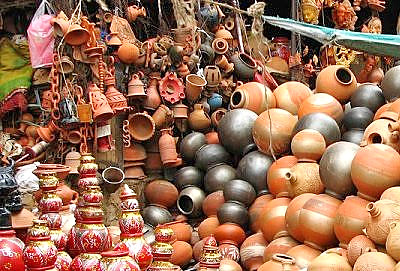
The Kumbhakar or the potter makes a number of clay wares like kalshi (household water vessel), handi (cooking pot), jala (big water jar), hara/dhakna (pot covers), shanki (dish), sharai (jug), plates, cups, badna (water pot) and dhupdani (vessel for scented sulphur). Clay made toys and clay fruits like palm, banana, jackfruit or mango, are popular items sold in traditional fairs and festivals specific to the potter community. All the earthen wares are made by the hand and often display considerable ingenuity.
All the Kumbhakar or potters use a simple technology in making the earthenware. The clay dug from the earth’s surface is prepared by beating and kneading with the hands, feet or simple mallets of stone or wood. There are a number of steps followed in making the ware. They include clay collection and preservation, preparing the clay for production, modeling the shape and size of the wares, drying the ware in the sun and lastly, firing and coloring it.
In the ancient times, the clay was well-tempered with water and was invariably used without any additional material. Earthen wares were shaped by digging out or cutting a solid lump or ball from this pure clay. Then it was done by building up piece by piece, or by squeezing cakes of clay on to some natural object or a mould or form.
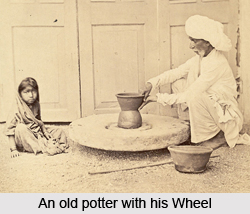
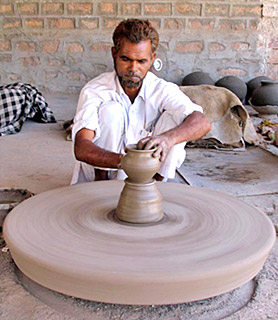
The potter’s wheel or chak is a later invention. Kumhars in the modern age use wheel with which they fashion various kinds of pottery, which are then dried in the sun and later are heated in the kiln (panja). The wheel in its simplest form is a heavy disk pivoted in a central point to be set going by the hand of the workman squatting on the ground. A large wheel is placed in a horizontal position on a small and well-lubricated pivot fixed strongly into the ground. At the centre of the wheel, above the pivot, a quantity of prepared clay ball is placed; then by means of a stick the wheel is made to revolve very rapidly, and sufficient impetus is imparted to it to keep it in motion for several minutes.
Seating on the ground before the wheel, the Kumhar stretches
their arms over and manipulates the revolving clay into the shape intended,
and, having done so, separates it by means of a cord from the rest of the clay,
and recommences the same operation so enough clay is left on the wheel for a
dozen vessels or more. When the wheel slackens in speed, he places the stick in
a hole near one of the spokes, and revolving it a few times forcibly, sends it
on again with its original speed. A round ball of hardened clay is held inside,
while with a wooden hammer the material is beaten from the outside into
requisite shape and thinness. Sometimes, the Kumhar uses hands to give the clay
a desired shape.
Types of Clay Used by Kumbhakars
Kumars or the potters use two kinds of earth, that are “bali” or sandy soil and “kalamati” or blackish sticky soil. Both the ingredients are mixed in the ratio 1:2 respectively for producing strong pottery. The red laterite earth from Bhowal is used for making the common red earthenware vessels. The cheap red and black earthenware are both prepared with the same clay, the latter being blackened by covering up the kiln at a certain stage and by adding oil-cake to the fire.
Many potters cannot glaze or fix the colours on the wares,
but are content to paint the vessel after it has been baked. The colours used
in the earthen wares are always made from different chemicals and metals such
as copper, manganese, lead, arsenic etc. Red paint is prepared with red leads,
yellow with arsenic, green by copper, blue from manganese, and black with the
combination of different chemicals. The Kumbhakar also manufactures bricks and
tiles.
Sub-Groups in Kumhar Caste
Kumbhakar, or Kumhar, community is broadly classified into Hindu and Muslim cultural groups. Within the Hindu social structure, the Kumhars have traditionally been recognized as an artisan caste and are generally placed within the Shudra varna. The Hindu Kumhar community is further divided into clean and unclean caste groups based on traditional social classifications. Several subgroups exist within the community, including the Gujarati Kumhar, Kurali ke Kumhar, Lad, Haral, and Telangi. These groups derive their names from different cultural, linguistic, or regional backgrounds, yet they are collectively regarded as part of the broader Kumhar caste cluster.
Many members of the Kumhar community traditionally engaged
in agriculture alongside their pottery profession, with some villages being
entirely owned and cultivated by them. Renowned for their farming skills, they
were often regarded as comparable to the Bagri Jats in terms of physique,
dress, and lifestyle. A significant concentration of these agriculturist
Kumhars was found around Abohar, a prominent commercial city in Punjab's Fazilka district. In
recognition of their notable contributions to agriculture, they came to be
officially known as the "Bagri Kumhars."
Society of Kumbhakar / Kumhar Caste
In many parts of India, potters have traditionally been regarded as creators and progenitors because of their association with shaping clay into useful and sacred objects. Before the installation of Lord Vinayak (Ganesha) during auspicious ceremonies, it is customary in several communities to visit the potter's home and ceremonially worship the potter's wheel in a ritual known as Chak-Poojan.
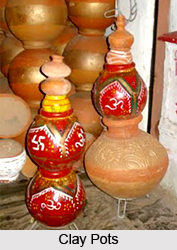
During this ceremony, women draw a Swastika symbol on the wheel with turmeric and offer prayers for the prosperity and growth of the family. Chak-Poojan holds an important place in Hindu marriage traditions across many castes, and other wedding rituals are performed only after its completion. At the conclusion of the ceremony, the potter is offered alms and dakshina as a mark of respect, and blessings are sought for the well-being and prosperity of the family.
The matrimonial customs of the Kumbhakar community closely resemble those of other Bengali communities. Traditionally, the marriage process begins with matchmaking arranged by ghotoks (matchmakers), although inter-clan marriages have become increasingly common in modern times. Like other Bengali weddings, a Kumbhakar marriage comprises several ceremonies held on different days, including the bride's Gaye Holud, the groom's Gaye Holud, the wedding ceremony, and the Bou Bhat. Before these rituals, an engagement ceremony, known as Ashirwad, is performed, often serving as the customary ring ceremony.
Historically, many potter families, had limited financial
means and therefore conducted relatively modest wedding celebrations. Over
time, however, improved socio-economic conditions have enabled many families to
celebrate these occasions with greater enthusiasm and grandeur. In keeping with
Bengali wedding traditions, brides of the Kumbhakar community typically wear
red attire, while their distinctive style of draping the sari adds to the
elegance and cultural identity of the bridal appearance.
Folk Stories Related to Kumhar Caste
 Folk tales of Punjab: According to a folk tradition
in Punjab, Sage Kuba
was known for making twenty earthen pots each day to distribute as alms. On one
occasion, however, a group of thirty sadhus arrived at his home and requested
pots as charitable offerings. Placing his faith in divine grace, Kuba Bhagat
instructed his wife to remain behind a curtain and hand the pots to the
visitors one at a time. According to the legend, a miracle occurred during the distribution,
as the original twenty pots multiplied into thirty, allowing each of the sadhus
to receive one. The story is remembered as an example to Kuba Bhagat's
devotion, generosity, and unwavering faith.
Folk tales of Punjab: According to a folk tradition
in Punjab, Sage Kuba
was known for making twenty earthen pots each day to distribute as alms. On one
occasion, however, a group of thirty sadhus arrived at his home and requested
pots as charitable offerings. Placing his faith in divine grace, Kuba Bhagat
instructed his wife to remain behind a curtain and hand the pots to the
visitors one at a time. According to the legend, a miracle occurred during the distribution,
as the original twenty pots multiplied into thirty, allowing each of the sadhus
to receive one. The story is remembered as an example to Kuba Bhagat's
devotion, generosity, and unwavering faith.
Folk Tales of South India: Among the Dravidian-speaking communities of Tamil Nadu, the term Kulal is traditionally used to refer to potters. According to local belief, the potter community traces its lineage to the three sons of Kulal, who is regarded as a son of Brahma. This traditional association gives the term Kulal cultural significance and is often viewed as reflecting a historical and cultural link between the potter communities of northern and southern India.
Distribution of Kumhar Caste across India
Kumhar community is widely distributed across India, with its members known by different names and possessing distinct regional identities based on local traditions, occupations, and cultural practices. Here is an overview of people of Kumhar caste from different parts of India.
Punjab: In Punjab, the Kumhar community primarily follows Hinduism and Sikhism. Although pottery was their traditional occupation in ancient times, many members transitioned to agriculture several centuries ago. Today, a large number of Punjabi Kumhars own and cultivate agricultural land, and they are regarded as a respectable community within the region. Their marriage customs generally follow endogamy with clan exogamy. In Punjab, they are commonly known as the Bagri Kumhars or Maru Kumhars.
Rajasthan: The Kumhar community is also widely known as Prajapat. It comprises several subgroups, including Mathera, Kheteri, Marwara, Timria, and Mawalia. Traditionally, the community occupies an intermediate position in the state's social hierarchy, between the higher castes and the Harijan communities. Like their counterparts in Punjab, Rajasthani Kumhars generally practice endogamy with clan exogamy. The Kumhar and Kumawat communities are listed separately, but within the same category, in the Central List of Other Backward Classes maintained for Rajasthan.
Jharkhand: A significant section of the Kumhar community speaks Bengali, making it one of the predominant linguistic groups among the state's Kumhars. The principal subgroups found in the region include the Khuntkati Kumhars and the Prajapati Kumhars. The Khuntkati Kumhars are regarded as the original inhabitants of the area, and commonly associated surnames within the community include Pal, Bhagat, Kumbhar, Bera, Pradhan, and Chaudhary.
Himachal Pradesh: In Himachal Pradesh, particularly in the Chamba region, Kumhars are renowned for their craftsmanship in producing a wide variety of earthenware, including pitchers, surahis, household vessels, grain storage jars, toys, and earthen lamps. Many of these pottery items are further embellished with decorative paintings and intricate designs.
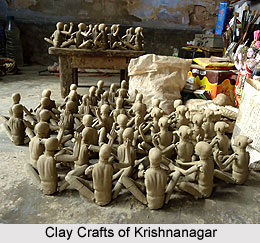 Maharashtra:
Kumhars are primarily concentrated in the districts of Satara, Sangli,
Kolhapur, Solapur, and Pune. Marathi is their
principal language, and they use the Devanagari script for written
communication. Alongside the Maratha Kumbhar groups, there are also Kumbhars
who do not belong to the Maratha clan and
traditionally specialize in making earthen pots and religious idols.
Maharashtra:
Kumhars are primarily concentrated in the districts of Satara, Sangli,
Kolhapur, Solapur, and Pune. Marathi is their
principal language, and they use the Devanagari script for written
communication. Alongside the Maratha Kumbhar groups, there are also Kumbhars
who do not belong to the Maratha clan and
traditionally specialize in making earthen pots and religious idols.
Madhya Pradesh: In Madhya Pradesh, two prominent subgroups of the community are the Hathretie and Chakretie (also known as Challakad) Kumhars. The Hathretie Kumhars derive their name from their traditional practice of rotating the potter's wheel (chak) by hand (hath). These communities are included in the state's list of Other Backward Classes (OBC).
West Bengal and Odisha: In West Bengal, the Kumhars have traditionally been regarded as one of the ceremonially pure artisan castes. In Odisha, the community is broadly divided into two groups, namely the Odia Kumbhar and the Jhadua Kumbhar. Among their traditional responsibilities is the preparation of earthen vessels used for the distribution of rice offerings at the Jagannath Temple.
Uttar Pradesh and Bihar: The Kannaujia Kumhars have traditionally been regarded as a respected community, and some families use the surname Pandit in these states. Other subgroups, including the Magahiya Kumhars and the Turkaha (Gadhere) Kumhars, have historically occupied different positions within the community's internal social structure. These Kumhar groups are included among the Other Backward Classes (OBC) in the two states.
Gujarat: In Gujarat, the
Kumhar community is officially listed among the Other Backward Classes (OBC).
Within the state, they are commonly identified under the broader Prajapati
grouping, which includes sub-communities such as Gujjar Prajapati,
Varia Prajapati, Sorthia Prajapati, and Sorathiya Prajapati. These
classifications reflect the regional and cultural variations within the Kumhar
community in Gujarat.
Kumhar Community in Modern India
Under India’s reservation system, the potter community is categorized under both Other Backward Classes (OBC) and Scheduled Castes (SC), depending on the region. In states such as Punjab, Haryana, Rajasthan, Maharashtra, Odisha, West Bengal, Uttar Pradesh, Bihar, and Gujarat, members of the community are generally classified as Other Backward Classes.
In Madhya Pradesh, however, their classification varies by district. In districts including Chhatarpur, Datia, Panna, Satna, Tikamgarh, Sidhi, and Shahdol, they are recognized as Scheduled Castes. In the remaining districts of the state, they are listed under the Other Backward Classes category.
Across different states and regions, members of the Kumhar community are also known by various surnames, reflecting local linguistic and cultural diversity.
Recently updated articles in Religion in India
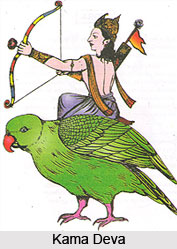
Kusumayudha
Kusumayudha is a name of Kamadeva, the Hindu God of Love. Depicted with a sugarcane bow and flower-tipped arrows, he represents attraction and longing...
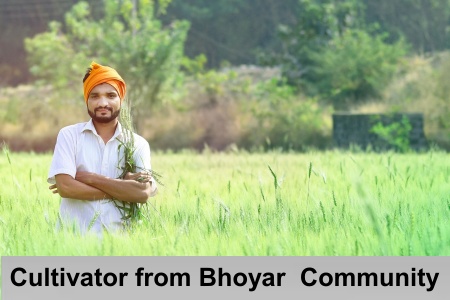
Bhoyar Caste
Bhoyar Caste is largely found in the Central Provinces of the country. Traditional occupation of Bhoyars is agriculture. They are good cultivators and...
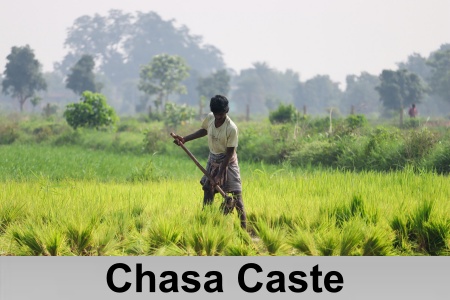
Chasa Caste
Chasa caste is a prominent agrarian community native to Odisha. Traditionally associated with cultivation and farming, Chasas have historically played...
Vigneswara, A Form of Lord Ganesha
Lord Vigneswara is another form of Lord Ganesha or Vinayaka, prominently worshipped as the God of intelligence and good luck in the Indian subcontinen...
Maheswara
Maheswara, meaning “the Great Lord,” is a revered name of Lord Shiva in Hindu tradition. It represents Shiva’s supreme authority over creation, preser...
Related articles in Religion in India

Religion in Indus Valley Civilization
Religion in Indus Valley Civilisation included Hinduism, Buddhism and Jainism. Details about the religion in Indus Valley Civilization have been gathe...

Iyer Brahmin
Iyer Brahmins are originally from Tamil Nadu of South India. They are known for their adherence to Advaita philosophy and Smarta traditions. Tradition...

Gujjars in Mughal Era
Gujjars in the Mughal era enjoyed great power. Further their power increased with the decline of Aurangzeb, Mughal emperor.

Gotra in Hinduism
In Hinduism, gotra refers to a lineage system tracing descent from ancient sages, primarily through the paternal line. Originating from Vedic traditio...