Dhimar Caste
The Dhimar caste, predominantly residing in the Central Provinces of India, is a distinct Hindu community with a rich heritage and diverse occupational divisions. Mainly engaged in fishing, they also participate in other professions such as palanquin-bearing, boatmen, rope weaving, grindstone sharpening, and selling various goods. Their marriage customs, allowing widow remarriage and limited divorce, reflect a unique cultural perspective.

Share this Article:

Introduction

The Dhimar caste, also known as Kahar, Bhoi, Palewar, Baraua, and Machhandar, is a Hindu caste primarily residing in the Central Provinces of India. While in some regions of the country the Bhois and Dhimars are recognized as distinct castes, in the Central Provinces they are considered synonymous and both names are used interchangeably. The term “Dhimar” originates from the Sanskrit word “Dhivara,” which means a fisherman. The diverse aspects of the Dhimar caste include their occupational divisions, marriage customs, religious practices, and societal challenges.


Occupational Diversity in Dhimar Caste

The Dhimar caste comprises mainly of fishermen and palanquin-bearers, although they are also engaged in other occupations. Within the caste, various sub-divisions exist based on occupation or locality. Occupationally oriented names within the Dhimar community include: 

·       Singaria: known for cultivating singara nuts

·       Nadha: the community that dwell along the banks of streams

·       Bandhaiyas: the community skilled in rope and sacking production using hemp and fiber

·       Tankiwalas: experts in sharpening grindstones

·       Dhurias: who trade in parched rice. 

Moreover, the Dhimar caste encompasses several exogamous groups with titular or totemistic names, such as: 

·       Baghmar (tiger-slayer)

·       Ojhwa (sorcerer)

·       Guru pahchan (knowledge of the teacher)

·       Midoia (guardian of boundaries)

·       Gidhwe (vulture)

·       Kolhe (jackal)

·       Gadhekhaya (donkey-eater)

·       Kasture (musk), and others. 

Additionally, some groups derive their names from towns or villages, like Tumsare, Nagpurkar, and others.


Mythical Legend Related to Dhimar Caste

The origins of the Dhimar community are preserved through a rich body of mythological traditions that reflect its long-standing association with fishing and water-based occupations. While historical records provide limited information beyond occupational descriptions, community narratives connect the Dhimars to revered figures and themes from Hindu mythology, emphasizing the sacred significance of their traditional way of life. 

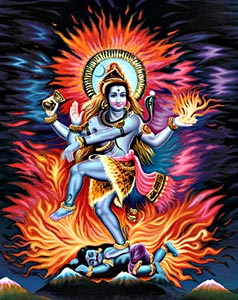
One prominent legend, particularly among related sub-groups such as the Dhuriya, traces the community’s beginnings to a divine act by Lord Shiva. According to this tradition, Shiva noticed that Goddess Parvati had become exhausted while returning from the abode of her father, Himachal. To ease her burden, he created a man and a woman from dust, known as “dhur” or “dhul.” After granting them life, Shiva united them in marriage, and they became the ancestors of the community. This narrative symbolizes divine approval of service-oriented occupations and highlights the community’s spiritual connection to Hindu beliefs. 

Another widely held tradition links the Dhimars to Matsyagandha, later known as Satyavati, a significant figure in the Mahabharata. Mythologically associated with a fish and closely connected to boating and fishing activities, Satyavati serves as an important ancestral figure in community lore. Through this association, the Dhimars reinforce their cultural identity as people whose lives and livelihoods have long been intertwined with rivers, lakes, and other water bodies.

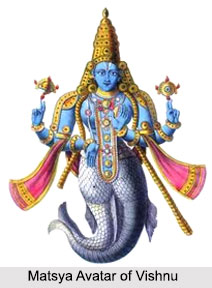
The community’s mythological framework also incorporates the story of Lord Vishnu’s Matsyavatar, the fish incarnation. According to Hindu tradition, Matsya rescued the sacred Vedas during a cosmic flood, preserving knowledge and restoring order. For the Dhimars, this divine episode elevates fishing beyond a mere occupation, portraying it as a continuation of a sacred relationship between humanity and the aquatic world. The symbolism of the fish, therefore, occupies a central place in their cultural imagination and spiritual heritage. 

Although these narratives form an important part of the Dhimar community’s collective identity, historical evidence regarding their precise origins remains limited.


Livelihood and Society of Dhimar Caste

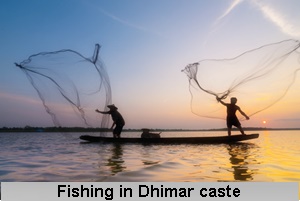
Fishing, the traditional occupation, remains the primary occupation of the Dhimar caste even today. However, a few members may engage in agricultural activities. On several occasions, Dhimars sustain their livelihood by selling sweet potatoes, dry grains, and rice. 

The caste has also set rituals concerning marriage, prohibiting unions within the same clan or between first cousins. Notably, widow remarriage is permitted within Dhimar society. Widow marriages typically takes place during nighttime, except on Tuesdays, Saturdays, and Sundays. Divorce, though rare, is also recognized within their social framework. 

The Dhimar community follows a patrilineal system of kinship, in which family lineage and inheritance are traced through the male line. After marriage, the customary pattern of residence is patrilocal, with the bride moving into the household of her husband and becoming part of his family unit. This arrangement reflects long-standing social traditions that are common among many rural Hindu occupational communities. 

Family life within the community has traditionally been centered around joint households, where several generations live together under one roof. Such family structures foster close kinship ties, collective responsibility, and the sharing of economic and domestic duties. 

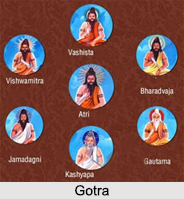
Many members of the Dhimar community identify themselves with the Kashyap gotra, tracing their ancestral origins to the revered sage Kashyap of Hindu tradition. The gotra serves as an important marker of lineage and identity, guiding social and marital relationships. In accordance with customary Hindu practices, marriages within the same gotra are generally prohibited, as such unions are considered to involve close kinship ties. This rule helps prevent consanguineous marriages and reinforces the community’s traditional system of exogamy. 

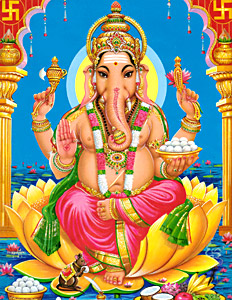
Burial is the customary method for the deceased among the Dhimars. When it comes to naming children, they are either named on the day of birth or on the twelfth day afterward. Dhimars are known for their religious disposition and deities they worship such as Dulha Deo, Lord Shiva, Lord Ganesha, Lord Hanuman, and Goddess Lakshmi.

Sub-Groups in Dhimar Caste

The Dhimar community is internally divided into several occupational and regional sub-castes that play a significant role in regulating marriage, social relationships, and community identity. These sub-groups traditionally function as endogamous units, with members generally marrying within their own subdivision while adhering to established social customs and kinship rules. 

The Dhimar caste is often referred to as a subcaste of boatmen in India. Related communities include Dhinwar, Dhewar, Jhimar, Jhinwar, Jhiwar, Kanshilya, and Koshyal. These sub-groups are mainly found in states such as Uttar Pradesh, Haryana, Punjab, Madhya Pradesh, Maharashtra, and Chhattisgarh. While distinct castes are not recognized within the Central Provinces, regional variations and subcastes do exist. Among them are the Sonjhara, who are traditionally associated with sandy riverbanks or aquatic environments. Other important groups include the Kashdhonia, Singaria, and Tankiwala. The Singaria are known for their involvement in the cultivation of singara, or water chestnut, a crop closely linked to wetlands and water bodies. The Tankiwala, on the other hand, have traditionally been connected with the maintenance of tanks, ponds, and other water-management systems, reflecting the community’s relationship with aquatic resources. 

Additional sub-groups such as the Bansia and Bandhaiya further illustrate the occupational diversity within the Dhimar community. These groups are generally associated with specialized water-related activities and service-oriented roles. In Maharashtra, the Dhimar constitute one of the three principal sub-groups within the broader Dhivar community. The other two major groups are the Mahawar and the Taraksha. Distinctions among these sub-groups are maintained through customary social regulations, particularly marriage practices.


Social and Religious Practices in Dhimar Caste

The Dhimar caste actively participates in Hindu festivals and celebrations. During the spring season, they join the broader Hindu community to celebrate Holi, the "festival of colors" or the "festival of love." Holi marks the end of winter and symbolizes the victory of good over evil. It is a joyous event that transcends caste and social boundaries, bringing people together in a spirit of play, reconciliation, love, and thanksgiving. However, it is important to note that Holi, while celebrated with enthusiasm, is ultimately linked to the worship of deities that may not align with the Dhimar’s traditional beliefs.


Persecution and Challenges of Dhimar Caste

Persecution levels experienced by the Dhimar community vary across different states in India. Central Provinces, in particular, have witnessed the enactment of stringent laws that aim to restrict conversions to Christianity. Despite such challenges, Central India remains a significant mission field, and efforts to reach out to the Dhimar people and their response to these initiatives are steadily increasing.

The Dhimar caste faces numerous socio-economic challenges, primarily stemming from their impoverished circumstances. Economic constraints restrict their access to resources and opportunities, exacerbating their physical and spiritual needs. As a marginalized group, they require support and interventions that address their fundamental necessities.


Share this Article:

More Articles in Religion in India


Religion in Indus Valley Civilization
Religion in Indus Valley Civilisation included Hinduism, Buddhism and Jainism. Details about the religion in Indus Valley Civilization have been gathered from archaeological artefacts.
Shaivism Religion
Shaivism is the second largest “religious community” in modern India with its roots deeply seated in the Hindu Vedic belief.
Vaishnavism
Vaishnavism is among the more popular denominations of Hinduism, with its own distinctive ideas about spirituality and morality. Vaishnavism concentrates on worshipping god Vishnu and of his incarnations.
Hinduism Religion
Hinduism is more of a philosophy which is a way of living according to the understanding of the principles of Vedas and Upanishads.
Islam
Islam is a religion that beliefs in Allah as the one and only God and creator of the Universe. Islamic law or Sharia is characterised by the five pillars of Islam which comprise the essential duties of every Muslim.
Christianity
Christianity is a religion based on the teachings and life of Jesus Christ and it is the largest religion in the world.
Buddhism
Buddhism is a religion and a philosophy that encompasses a wide variety of beliefs, practices and traditions that are chiefly based on the teachings of Gautama Buddha and its later disciples.
Jainism
Jainism chronologically preceded the religion of Buddhism. It is considered as one of the oldest religions of India. Jainism in India shared with Hinduism and Buddhism. It is an integral part of South Asian religious belief and practice, but it is not a Hindu sect and not a Buddhist heresy, as earlier scholars believed.
Zoroastrianism
Zoroastrianism, closely related to Judaism, Christianity and Islam was founded by Zoroaster.
Sikhism
Sikhism is a religion started by Guru Nanak in land of Punjab in 15th century A.D.
Iyer Brahmin
Iyer Brahmins are originally from Tamil Nadu of South India. They are known for their adherence to Advaita philosophy and Smarta traditions. Traditionally associated with scholarship, rituals, and temple practices, they have contributed significantly to South Indian culture, education, and intellectual.
Barai Caste
Barai Caste is the professional cultivator caste of betel leaf. Tamboli and Pansari are the terms used indifferently to the people of Barai Caste. The diversity of names of the sub-divisions of Barai Caste highlights the mixed elements that formed the caste.
Dangi Caste
Dangi Caste is largely distributed in the high land regions, and the word Dangi is said to have originated from the geographical features of their territory. Main occupation of the members of Dangi Caste is cultivation.
Nadar Caste
One of the most renowned castes of Tamil Nadu is the Nadar caste. The Nadar community is a mixture of sub-castes and classes of different origins, which came under one banner of Nadar caste gradually.
Kumbhakar Caste
Kumbhakar is the potter caste who manufactures all kinds of earthen vessels.
Gujjars in Maharashtra
Gujjars in Maharashtra have several sub-castes. Here, in this state the Gurjars are listed as a separate caste. They are included in the Maharashtra OBC list.
Awasthi Brahmin
Awasthi Brahmins are a sub-group of the Kanyakubja Brahmin community traditionally associated with Vedic scholarship and priestly duties. The surname “Awasthi” is linked to the Sanskrit word avastha.
Bhoyar Caste
Bhoyar Caste is largely found in the Central Provinces of the country. Traditional occupation of Bhoyars is agriculture. They are good cultivators and mostly grow sugarcane.
Gujjars in Mughal Era
Gujjars in the Mughal era enjoyed great power. Further their power increased with the decline of Aurangzeb, Mughal emperor.
Origin of Vaishnavism
Origin of Vaishnavism shares its attributes to many sources and religious evolution, dating back to pre-Vedic epoch.
Gotra in Hinduism
In Hinduism, gotra refers to a lineage system tracing descent from ancient sages, primarily through the paternal line. Originating from Vedic tradition, it plays a crucial role in identity and marriage customs. Individuals from the same gotra are considered to share a common ancestor and are traditionally prohibited from intermarrying.