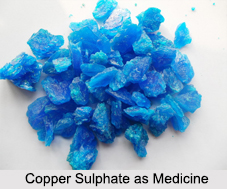
Copper is described as an alterative, emetic and purgative and used in poisoning,
dyspepsia, fever, enlarged liver and spleen,
anaemia, skin diseases, diarrhoea etc.
Dose of Copper in Medicine : In poisoning, prepared copper is given in doses of about 24 grains with sugar or honey to cause vomiting. Copper enters into the composition of several medicines for ague, remittent fever, enlarged spleen etc. The following are a few illustrations.
Sitabhanji Rasa: Take orpiment, mercury, sulphur and
realgar, 2, 1, half and quarter parts, respectively, rub them together into a thin paste with the juice of
Momordica Charantia (Karavella). Apply this paste on copper plates equal in weight to the other ingredients, enclose the plates in a covered crucible, and roast in a sand-bath over a strong fire for 12 hours. When cool extract the copper plates from the crucible and powder them. Dose should be 4 grains with 4
black peppers enclosed in a
betel leaf. This packet should be chewed. It is given in intermittent fever with shivering fits, followed by burning and heat of skin. A preparation very similar to the above in composition is called
Pliha Panchanana Rasa, and used in enlarged spleen.
Svachchhanda Bhairava Rasa: Take prepared copper and aconite equal parts, rub together with the juice of
datura leaves and make into 1 grain pills. They are given with
ginger juice, sugar and rock
salt in fevers complicated with cerebral symptoms.
Mahaamritunjaya Lauha: Take mercury, sulphur, talc, orpiment and realgar, each 1 part, iron 2 parts, copper 4 parts,
yavakshara and
sarjikakshara, borax, black salt, burnt couries and
conch-shells, plumbago-root,
asafoetida, root of
Picrorrhiza Kurroa (
katuki),
Amoora, rohitaka and Ipomoea Turpethum (
trivrit);
tamarind pulp, colocynth root, root bark of
Anogeissus latifolius (dhava), root of
Alangium decapetalum (ankota),
Achyranthes aspera (
Apamarga), ashes of the spikes of the
palm tree, turmeric and wood of
Berberis Asiatica (
Daruharidra), croton seeds, sulphate of copper rusot and
Oxalis corniculata (amlalonika), all in equal parts, with the exception of rohitaka bark, which should be 2 parts. Powder the ingredients, mix, soak the mixture in the fresh juice of ginger and
gulancha and add to it 32 tolas of honey. Make into 6 grain pills with honey. One pill is given every morning in enlarged liver, spleen disease, ascites etc.
In enlargements of the abdominal viscera, designated by the term
gulma, copper is used in a variety of forms. Thus, prepared copper in doses of 2 grains rubbed with ginger juice and enclosed in betel leaf may be given, or the following composition may be used.
Gulma Kalanana Rasa: Take mercury, sulphur, copper, orpiment, borax, and
yavakshara, each 2 tolas, tubers of
Cyperus rotundus (
mustaka), black pepper, ginger,
long pepper, fruit of
Pothos officinalis (
Gajapipul),
chebulic myrobalans,
Acorus Galamus (
vacha) and
Aplotaxis auriculata (kushtha), each 1 tola. Powder them all, mix and soak the mixture in the juice of
Hedyotis biflora (Parpati),
Heliophytum Indicum (hastisundi),
Achyranthes aspera (Apamarga) and
Trichosanthes dioica (
patala) respectively and dry. This medicine is given in the form of a powder in doses of 8 grains with the decoction of chebulic myrobalans.
Several preparations of copper are recommended for use in with
asthma and
heart disease, as for example,
Suryavarta Rasa, Hridayarnava Rasa etc.
Suryavarta Rasa: This preparation of copper is recommended for use in asthma by Sarangadhara and thus prepared. One part of mercury and one of sulphur are rubbed together with the juice of
Aloe Indica for 6 hours. 2 parts of copper leaves are pasted with the above mixture and mounted within a closed crucible in a sand-bath for 12 hours. When cool the copper leaves are taken out from the crucible and powdered. Dose will be 4 grains with the addition of honey and the juice of
Adhatoda Vasica (
vasaka).
Hridayarnava Rasa: Take purified mercury and sulphur, each one part, prepared copper 2 parts; rub them together for 12 hours with the decoction of the 3 myrobalans, and with the fresh juice of
Solanum Nigrum (kakamachi). Make into pills about 4 grains each, These pills are administered with a decoction of the fruits of
Solanum Nigrum and the 3 myrobalans, prepared with 2 tolas, in all of the drugs and 32 tolas of water, which is boiled down to 4 tolas. They are said to be useful in heart disease.
Tamresvara: Take prepared copper, mercury, borax, iron, sulphur and long pepper, equal parts, soak in the decoction of the leaves, bark, fruit, root, and flowers of
Azadirachta Indica (nimba), of the pulp of
Cassia fistula and of the 3 myrobalans. Dose should be 4 grains, in skin diseases of various sorts. During the administration of this medicine a cooling regimen should be observed.

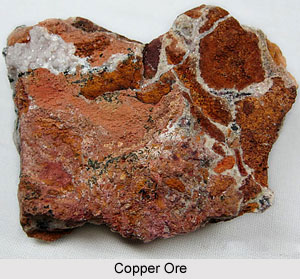 Copper in India is chiefly used for the production of electrical machinery. As an industrial metal, copper stands second only to steel. It is measured as the best conductor of electricity. Copper is also used in producing brass and bronze, castings and pipes. Further, for the refining of copper, cheap and abundant electricity is required. India manufactures only a little amount of copper and it imports a huge quantity of this mineral resource annually to meet domestic needs. At present, most of the copper ore is mined in the districts of Singhbhum (Jharkhand), Baiaghat (Madhya Pradesh) and Jhunjhunu District and Alwar in Rajasthan. The small producers of copper include Khammam District of Andhra Pradesh, Dhitradurga and Hassan District of Karnataka and also in some parts of Sikkim.
 Copper Ore in India is only about 0.2 percent of world production. Copper is considered as one of the most important metal used in the country next to