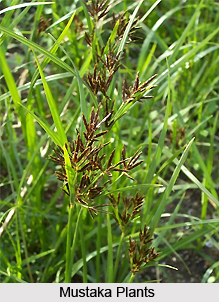
 Mustaka is considered as a medicinal plant in India. It is a cosmopolitan weed which is common in open, disturbed habitats to an elevation of about 1800 m throughout the country. The botanical name of this medicinal plant is Cyperus rotundus L. It is also popular as nut grass throughout the world. Mustaka medicinal plant is however widely popular as Motha in Bengali, Marathi and in Hindi. In other local languages of India, such as in Kannada, Tamil and in Telegu it is known as Bhadrahullu, Kora and Gandala respectively.
Mustaka is a smooth, hairless perennial herb with slender stolons ranges from 10 cm to 20 cm in length. This plant bears hard, fragrant, globose-ovoid tubers up to 1.2 cm in length and 0.3 to 0.7 cm in diameter. The stalks are solitary or few together, sparsely tufted, erect and 10cm to 75 cm tall, 3-angled at top. Leaves of this medicinal plant are grown linear, which is shorter or longer than stem, and 0.4 to 0.8 cm wide. These plants posses1-nerved leaves which are dark green to the above and paler to the lower end.
The inflorescence (umbel) of Mustaka plant is simple or compound, grows in 2-8rays, each up to 7.5 cm in length. It bears short spikes of 3-10 spreading red-brown spikelets and 3 bracts, which are variable in length and 15 cm long. The spikelets of this medicinal plant are linear and variable in length. These ranges from 1.6 cm to 3.8 cm, bear 10 to 50 flowers. This plant possesses glumes that measures 3 mm to 4 mm in length which is oblong in shape and reddish-brown coloured obtuse apex. Achenes vary from oblong to ovate-oblong and are 3-sided of 1.3-1.5 mm in length and 0.5-0.7 mm wide. These become brown colour on maturing.
Mustaka medicinal plants are famous for its medicinal values. Numerous medicines are prepared from its different parts. The roots (tubers) are considered diuretic, carminative, emmenagogue, anthelmintic, galactagogue, diaphoretic, astringent, stomachic and stimulant. They are used to treat stomach disorders and irritation of the bowels, and have been shown to be effective in the treatment of conjunctivitis. A paste of the roots is used externally for the treatment of healing of wounds and sores. In Ayurveda the roots are also used to treat leprosy, fever, blood diseases, biliousness, dysentery, pruritis, vomiting, epilepsy and ophthalmia. In Unani practice these medicinal plants are used to cure fevers, dyspepsia and urinary concretions. In some region of India, the fresh tubers are applied to the breast as a galactagogue. Whereas in some other parts the tubers are crushed with the roots of Panicum repens and are taken internally to relieve rheumatoid arthritis. The tubers yield an essential oil that has antibiotic properties.