Pahuj River

Pahuj River is an important tributary of the Sindh River that flows through the Indian states of Madhya Pradesh and Uttar Pradesh. Originating in the Tikamgarh district, it traverses the Bundelkhand region and supports irrigation, fisheries, and local biodiversity while also facing significant environmental challenges.

Introduction

Pahuj RiverPahuj River flows through the Indian states of Uttar Pradesh and Madhya Pradesh. It is a tributary of the Sindh River, which subsequently joins the Yamuna River. Extending for approximately 195 kilometres, the river passes through the historic city of Jhansi and serves as an important component of the region's river system.

The Pahuj River has been identified as the “Pushpavati” in several religious texts. Flowing through the Bundelkhand region, the river plays a significant role in defining sections of the boundary between the Indian states of Uttar Pradesh and Madhya Pradesh.

Course of Pahuj River

Pahuj River originates in the hills of the Tikamgarh district of Madhya Pradesh, near Jhansi. Flowing through the Bundelkhand region, the river passes near the Shivpuri National Highway before joining the Sindh River, a major tributary of the Yamuna River. The Sindh eventually merges with the Yamuna in the Etawah region, downstream of the Chambal River confluence. At Pachnada, the Sindh River joins four other rivers, the Yamuna, Chambal, Kunwari, and Pahuj, creating a rare and remarkable confluence of waterways. 

Pahuj River Basin: Pahuj River basin covers an area of approximately 912 square kilometres, extending across the central and southern regions of the Datia district in Madhya Pradesh and into adjoining parts of the Jhansi district in Uttar Pradesh. The basin is characterized by the granitic landscape of the Bundelkhand craton, interspersed with low-lying alluvial deposits. These geological features contribute to the development of a dendritic drainage pattern throughout the basin. 

The Pahuj River is fed by several smaller tributaries, including the Mirga River, a minor stream that originates near Rawatpura and significantly enhances the river's flow during the monsoon season. Another important tributary is the Angori Nadi, which also contributes to the river system.

Role of Pahuj Reservoir

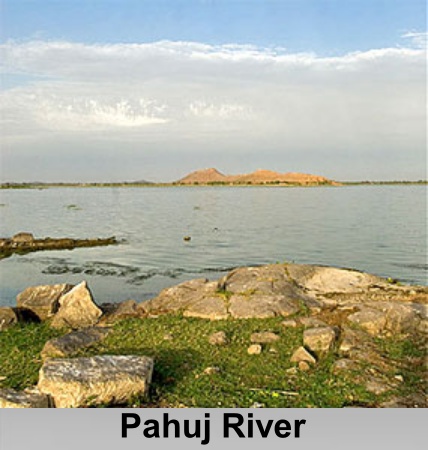
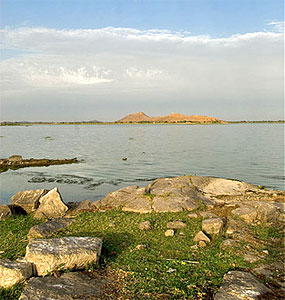
Pahuj Reservoir is a multipurpose, human-made water body located on the Pahuj River, approximately 5 kilometres west of the city of Jhansi. Officially commissioned in 1909, the reservoir has since served as an important resource for the surrounding region by supplying water for irrigation, supporting fisheries, and providing drinking water to local communities. 

The reservoir structure extends for 2,040 metres and has a height of 10.67 metres, while its catchment area covers approximately 310.80 square kilometres. The landscape surrounding the reservoir is marked by steep hills on three sides, with an artificial embankment forming the fourth boundary. At its full reservoir level (FRL), the water body occupies an area of 543 hectares and possesses a gross storage capacity of 18.25 million cubic metres. 

Seasonal changes exert a considerable influence on the reservoir's water chemistry. Concentrations of major ions generally reach their highest levels during the pre-monsoon season as a result of atmospheric precipitation and the weathering of the phosphate- and carbonate-rich rocks found in the surrounding area.

Biodiversity Supported by Pahuj Reservoir

Pahuj River and the adjoining Pahuj Reservoir support a diverse range of aquatic and avian species, reflecting the influence of the region's semi-arid climate and the river's seasonal flow pattern. The reservoir provides a habitat for approximately 167 species of birds, including both resident and migratory waterfowl, wading birds, and birds of prey that depend upon the wetland ecosystem for feeding, nesting, and breeding. 

The reservoir also sustains a rich variety of aquatic organisms. Studies have identified 18 species of zooplankton belonging to three principal groups, namely rotifers, cladocerans, and copepods, whose populations fluctuate according to monsoon inflows and seasonal changes in temperature. In addition, the phytoplankton community is composed of nearly 20 recorded species, further highlighting the ecological importance of the river and its reservoir.

Pollution in the Pahuj Reservoir

In recent decades, the ecological condition of the Pahuj River has deteriorated considerably owing to increasing levels of pollution and human encroachment. Industrial waste discharged from power plants in Uttar Pradesh, along with untreated sewage from settlements situated along the riverbanks, has contributed significantly to the contamination of the river's waters. Areas such as Sipribazar and Nandanpura have been identified as major sources of waste disposal, resulting in a severe decline in aquatic life within the river ecosystem. 

The situation has been further aggravated by the indiscriminate dumping of household waste from bridges crossing the river and by the expansion of human settlements along its banks. The construction of residential colonies on both sides of the river has encroached upon its natural course, thereby reducing the speed and volume of water flow. In addition, extensive illegal mining activities along the riverbanks have accelerated the degradation of the river and contributed to the depletion of its water resources. 

Although the Pahuj River extends for approximately 195 kilometres from its source to its confluence, large sections of the river remain dry for much of the year, particularly during the summer months. Despite these conditions, the river experienced unusually high-water levels for three consecutive days in 2024, highlighting the considerable seasonal variations that characterize its flow.

Conservation of Pahuj Reservoir

In 2014, the then Union Minister for Water Resources, Uma Bharti, adopted the Pahuj River under the ambit of the “Aviral Ganga Yojana” with the objective of improving its ecological condition and promoting its conservation. However, several years after the initiative was launched, the river continued to face serious environmental challenges. 

The Pahuj River remains threatened by the unchecked growth of water hyacinth, the discharge of untreated sewage, and widespread encroachment along its banks. These factors have significantly affected the river's natural ecosystem and have intensified concerns regarding its long-term sustainability and survival.

Recently updated articles in Geography of India

Pahuj River
Pahuj River Thumbnail

Pahuj River

Pahuj River is an important tributary of the Sindh River that flows through the Indian states of Madhya Pradesh and Uttar Pradesh. Originating in the...

Arunavati River
Arunavati River Thumbnail

Arunavati River

Arunavati River is a seasonal right-bank tributary of the Tapi River, flowing through parts of Madhya Pradesh and Maharashtra. Originating in the Satp...

Nira River
Nira River Thumbnail

Nira River

Nira River is an important tributary of the Bhima River flowing through Maharashtra. Originating in the Western Ghats, it traverses Pune, Satara, and...

Vena or Wena River
Vena or Wena River Thumbnail

Vena or Wena River

Vena, also known as the Wena River, is a tributary of the Wardha River in Maharashtra, India. Originating from the Mahadagad Hills in Nagpur district,...

Kwari or Kuwari/ Kunwari River
Kwari or Kuwari/ Kunwari River Thumbnail

Kwari or Kuwari/ Kunwari River

Kwari River, also known as Kuwari or Kunwari, is a significant river of central India, flowing through Madhya Pradesh and Uttar Pradesh. Originating n...