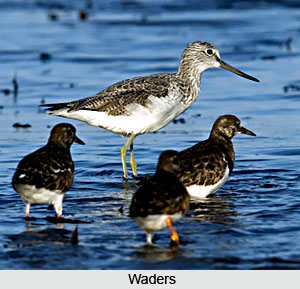
 Waders or shore birds are the names applied in general to aquatic or waterside birds belonging to the heterogeneous order Charadriiformes, represented in the Indian subcontinent by eleven families which include Jacanas, Plovers, Gulls, Courses, and a diverse assortment of other waterside birds. More specifically the names `Wader` and `Shore bird` are commonly applied to the family Charadriidae - plovers, curlews, snipes, sandpipers and such like birds that live around sea coasts, estuaries, and freshwater lakes and feed on aquatic invertebrates and vegetable matter in shallow water, or between tidemarks on the seashore, or on mudflats, or moist and inundated fields, etc. They mostly have long slender bills for probing in the wet mud.
The family contains both resident and migratory forms, some of the latter, e.g. Golden Plover, being among the longest distance non-stop trans-ocean fliers known. The great majority of migratory waders to India come from far northern Asia. Ruffs ringed in India have been recovered on their breeding grounds in the Arctic Circle over seven thousand kilometres away, and many of the smaller sandpipers, e.g. Spotted Sandpipers, likewise travel astonishing long distances. Waders are sober-coloured birds - usually sandy brown and white, often scalloped or otherwise patterned with blackish. But many species change into a colourful nuptial plumage on their breeding grounds in spring; in some cases this happens while the migrants are still in their winter quarters, before the summer exodus has commenced. This makes their identification confusing and difficult for the inexperienced bird-watchers. On account of the vast mixed concentrations and the open landscapes in which waders normally feed they hold a special fascination for the bird-watcher because there is always the exciting possibility of his/her picking out some rare and unexpected vagrant amongst the densely packed flocks of the commoner species. Among the more rewarding places in the subcontinent for wader watching in winter, are the Makran, Sind and Kathiawar coasts with their offshore islets in the west; and Point Calimere and the various brackish lagoons on the Coromandel coast, the low-laying flood plains of the Ganga River in Bihar, the Chilka Lake in Orissa, and the Sunderban in West Bengal in the east.
Most waders lay their eggs on the ground in shallow saucer-like `scrapes` on shingly or sandy river-beds, meadows, and the like. The normal clutch is of two to four cryptically coloured and patterned pegtop-shaped eggs. In most species both sexes take part in incubation. The hatchlings are clothed in camouflagingly coloured down and are capable of actively running about and hiding almost from the time they emerge from the shell (nidifugous).