
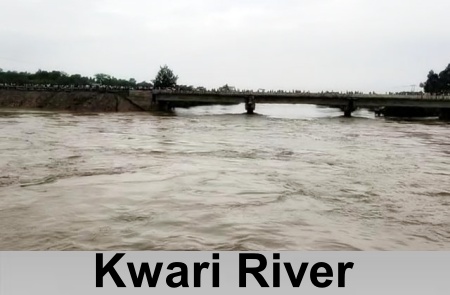
 Kwari
River, also referred to as the Kuwari or Kunwari River, is a river in central India that flows through the districts of Sheopur, Morena, and Bhind in the state of Madhya Pradesh. Extending for approximately 220 kilometres,
it forms an important part of the region's river system. Kwari River flows
through arid and semi-arid landscapes, where it provides limited support for irrigation and agriculture. Characterized by an intermittent flow, the
river often experiences reduced water levels due to upstream water extraction
and insufficient rainfall.
Kwari
River, also referred to as the Kuwari or Kunwari River, is a river in central India that flows through the districts of Sheopur, Morena, and Bhind in the state of Madhya Pradesh. Extending for approximately 220 kilometres,
it forms an important part of the region's river system. Kwari River flows
through arid and semi-arid landscapes, where it provides limited support for irrigation and agriculture. Characterized by an intermittent flow, the
river often experiences reduced water levels due to upstream water extraction
and insufficient rainfall.
Kwari or Kuwari/ Kunwari River
Kwari River, also known as Kuwari or Kunwari, is a significant river of central India, flowing through Madhya Pradesh and Uttar Pradesh. Originating near Devpura village, it joins the Sindh River and forms part of the Yamuna basin. The river supports agriculture, biodiversity, and local communities while facing environmental challenges from pollution and seasonal water fluctuations.
Introduction
Geography of Kwari or Kuwari/ Kunwari River
Kwari River
originates near the village of Devpura in Madhya Pradesh. Flowing eastward
roughly parallel to the Chambal River, it is a tributary of the Sindh River and joins it in the Etawah district. The Sindh River subsequently merges
with the Yamuna River at Pachnada, making the Kwari part
of the larger Yamuna River basin. The towns of Bijeypur and Kailaras are situated along the river's
banks, where it contributes to the local landscape and communities. Unlike many
rivers in the region, the Kwari has no significant tributaries. The Kwari
Bridge was constructed in 1962.
Course of Kwari or Kuwari/ Kunwari River
Kwari River originates near the village of Devpura in Madhya Pradesh. From its source, it flows in a southeasterly direction through the districts of Sheopur, Morena, and Bhind before entering Etawah district in Uttar Pradesh. The river eventually joins the Sindh River near Etawah, upstream of the Sindh's confluence with the Yamuna River at the Pachnada region, where the Chambal, Pahuj, and several other rivers also converge. Through its connection with the Sindh River, the Kwari forms part of the larger Yamuna River basin. The river exhibits a predominantly seasonal flow regime, with water levels largely dependent on monsoon rainfall. As a result, its discharge declines significantly during the dry season, and portions of the river channel may experience periodic drying outside the monsoon months.
Kwari
River Basin: Kwari
River drains a catchment area of approximately 6,821 km. sq., with elevations
ranging from about 100 metres to 467 metres above sea level. Its basin is
characterized by a dendritic drainage pattern and is predominantly used for
agriculture. The fertile landscape supports the cultivation of crops such as
wheat, sorghum, soybeans, and mustard. The basin is underlain by a variety of
soils, with extensive alluvial deposits gradually transitioning into red and
black soil types, which contribute to the region's agricultural productivity.
Flora and Fauna Supported by Kwari River
The riparian zones of the Kwari River lie within the tropical dry deciduous forest belt of central India and are characterized by vegetation adapted to arid and seasonal climatic conditions. The riverbanks are predominantly lined with drought-resistant tree species such as khair and kardhai, which are common throughout the Sheopur and Morena districts. These gallery forests play an important ecological role by providing habitat connectivity for a variety of plant species, including shrubs and grasses that help stabilize riverbanks and reduce soil erosion during the monsoon season. The river also supports aquatic and semi-aquatic vegetation, including emergent macrophytes that are well adapted to the fluctuating water levels typical of the Kwari’s seasonal flow regime.
The fauna of the Kwari River ecosystem includes a variety of aquatic and terrestrial species, with fish populations representing a significant component of its biodiversity. Reports of large-scale fish mortality events resulted in the deaths of thousands of fish due to contaminated discharges from upstream dams. Although detailed documentation of specific fish species in the Kwari River remains limited, river systems across Madhya Pradesh are known to support more than 180 fish varieties. The river ecosystem also provides habitat for avian species.
The
mammalian diversity associated with the Kwari River ecosystem is influenced by
its proximity to protected areas such as Kuno National Park, with riverine corridors providing
pathways for the movement of various wildlife species. Animals such as the Indian leopard, striped hyena, and Bengal fox may utilize these
connected landscapes. In relatively unpolluted stretches of the river, aquatic
mammals such as the smooth-coated otter may also occur occasionally. However,
the ecosystem faces growing threats from agricultural runoff and illegal
fishing activities, highlighting the need for focused conservation measures to
protect its habitats and biodiversity. Overall, the Kwari River contributes to
the broader ecological network of Madhya Pradesh, supporting elements of the
state's diverse vertebrate fauna, which includes approximately 500 bird species.
Cultural Significance of Kwari or Kuwari/ Kunwari River
Kwari River
holds cultural and historical significance, with references of it found in the
ancient Indian epic, the Mahabharata. Owing to its association with the Sindh
River, it is traditionally revered as the daughter of the Sindh. The village of
Sindos, located in the Chakarnagar tehsil of Etawah district, is believed to be
closely connected with the river and continues to preserve this heritage. In
Sindos, the Kwari River is worshipped as a goddess, reflecting its enduring spiritual importance
to the local community. The river is also bordered by scenic forests along much
of its course, enhancing its natural beauty and ecological value.
Economic Significance of Kwari or Kuwari/ Kunwari River
The fertile
banks of the Kwari River support extensive cultivation of flowers and vegetables, making agriculture a vital economic activity
in the region. Numerous villages depend on the river for their livelihoods,
relying on its waters for irrigation and daily use. Known for its naturally
sweet and potable water, the Kwari River provides favorable conditions for the
cultivation of high-value crops, particularly flowers and vegetables, thereby
contributing significantly to the local agricultural economy.
Tourism Along the Banks of Kwari or Kuwari/ Kunwari River
 Several
temples are situated along the banks of the Kwari River, reflecting the river's
religious and cultural importance. Among these are the Pardi Baba Temple,
Ghatwai Baba Temple, and Korana Wale Maharaj Ji Temple. The most prominent is
the Hanuman Temple, located near the Kunwari River
Bridge. The temple serves as a significant place of worship and community
gathering, particularly during the annual fair held every January. The event attracts
numerous visitors and features a variety of traditional activities and
competitions, including wrestling contests and boat races, highlighting the region's rich cultural
heritage.
Several
temples are situated along the banks of the Kwari River, reflecting the river's
religious and cultural importance. Among these are the Pardi Baba Temple,
Ghatwai Baba Temple, and Korana Wale Maharaj Ji Temple. The most prominent is
the Hanuman Temple, located near the Kunwari River
Bridge. The temple serves as a significant place of worship and community
gathering, particularly during the annual fair held every January. The event attracts
numerous visitors and features a variety of traditional activities and
competitions, including wrestling contests and boat races, highlighting the region's rich cultural
heritage.
Threats and Conservation Efforts on Kwari River
Kwari River faces significant environmental challenges due to pollution from multiple sources, particularly industrial activities. The discharge of untreated industrial effluents into the river has resulted in severe ecological impacts, affecting overall water quality and aquatic health. Domestic sewage and urban runoff further add to the pollution burden, with assessments indicating considerable amounts of untreated wastewater entering the Yamuna sub-basin, including areas associated with the Kwari River. These pollutants contribute to elevated biochemical oxygen demand (BOD) and increased nutrient levels, creating conditions that encourage eutrophication. In addition, seasonal religious activities, such as idol immersion ceremonies during festivals, temporarily contribute to further deterioration of the river’s water quality.
Conservation
efforts for the Kwari River are primarily focused on regulatory measures and
environmental monitoring, with the Madhya Pradesh Pollution Control Board
(MPPCB) playing a key role in overseeing water quality management. The MPPCB
conducts water quality assessments before and after major events to evaluate
pollution levels, particularly those associated with festival activities, and
works to ensure compliance with environmental regulations. The river’s location
within the broader Chambal River basin landscape also provides indirect
protection, as its proximity to protected areas helps reduce the risk of
habitat encroachment and supports the preservation of surrounding ecosystems.
Recently updated articles in Geography of India
Krishnaveni River
The Krishnaveni River, presently known as the Krishna River, is one of India’s major rivers. Originating in the Western Ghats of Maharashtra, it flows...

Wakal River
The Wakal River is an important tributary of the Sabarmati River, originating in Rajasthan’s Aravalli Range and flowing through Rajasthan and Gujarat....
Pahuj River
Pahuj River is an important tributary of the Sindh River that flows through the Indian states of Madhya Pradesh and Uttar Pradesh. Originating in the...
Arunavati River
Arunavati River is a seasonal right-bank tributary of the Tapi River, flowing through parts of Madhya Pradesh and Maharashtra. Originating in the Satp...
Nira River
Nira River is an important tributary of the Bhima River flowing through Maharashtra. Originating in the Western Ghats, it traverses Pune, Satara, and...
Related articles in Geography of India
Geography of Sikkim
Geography of Sikkim is characterised by a vast array of magnificent hillock that extends from one corner of the state to the other.
Geography of Meghalaya
The suitable climate, highland plateaus, rivers and the flora and fauna together forms the geography of Meghalaya.
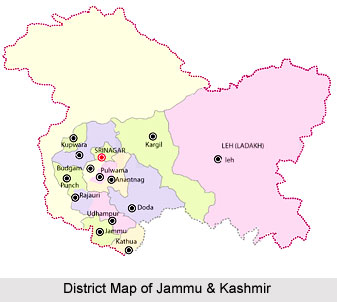
Geography of Jammu & Kashmir
Jammu and Kashmir is encompassed by valleys. Some of the dominant valleys of the state are Kashmir Valley, Tawi Valley, Chenab Valley, Poonch Valley,...
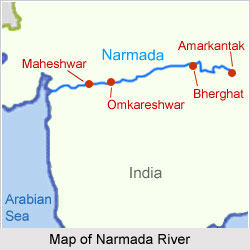
Narmada River
Narmada River is regarded as the 5th longest river of India and the life line of Madhya Pradesh. Narmada River basin spreads over an area of about 98,...
Bhima River
The Bhima River is the largest tributary of the Krishna River and is significant in the western and southern Indian states.