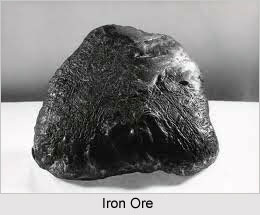
Iron
India is extraordinarily rich- both in quantity and quality of its iron ore deposits.

Share this Article:

Introduction

India is extraordinarily rich- both in quantity and quality of its iron ore deposits. The ores primarily comprise haematite and magnetite.

Iron, Indian Mineral Resources Haematite contains upto 68% metal content, while magnetite asserts upto 60%. Then comes limotitie- an inferior quality iron ore. The latest official figures about the iron ore reserves are a little over 13,000 million tonnes. The élite quality reserves of iron-ore are located in Singhbhum in Bihar and Keonjhar, Bonai and Mayurbhanj in Orissa. Second in line is Chhatisgarh with Raipur, Durg and Bastar districts. The Bailadila mines in Bastar have been developed with Japanese collaboration. Ores are mechanically transported to Visakhapatnam for agile despatch on their way to Japan.

The other iron-ore deposits are found in several districts of Andhra Pradesh, Salem and Tinichirapalli districts of Tamil Nadu, and Chikmagalur and Bellari districts of Karnataka. Goa also has iron-ore deposits, which are habitually shipped to Japan from Portuguese times.

Production of iron-ore was 3 million tonnes in 1950-51. By 1997-98 it had surpassed the 70 million tonne mark. Ports specialising in export of iron-ore comprise Visakhapatnam, Marma Goa, Paradip and Calcutta. Kudremukh manufactures iron pallets and are anticipated to be exported from Mangalore port. Indian iron-ore has enormous requirement in international market because of its rich iron contents.
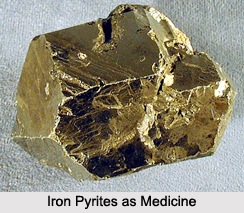

Use of Iron Pyrites as Medicines

Use of Iron Pyrites as MedicinesIron pyrites is met with in many parts of India, and has been used in medicine from a very remote period. It occurs in two forms, namely, in dark yellow nodules with a golden lustre, and in, silvery, radiated crystals. The former is called Svarnamakshika and the latter Taramakshika. The ancients supposed that they contained gold and silver respectively, in combination with other ingredients, and possessed in part the properties of those precious metals.
Processing of Iron Pyrites : Chemically iron pyrites consists of bisulphide of iron. It is purified by being boiled in lemon juice with one-third of its weight of rock salt in an iron vessel, till the pot turns red hot. It is reduced to powder by being rubbed with oil or goat"s urine and then roasted in a closed crucible. Iron pyrites thus prepared which has a sweetish bitter taste.

Benefits of Iron Pyrites : Iron pyrites is considered as tonic, alterative and useful in anaemia, urinary diseases, ascites, anasarca, prurigo, eye diseases, etc. As an alterative tonic it is generally used in combination with other medicines of its class, such as iron, talc, mercury etc.

Dose of Iron Pyrites in Medicine : The following is an example of Iron Pyrites used in medicine. Take prepared iron, sesamum seeds, long pepper, black pepper and ginger, each 1 part, iron pyrites 5 parts. Beat into a mass with honey. Dose should be about half a drachm in advanced anaemia.

In diseases of the pregnant state, the following called Garbha vinoda rasa is much used, as an alterative tonic. Take iron pyrites and cinnabar, each 4 tolas, ginger, long pepper and black pepper, each 3 tolas, cloves and mace, each 6 tolas, beat them together with water and divide into pills about 4 grains each. One pill should be taken twice daily.


Use of Sulphate of Iron as Medicines

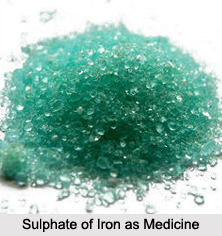
Use of Sulphate of Iron as MedicinesSulphate of Iron is indigenous to India and has been used in medicine from a very ancient age. Two sorts of sulphate of iron are mentioned, namely, Dhatukasis or green variety and Phushpa kasis or yellowish variety. It is seldom used internally.
Dose of Sulphate of Iron as Medicine : Externally, it is used in skin diseases along with other medicines. Thus take sulphate of iron, gall-stone of cows (Gorochana), rusot and orpiment, equal parts and beat into to a paste with Kanjika. It is useful in intertrigo, pruritis etc.

Kasisadya Taila: Take sesamum oil 4 seers, water 16 seers, sulphate of iron, wood of Withania somnifera (asvagandha), bark of Symplocos racemosa (lodhra), root of Pothos officinalis (Gajapipul), each 16 tolas. Beat the solid ingredients into a paste and boil it with the oil and water in the usual way. This oil is recommended to be applied to the genitals and the breasts with the view of strengthening these parts.


Share this Article:

More Articles in Geography of India


Geography of Uttar Pradesh
The fourth largest State in India UP is located in the Northern part of India whose area is 2,36,286 sq Kms.
Geography of Maharashtra
Covering an area of 308,000 sq. km, Maharashtra, the third largest state in India.
Geography of Kerala
Geography of Kerala includes plains, hills, valleys and coasts. With the Arabian Sea in the west, the Western Ghats in the east and networked by several rivers, Kerala enjoys diverse geographical features.
Geography of West Bengal
The geography of West Bengal is unique with high peaks of the Himalayan range in the north, the Bay of Bengal in the south and the remaining region is covered with both plains and plateaus.
Geography of Jharkhand
Geography of Jharkhand is comprised of the rich mineral resources and the highly agricultural prospect in this state.
Geography of Sikkim
Geography of Sikkim is characterised by a vast array of magnificent hillock that extends from one corner of the state to the other.
Geography of Meghalaya
The suitable climate, highland plateaus, rivers and the flora and fauna together forms the geography of Meghalaya.
Geography of Mizoram
Mizoram is surrounded by hills, valleys, rivers, waterfalls and lakes. The hills range from 1000 meters to 2000 meters. Rivers, lakes and waterfalls also play major role in forming the land of Mizoram.
Geography of Jammu & Kashmir
Jammu and Kashmir is encompassed by valleys. Some of the dominant valleys of the state are Kashmir Valley, Tawi Valley, Chenab Valley, Poonch Valley, Sind Valley and Lidder Valley etc. Jhelum River is the only major Himalayan River which flows through the Kashmir valley. Indus, Tawi, Ravi and Chenab Rivers are the major ones flowing through the region.
Geography of Daman and Diu
Daman and Diu is situated on the west coast of India and are the smallest union territories of India.
Geography of Goa
Geography of Goa occupies a prime location along the Konkan coastal belt on the western coast of India. The state is bordered by Maharashtra in the north and Karnataka in the south. The Western Ghats in the east contribute to the flora and fauna of Goa.
Geography of Arunachal Pradesh
Geography of Arunachal Pradesh reveals that it is a hilly tract nestled in the foot of Himalayas.
Geography of Kutch
Geography of Kutch District is covering an area of 45,612 km. Kutch District is the largest district in the state of Gujarat.
Geography of Ladakh
Geography of Ladakh mainly comprises the huge Karakoram Range with long stretch of cold desert which mark the region separately from the rest of the states of Indian subcontinent. Surrounded with the mountain ranges from all corners this small region separates Indian subcontinent from rest of the Asian continent.
Geography of Rajasthan
Geography of Rajasthan defines the dry topography with arid climate of the western mountain region.
Geography of Tamil Nadu
The Indian state of Tamil Nadu is located in the Northern hemisphere in the hot zone.
Ganga River
Ganga River is a trans-boundary river which has religious, economic and historic significance. The river is considered to be the third largest river in the world by discharge. In 2007, Ganga River was ranked as the fifth most polluted river in the world.
Narmada River
Narmada River is regarded as the 5th longest river of India and the life line of Madhya Pradesh. Narmada River basin spreads over an area of about 98,796 square kilometers. It comes next to Ganga River in terms of holiness and it has several legends associated with its origin.
Bhima River
The Bhima River is the largest tributary of the Krishna River and is significant in the western and southern Indian states.
Cauvery River
The Kaveri River or Cauvery River is one of the most important rivers in southern India.