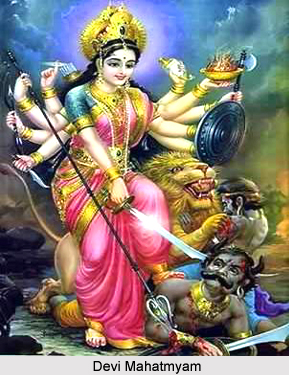
Devi Mahatmyam also known as Durga Saptashati or Chandi Patha is a part of the
Markandeya Purana. Devi Mahatmyam is regarded as an effort to unify the Vedic male pantheon with the pre-existing mother goddess cult. The images of the goddess have been provided with a variety of arms in several texts. In India a large number of images and sculptures of the goddess with two to thirty two arms have been discovered. A study of the few of the early reliefs helps in realizing the development aspect of this iconic motif. The variations in arms of the goddess have been discussed below in details.
Two Armed Devi Mahatmyam : The two armed form of the Devi Mahatmyam had been very common in the ancient period. The use of the same motif continued almost upto the medieval times.
Four Armed Devi Mahatmyam : Several texts describe the goddess having four arms with which she holds a
conch shell, a chakra, a noose, an ankusa or the head of the demon. The four armed variety of the goddess appears during the time of
Kushana Empire. The two terracotta plaques from Nagar dating back to the 1st century B.C. depict the goddess having four arms. This form of the goddess became much popular during the Gupta period. A sculpture has been discovered from Bhumara where the goddess has placed her right foot over the snout of the buffalo. In her two hands she holds a khatvanga, while in the right hand she holds a trident and the buffalo`s hind legs. Another image of the goddess from Bhuvanesvara portrays her almost similarly except that she lifts the buffalo with her left hand and pierces the trident into its head. In a sculpture of the eighth century A.D., preserved in the Srirangam temple, she is depicted with her right knee slightly bent over the severed head of the buffalo. Two devotees kneel on either side of the goddess. One of them is cutting out his flesh to offer the goddess. Another four armed bronze image of the goddess has been discovered in
Chamba in
Himachal Pradesh. It is popularly known as Laksana Devi and dates back to the eighth century. A stone image of the goddess has also been preserved in the
Thiruvananthapuram Museum. The asura emerging out of the severed neck of the buffalo holds a club in the right hand and the shield in the left one. The lion is present to the right of the goddess. The asura is sometimes depicted in composite form with the animal head placed over the human body. One such specimen was discovered from
Aihole. The demon is seen lying down whose head is held by the goddess in her right hand while striking into his stomach. In a terracotta seal from
Punjab, the goddess is shown slaying the asura with her trident. The lion is on the right of the goddess. In another specimen from Chhatrari, in Himachal Pradesh,
Mahisasura has been shown in human form. It also has horns and its severed head is being carried by the lion in its mouth. The standing goddess in her triumphant form had been famous during the reign of the
Pallava Dynasty and the
Chola Dynasty. The outstanding specimen of this type is available from Brihadeshwara temple. The goddess holds a disc, a conch shell and
abhaya mudra and the fourth hand is placed over the waist in the katihasta posture. A wooden sculpture from Chamba depicts the demon being attacked by the goddess with a trident in her left arm. A specimen has been preserved in the
National Museum, New
Delhi in the form of a miniature where the goddess is shown mounted over a lion.
Six Armed Devi Mahatmyam : The six armed sculpture of the goddess belong to the Kushana period and have been well preserved in the
Mathura Museum. In this form she carries the wheel, a conch, a sword, a trident, a bow and an arrow. She is holds the buffalo demon in the form of breaking her neck. Her mount, the lion is absent in the cases.
Eight Armed Devi Mahatmyam : Several Sanskrit texts portray the goddess having eight arms with which she holds a noose, a conch, a trident, a sword, a bow, an arrow, a chakra and a club. Some of these weapons were sometimes replaced by mudras. Artists have at times resorted to minor deviations from the texts and depict situations completely different from the theme. In certain cases Maruti or other gods like
Lord Brahma, Lord Vishnu and
Lord Shiva have been placed in the battle field. The Mahisasura has been portrayed in several forms like the buffalo or the human form emerging out of the severed neck of buffalo. Sometimes the demon was grabbed by the heels and at other times the tongue of the animal was pulled out by the goddess.
During the Kushana period Mathura had been a centre of great worship of the deity. The Mathura Museum has two sculptures of the eight armed goddess. In one of the forms she holds the neck of the demon while she pierces the trident in the body of the asura. A temple in Bhubaneshvar has an eight armed goddess. She holds the usual attributes. With one of her left hand she holds the snout of the buffalo tightly and places her right foot firmly over the back of a buffalo. Another sculpture discovered at Aihole depicts the goddess placing her left foot over the back of the demon. The trident of the goddess pierces the back of the buffalo. The image of the goddess from Jagat depicts her standing in alidha posture. Another eight armed goddess from
Alampur portrays the goddess standing in pratyaildha posture. She places her left foot over the back of the buffalo.
A sculpture of the goddess from
Khajuraho depicts her standing in alidha posture, placing her right foot over the buffalo`s back which kneels down in front. The chakra half pierces into the buffalo`s back. The
Virupaksha Temple at Bilgi projects the goddess standing on her right leg and raising up her left one. The buffalo demon here instead of resisting, fondly licks the foot of this goddess. A similar representation is available from Aihole. The image of the goddess from
Vellore depicts her standing in alidha posture placing the right foot over the back of the buffalo. The goddess stands in pratyalidha posture in an image preserved in the
Hyderabad Museum. She places her left foot over the back of the buffalo. The lion is seated to the right. Another image of the goddess from the Chausatha-yogini temple depicts her lifting the buffalo by the heels and placing her right foot over its back. A sculpture of the goddess from the
Lucknow Museum represents her standing in alidha posture.
Bharat Kala Bhavan in
Varanasi preserves an image of the eight armed goddess. In this case the goddess holds the demon by his hair. The goddess from Serai from
Hooghly district stands in alidha posture and pierces a trident into the chest of the asura.
Ten Armed Devi Mahatmyam : Devi Mahatmyam possessing ten arms has been depicted in several Sanskrit texts. She holds a chakra, an arrow, a bow, a sula, a vajra, an ankusa and a bell. A sculpture of the goddess has been kept in the
Allahabad Museum. It demonstrates the goddess dancing over the body of the buffalo, whose head is severed. In one of her hands she holds a bowl of human skull. Another image of the goddess from the
Lakshmana Temple at Khajuraho illustrates the goddess piercing the trident into the body of the buffalo. A tenth century image of the goddess from Sakta in Bengal, depicts the goddess standing in pratydlidha posture placing her left foot over the asura in human form, holding a sword in both his hands. A sculpture from Dulmi kept in the
Indian Museum;
Kolkata depicts the goddess killing the asura. A similar sculpture of the goddess has been preserved in the Marimata temple, Nowgaun in
Assam. Several sculptures of the goddess with ten arms are reported from
Cuttack, Baijnath- Almora, Bharat Kala Bhawan, Varanasi, Udayagiri-Vidisa and several other sites in the country.
Twelve Armed Devi Mahatmyam : The twelve armed idol of Devi Mahatmya has been described in
Matsya Purana. A twelve armed sculpture has been preserved in the
Udayagiri caves. A sculpture of the twelve armed goddess belongs to the of the Gupta period. A late medieval sculpture from
Rohtak depicts the goddess dealing with the buffalo from whose severed neck the asura emerges holding a shield and a sword. The asura has two horns over his head.
Sixteen Armed Devi Mahatmyam : The goddess with sixteen arms is rarely seen. However, this form has also been patronised. A stone panel in the Rajshahi Museum, in West Dinajpur district displays the goddess in the centre with eighteen arms. Another sixteen armed idol of the goddess depicts her killing of buffalo form from whose severed neck the asura emerges. The trident of the goddess is shown pierced into the chest of the asura. The images of the goddess from Baijnath (Almora), Khajuraho,
Kangra and
Belur, have similar type of projections. A miniature from Chamba has been preserved in the Victoria and Albert Museum. Here the goddess with her sixteen arms holds various attributes like a
lotus, an axe, a rod, a conch, an arrow, a chakra and a sword in her left hands while in the right hands, she holds a bow, a noose, a club, a trident, a sula, a cup and a dagger. She stands on the back of the buffalo piercing a trident in the chest of the asura and simultaneously slaying the buffalo.
Eighteen Armed Devi Mahatmyam : Several texts describe Devi Mahatmyam having eighteen arms. A sculpture of the goddess from the temple at Chidambaram is depicted with eighteen arms. An inscription has been engraved below the idol states that the goddess is Tripurasundari. Another sculpture from Gangaikonda-colapuram depicts the eighteen armed goddess in combat with asura. In a miniature from Kulu portrays the asura having ears of an
elephant. In a Rajasthani miniature the goddess is shown engaged in combat with asura.
Twenty Armed Devi Mahatmyam : The goddess with twenty arms has been patronised by artists at a much later stage. A sculpture from Chidambaram depicts the goddess engaged in combat with asura. The head of a buffalo fixed over the human body. The goddess has placed her foot over the left foot of the demon. The goddess from Bheraghat,
Jabalpur has twenty unbroken arms and stands in alidha posture, with her right foot over the buffalo, whose neck is already severed. It head with a protruding tongue is seen fallen on the ground. The asura has emerged out of the severed neck of the buffalo and kneels down in front.
Thirty-Two Armed Devi Mahatmyam : The textual references to the goddess possessing thirty-two arms are rarely found. A stone sculpture from West Dinajpur district of
West Bengal, depicts the goddess with thirty-two arms that holds various attributes. On the right side of the goddess a female attendant is seen holding an umbrella over the goddess. On the left side four pot bellied dwarfs with wide open eyes can be seen. On the top of prabhavali, the miniature figurines of
Ganga, Lord Surya, Lord Vishnu, Lord Siva and Lord Brahma are carved.
Thousand Armed Devi Mahatmyam : The Puranic texts also defines the goddess possessing thousands arms. Devi Mahatmya has been defined as the goddess as all powerful, omnipresent, and the universal mother who destroys the demonic power of the universe.

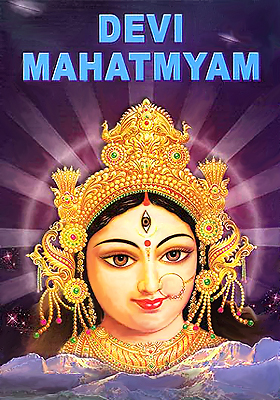 Devi Mahatmyam is a part of the Markandeya Purana. It is also known as Durga Saptashati or Chandi Patha. Devi Mahatmyam contains 700 verses that have been arranged into thirteen chapters. This is considered as the most important text of Shaktism. Devi Mahatmyam is considered as an effort to unify the Vedic male pantheon with the pre-existing mother goddess cult. Some aspects of Samkhya philosophy have also been elaborated in the narrative.
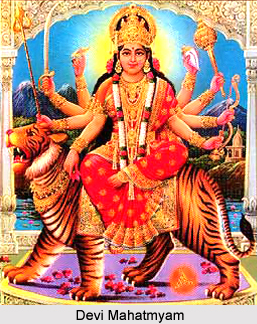 Devi Mahatmyam is a Hindu religious text and a part of the