
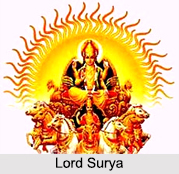
 Lord Surya is considered as the creator of the universe and the source of all life. He is the chief of the "Navagraha", the nine Indian Classical planets and significant elements of Hindu astrology. The entire universe including Devas, Asuras and human beings originates from him. He is also the basis of "Ravivara", or Sunday, in the Hindu calendar.
Lord Surya is also a description for the major Hindu Gods Shiva and Vishnu.
Lord Surya is considered as the creator of the universe and the source of all life. He is the chief of the "Navagraha", the nine Indian Classical planets and significant elements of Hindu astrology. The entire universe including Devas, Asuras and human beings originates from him. He is also the basis of "Ravivara", or Sunday, in the Hindu calendar.
Lord Surya is also a description for the major Hindu Gods Shiva and Vishnu.Lord Surya
Lord Surya represents the solar God in Hinduism. He is one of the five deities considered as counterpart features in the Smarta Tradition.
Introduction
Lord Surya is considered as the creator of the universe and the source of all life. He is the chief of the "Navagraha", the nine Indian Classical planets and significant elements of Hindu astrology. The entire universe including Devas, Asuras and human beings originates from him. He is also the basis of "Ravivara", or Sunday, in the Hindu calendar.
Lord Surya is also a description for the major Hindu Gods Shiva and Vishnu.Legends of Lord Surya
Lord Surya first appears in literature in the "Rig Veda". According to some myths, Lord Surya is the son of sage Kasyapa and Aditi. The Vedas state Surya to be the creator of the material universe. He is regarded as the absolute idol by "Saura" sect and "Smartas" worship him as one of the five principal forms of God. He is often identified with "Aditya", "Savitr" and "Pusan", is another important Vedic deity.
In the "Mahabharata", Karna was the son of Surya and unmarried princess Kunti. He is also celebrated as a God in Buddhist artwork, for example the ancient works attributed to Ashoka. Surya had three wives, namely, Sharanya, Ragyi and Prabha. Surya had three children with Sanjna (Conscience), the daughter of Viswakarma. These were Vaivasvata (one of the 14 original men), Yama (God of the death), and Yami (Goddess of the Yamuna river). Sadly, Sanjna became so tired of Surya"s light that she gave him a handmaid one day, Chaya (Shade), and left him to live a life of reflection in the forests. The resulting children were Revanta (chief of the Guhyakas) and two twin sons, the youthful Ashvins. The other children of Surya are the monkey chief Sugriva, Ushas and Shani, the representation of the planet Saturn. In the Ramayana, Lord Surya is explained as the father of the King Sugriva, who helped Rama and Lakshmana in defeating Ravana. He also trained Lord Hanuman.
In the "Mahabharata", Karna was the son of Surya and unmarried princess Kunti. He is also celebrated as a God in Buddhist artwork, for example the ancient works attributed to Ashoka. Surya had three wives, namely, Sharanya, Ragyi and Prabha. Surya had three children with Sanjna (Conscience), the daughter of Viswakarma. These were Vaivasvata (one of the 14 original men), Yama (God of the death), and Yami (Goddess of the Yamuna river). Sadly, Sanjna became so tired of Surya"s light that she gave him a handmaid one day, Chaya (Shade), and left him to live a life of reflection in the forests. The resulting children were Revanta (chief of the Guhyakas) and two twin sons, the youthful Ashvins. The other children of Surya are the monkey chief Sugriva, Ushas and Shani, the representation of the planet Saturn. In the Ramayana, Lord Surya is explained as the father of the King Sugriva, who helped Rama and Lakshmana in defeating Ravana. He also trained Lord Hanuman.
Iconography of Surya
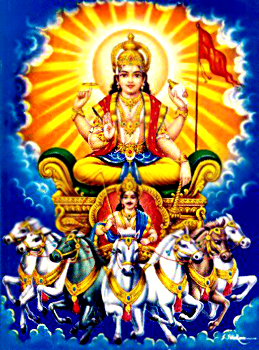 Iconography of Surya had occupied a very important position in India. Surya has been worshipped in India from the early times. The Vedas refer to Surya and his various aspects namely Savitri, Pusan, Bhaga, Vivasvat, Mitra, Aryaman and Vishnu. Most of these deities along with a few others formed the class of gods called Adityas. The various aspects of Lord Surya have been numbered as twelve. The worship of twelve Adityas along with the Navagrahas came to occupy an important place in the religious life of the people. The Navagrahas are Ravi, Soma, Mangala, Budha, Brihaspati, Sukra, Sani, Rahu and Ketu. Among these nine names barring the first two and the last two all are planets. According to the Grahayaya or Svastyana-vidhi the Navagrahas are to be worshipped by all in times of danger, for it is believed that the troubles occur from the wrath of these planetary positions. As Surya is a deity of yesteryears for the Hindus it is obvious that the iconography of Surya will occupy a prominent position.
The figures of Lord Surya are generally represented in a standing pose on stone slabs. The deities are rarely represented in a seating position. The Sun God is generally represented by means of various symbols before the development of solar cult. Surya however appeared in human form from an early period in Indian history. The early Surya images seldom fail to show the alien features although gradual idealization of these traits and emphasis of Indian elements appear to have begun from the Gupta period.
Sometimes the images made of bluish black stone forms the model of the iconic type. The figures of Dandi and Pingala generally occur on two sides of the main figure while the figure of Aruna is shown as the charioteer. The two arrow shooting goddesses namely Usha and Pratysha appear as accessories on either sides of the chariot. The chariot with seven horses and one wheel appear interestingly carved on the pedestal. The Kushana dress is absent, but the sacred thread on the body of the deity and his other attendants like Mahasweta and the two consorts namely Samjna and Chaya, Samjna`s earthy double almost invariably found present in such images of the Pala period.
The images of Surya which is found is generally ornamented in style with the floral sign at the top with a flying Vidhyadhara on either side of the deity. The girdle which holds the deity`s cloth tight round the waist is decorated with artistic hangings and a dagger is shown attached to the right side of the girdle. The high foot wears which cover the legs of the god are partially visible. The god wears a necklace, a sacred thread and ear rings and an artistically worked elongated head dress. He holds two lotuses in his two hands which rise a little above his shoulders. The bearded figure of Pingala is shown on the right side of the deity with pen and ink stand in his hands, the figure of Dandi stands to the left with a sword in his right hand while his left hand rests on the staff.
The two consorts of the deity namely Samjna and Chaya are shown as standing on the left and right sides of the main figure respectively. The figure of the goddess Mahasweta is placed in front of the god. The iconography shows that Aruna is driving the chariot of one wheel and drawn by seven horses. Two arrow shooting goddesses namely Usa and Pratyusha are shown to the right and left of Pinga and Dandi respectively. The agni kundas near the deity is issued a lotus on which the god is made to stand.
Originally the sun-god is shown represented in a standing position holding a full blown lotus in each of his two hands. The deity also wears ornaments on the body and a square shaped and flat head dress. The graham-devatas found here are beautifully carved as standing in a row on low pedestals, with Ganesha in front of the row. All the deities are shown as two-armed and they hold their respective attributes excepting the fierce-looking pingalorddhakesa. In some of the iconographies of Surya Rahu whose hands are shown in the tarpana-mudra.
In some cases the two-armed gods are shown standing in a row with raised holding lotuses with usual head-dresses. Their bodies are adorned with necklaces and yajno-pavitas. The lower portion of the panel is also broken. But the clothes which are worn by the deity of Surya are visible.
Lord Surya in Astrology
In Vedic astrology, Lord Surya symbolizes soul, determination, reputation, general verve, bravery, kingship and power. He is acclaimed in the sign Mesha, is in mulatrikona in the sign Simha and is in debilitation in the sign Tula. Surya is the lord of three nakshatras namely "Krittika", "Uttara Phalguni" and "Uttara Ashadha". Lord Surya has the gemstone - ruby, his direction is east and the season is summer. The food grain associated with him is wheat.
Worship of Lord Surya
One of the adhyayas in Agni Purana has been dedicated to the worship of Lord Surya. The worship of the sun-god has been described in a detailed manner by Lord Agni in chapter number seventy three. The Lord begins with saying that the worshipper should contemplate himself identical with the divine energy and worship the preliminary oblations accordingly.
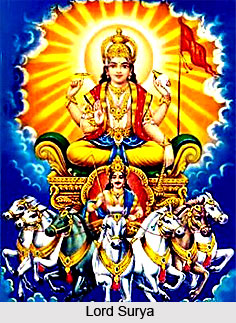 The worship of Lord Surya should commence facing the east. The two attendants of the Lord namely Dandi and Pingala should be worshipped at the right and left corners respectively. The god Gana should be worshipped in the north-east corner of the heaven. As the description follows the Lord says that the components of the solar rays such as Bimala, Sara, Parama and Sukha should be worshipped in the angular quarters of the heaven starting with the south-east imaged as mighty lions of a white blood yellow or of a blue colour respectively. According to the custom it is essential that the energies of the god should be worshipped inside the lotus.
The seat or the cushion of the sun- god should be presented at the centre of the lotus by uttering the mantra Rang and the six letters which compose the principal mantra in the worship. The sun god needs to be evoked with the help of the mantra. And the mantra should be mentally located with the help of water oblation touched with the head as a resplendent spirit of deep red colour. The God of Fire states in his account that Lord Surya should be satisfied by offering him flowers and perfumes. At the same time it is necessary to perform the Bimala mudra in order to satisfy the lord.
Lord Agni narrates that in the worship of sun-god it is necessary that the other mudras like the Padma mudra and the Vilvamudra should be exhibited to the god and the rite known by the name Sadanganyasa should be performed in different directions of the heaven. The next step involves performing of various obesiance in order to satisfy the lord. The various mudras should also be exhibited to the sun-god.
Worship of Lord Surya involves obeisance to the planets and the ceremony is performed in the different petals of lotus shaped diagram commencing from the east. It has been mentioned in the Agni Purana that Argha or water oblations should be offered to the sun-god out of the vessels containing water for the same and by uttering the principal mantra appertaining to that particular divinity.
Finally the God of Fire ends his description of Lord Surya by saying that having performed the rite of mentally merging the component principles of the universe in the fundamental one, it is the duty of the votary of the sun-god to contemplate in his heart the god as identical with the god Sankara and offer the light or the effulgence to the latter as a garland made of solar rays. Lord Agni opines that a man who worships and contemplates the sun-god with utmost dedication is able to achieve everything in life.
The worship of Lord Surya should commence facing the east. The two attendants of the Lord namely Dandi and Pingala should be worshipped at the right and left corners respectively. The god Gana should be worshipped in the north-east corner of the heaven. As the description follows the Lord says that the components of the solar rays such as Bimala, Sara, Parama and Sukha should be worshipped in the angular quarters of the heaven starting with the south-east imaged as mighty lions of a white blood yellow or of a blue colour respectively. According to the custom it is essential that the energies of the god should be worshipped inside the lotus.
The seat or the cushion of the sun- god should be presented at the centre of the lotus by uttering the mantra Rang and the six letters which compose the principal mantra in the worship. The sun god needs to be evoked with the help of the mantra. And the mantra should be mentally located with the help of water oblation touched with the head as a resplendent spirit of deep red colour. The God of Fire states in his account that Lord Surya should be satisfied by offering him flowers and perfumes. At the same time it is necessary to perform the Bimala mudra in order to satisfy the lord.
Lord Agni narrates that in the worship of sun-god it is necessary that the other mudras like the Padma mudra and the Vilvamudra should be exhibited to the god and the rite known by the name Sadanganyasa should be performed in different directions of the heaven. The next step involves performing of various obesiance in order to satisfy the lord. The various mudras should also be exhibited to the sun-god.
Worship of Lord Surya involves obeisance to the planets and the ceremony is performed in the different petals of lotus shaped diagram commencing from the east. It has been mentioned in the Agni Purana that Argha or water oblations should be offered to the sun-god out of the vessels containing water for the same and by uttering the principal mantra appertaining to that particular divinity.
Finally the God of Fire ends his description of Lord Surya by saying that having performed the rite of mentally merging the component principles of the universe in the fundamental one, it is the duty of the votary of the sun-god to contemplate in his heart the god as identical with the god Sankara and offer the light or the effulgence to the latter as a garland made of solar rays. Lord Agni opines that a man who worships and contemplates the sun-god with utmost dedication is able to achieve everything in life.
Hymns on Surya
In the hymn on Surya, the Solar God is described as driving a chariot whose rays are said to be the seven mares. In his fiery aspect, he is identified with Agni `Knower of Creatures` (Jatavedas), and through the recurrent image of seeing and being seen and giving light that allows others to see he is further identified with Lord Varuna, the eye of the gods. According to the Rig Vedic hymns, the brilliant banners of Surya draw upwards the god who knows all creatures, so that everyone may see the sun.
The hymns on Lord Surya state that the constellations, along with the nights, steal away like thieves, making way for the sun who gazes on everyone. It has been mentioned in the hymn that the rays that are his banners have become visible from the distance, shining over mankind like blazing fires. It says that Surya looks most busy among men. He has the capacity to cross heaven and the vast realm of space, measuring days by nights and looking upon the generations. Surya or the Sun illumines the entire world and gives light to mankind like blazing fire. Surya is the maker of the light and lightens up the wide realm of the space. It is believed in the hymn that through the Surya which acts as the eye of Lord Vishnu to keep a careful surveillance on mankind.
The belief which has been expressed in the hymn dedicated to Surya is that the worshippers are able to come out of all darkness with the help of Surya. The hymn says that coming out of darkness one sees the higher light around us, going to the sun, the god among gods and in the process the highest light is experienced by a worshipper.
The hymn on Surya proclaims that the sun is honoured as a friend, climbing to the highest sky. It has the capacity to free the worshipper from every kind of heart ache and yellow pallor.
Finally the hymn ends saying that the sun rises with all the dominating force, hurling my hateful enemy down into the hands. In this particular hymn the worshipper has prayed to Surya that he should be released from all enemies.
The hymns on Lord Surya state that the constellations, along with the nights, steal away like thieves, making way for the sun who gazes on everyone. It has been mentioned in the hymn that the rays that are his banners have become visible from the distance, shining over mankind like blazing fires. It says that Surya looks most busy among men. He has the capacity to cross heaven and the vast realm of space, measuring days by nights and looking upon the generations. Surya or the Sun illumines the entire world and gives light to mankind like blazing fire. Surya is the maker of the light and lightens up the wide realm of the space. It is believed in the hymn that through the Surya which acts as the eye of Lord Vishnu to keep a careful surveillance on mankind.
The belief which has been expressed in the hymn dedicated to Surya is that the worshippers are able to come out of all darkness with the help of Surya. The hymn says that coming out of darkness one sees the higher light around us, going to the sun, the god among gods and in the process the highest light is experienced by a worshipper.
The hymn on Surya proclaims that the sun is honoured as a friend, climbing to the highest sky. It has the capacity to free the worshipper from every kind of heart ache and yellow pallor.
Finally the hymn ends saying that the sun rises with all the dominating force, hurling my hateful enemy down into the hands. In this particular hymn the worshipper has prayed to Surya that he should be released from all enemies.
Festivals of Lord Surya
Following are the festivals dedicated to Lord Surya in India:
Pongal: It is the most extensively celebrated Hindu festival dedicated to the Surya. It is celebrated as "Makar Sankranti" in many parts of India. People worship the Sun God for ensuring a good harvest and give the first grain to him.
Chhath: It is another Hindu festival dedicated to Lord Surya. It is believed to start by Karna who became a great warrior and fought against the Pandavas in the Kurukshetra War. It is celebrated widely in Bihar, Jharkhand, and some parts of Uttar Pradesh and Nepal.
Samba Dashami: It is celebrated in the eastern coastal state of Odisha in the honour of Samba, the son of Krishna who was cured of leprosy by praying to Lord Surya.
Aytar Puja: It is celebrated in Goa on Sundays of the Hindu lunar month of "Shravana". Known as "Aditya Vrata" in Sanskrit, this ceremony is known as "Aditya Ranubai" in Maharashtra.
Ratha Saptami: It is a Hindu festival that falls on the seventh day (Saptami) of the bright half of the Hindu month "Magha". This day is also known as "Surya Jayanti" because it celebrates the supremacy of Lord Surya.
Pongal: It is the most extensively celebrated Hindu festival dedicated to the Surya. It is celebrated as "Makar Sankranti" in many parts of India. People worship the Sun God for ensuring a good harvest and give the first grain to him.
Chhath: It is another Hindu festival dedicated to Lord Surya. It is believed to start by Karna who became a great warrior and fought against the Pandavas in the Kurukshetra War. It is celebrated widely in Bihar, Jharkhand, and some parts of Uttar Pradesh and Nepal.
Samba Dashami: It is celebrated in the eastern coastal state of Odisha in the honour of Samba, the son of Krishna who was cured of leprosy by praying to Lord Surya.
Aytar Puja: It is celebrated in Goa on Sundays of the Hindu lunar month of "Shravana". Known as "Aditya Vrata" in Sanskrit, this ceremony is known as "Aditya Ranubai" in Maharashtra.
Ratha Saptami: It is a Hindu festival that falls on the seventh day (Saptami) of the bright half of the Hindu month "Magha". This day is also known as "Surya Jayanti" because it celebrates the supremacy of Lord Surya.
Temples of Lord Surya
Surya temples are found in many parts of India. Following are the temples of Lord Surya:
•The Dakshinaarka temple (Bihar)
•The Bhramanya Dev Temple (Madhya Pradesh)
•Sun Temple (Bihar)
•Sun Temple (Assam)
•Suryanaar Kovil (Tamil Nadu)
•Suryanarayanaswamy Temple (Andhra Pradesh)
•The Sun Temple (Gujarat)
•Konark Sun Temple (Odisha)
•Martand Sun Temple (Jammu and Kashmir)
•The Surya temple of Bhinmal
•The Dakshinaarka temple (Bihar)
•The Bhramanya Dev Temple (Madhya Pradesh)
•Sun Temple (Bihar)
•Sun Temple (Assam)
•Suryanaar Kovil (Tamil Nadu)
•Suryanarayanaswamy Temple (Andhra Pradesh)
•The Sun Temple (Gujarat)
•Konark Sun Temple (Odisha)
•Martand Sun Temple (Jammu and Kashmir)
•The Surya temple of Bhinmal
Recently updated articles in Religion in India
Kusumayudha
Kusumayudha is a name of Kamadeva, the Hindu God of Love. Depicted with a sugarcane bow and flower-tipped arrows, he represents attraction and longing...

Bhoyar Caste
Bhoyar Caste is largely found in the Central Provinces of the country. Traditional occupation of Bhoyars is agriculture. They are good cultivators and...
Chasa Caste
Chasa caste is a prominent agrarian community native to Odisha. Traditionally associated with cultivation and farming, Chasas have historically played...
Vigneswara, A Form of Lord Ganesha
Lord Vigneswara is another form of Lord Ganesha or Vinayaka, prominently worshipped as the God of intelligence and good luck in the Indian subcontinen...
Maheswara
Maheswara, meaning “the Great Lord,” is a revered name of Lord Shiva in Hindu tradition. It represents Shiva’s supreme authority over creation, preser...
Related articles in Religion in India
Religion in Indus Valley Civilization
Religion in Indus Valley Civilisation included Hinduism, Buddhism and Jainism. Details about the religion in Indus Valley Civilization have been gathe...
Iyer Brahmin
Iyer Brahmins are originally from Tamil Nadu of South India. They are known for their adherence to Advaita philosophy and Smarta traditions. Tradition...
Kumbhakar / Kumhar Caste
Kumbhakar or Kumhar caste is a traditional artisan community in India known for pottery making. Derived from Sanskrit word Kumbhakar, meaning potter,...

Gujjars in Mughal Era
Gujjars in the Mughal era enjoyed great power. Further their power increased with the decline of Aurangzeb, Mughal emperor.
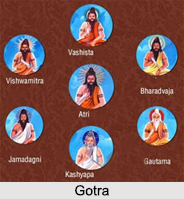
Gotra in Hinduism
In Hinduism, gotra refers to a lineage system tracing descent from ancient sages, primarily through the paternal line. Originating from Vedic traditio...