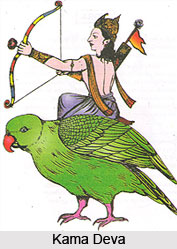
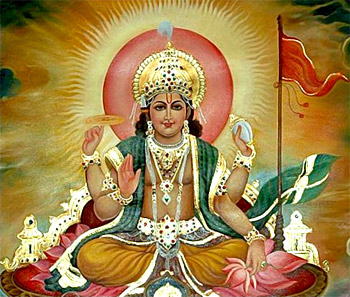
 belongs to a class of Vedic gods. According to the Vedas Savitr is pre-eminently a golden deity. It is described that his eyes, hands, tongue are golden. He is yellow-haired and puts on a yellow garment. His vehicle is a golden car with a golden pole, which is omni-form and is drawn by two radiant steeds. He has been described as a beneficent deity.
According to some scholars Savitr is the god of the Sun at Sunrise and Sunset. He is the lord that moves as well as stationary. Savitr acts as a protector of all beings who are visionary as well as guard the world of spirits. He is prayed in order to convey the departed spirit to where the virtuous dwell. He confers immortality on the gods as well as length of life on man. He is also a supporter of the sky. Savitr is also considered as an agent God. He also has a major role in creation.
There are several Epithets of Savitr. Apam napat is one of them that means born of the Waters. Savitr is also known as God of the Middle Region. As Savitr is attributed with causing rain he is considered to belong to atmosphere. At times Savitr is also known as Prajapati. For instance in the Satapatha Brahmana he has been identified with Prajapati. In the Taittiriya Brahmana it has been stated that Prajapati became Savitr and created living beings. In Rig Veda Savitr has been twice spoken of as Damunas. In many Rig Vedic hymns he has also been considered as Asura. As he is the lord of animating power and due to his movements he becomes Pusan. Pusan and Savitr are considered to be connected in two consecutive verses. By reason of laws Savitr becomes Mitra. Savitr becomes Bhaga as he is known to have bestowing benefits. In Rig Veda the epithet "surya-rashmi" has been applied to Savitr.
Savitr is considered as the Lord who removes evil dreams as well as make men sinless. Fixed laws are observed by him. Fixed laws are observed by him. Waters and wind are under his authority. He is praised by the Vasus, Aditi, Varuna, Mitra and Aryaman.