
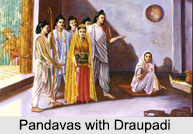
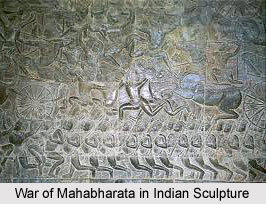
 The Pandavas were the five powerful and skilled sons of Pandu, the King of Hastinapur and his two wives were Kunti and Madri. The Pandavas were Yudhistira, Bhima, Arjuna, Nakula, and Sahadeva, they are the central characters in the most applauded epic in Hinduism, the Mahabharata. The brothers were famously involved in the Kurukshetra War with their cousins the Kauravas over who would control the throne of Hastinapur, and were, ultimately, victorious.
Pandavas
The five sons of king Pandu, who fought for Dharma or righteousness all their lives, were called the Pandavas.
Introduction
The Pandavas were the five powerful and skilled sons of Pandu, the King of Hastinapur and his two wives were Kunti and Madri. The Pandavas were Yudhistira, Bhima, Arjuna, Nakula, and Sahadeva, they are the central characters in the most applauded epic in Hinduism, the Mahabharata. The brothers were famously involved in the Kurukshetra War with their cousins the Kauravas over who would control the throne of Hastinapur, and were, ultimately, victorious.Birth of Pandavas
King Pandu was cursed by Sage Kidamba that if he ever tried to get intimate with any woman, he would immediately die. Hence, the actual fatherhood of Pandu"s children- the Pandavas, is traditionally attributed to various Gods, in virtue of a boon that Kunti had received from the sage Durvasa and had transferred to Madri, both of whom were the wives of King Pandu. Thus, it said that Yudhisththira was the oldest and the son of Lord Yama, who was the God of death. After that was Bhima, the son of Lord Vayu or the God of Wind, with Arjuna being the third Pandava and the son of Lord Indra, who was the God of Rain. The first three Pandavas were Kunti"s. Madri summoned the Ashwini Kumaras and bore two sons, Nakula was the son of Nasatya, who was the God of Health and Sahadeva was the son of Darsa, who was the God of Medicines. Other than these, Kunti also had a son with Lord Surya, named Karna who was born before she was even married to King Pandu.
The Pandavas
 Panduputra or the sons of Pandu, as the name suggests there were five Pandavas.
Yudhishthira: The eldest of the Pandavas, Yudhishthira"s name indicates steadfastness at all times, even at war when things are most difficult. As he was the son of Yama, he was the most righteous and steadfast, a follower of Dharma in all walks of life, and shining like the brilliant sun in the knowledge of law, ethics, and morality. He was the most righteous of the Pandavas never having spoken a lie in his life, except during the final war where he was made to suppress the loud truth through neutrality. He was such a steadfast man of righteous deeds that his chariot while moving would remain a few inches above the ground. Unfortunately, due to this fondness for righteousness, he was duped during a game of dice with the Kauravas to gamble his wife Draupadi and lost her.
Bhima: He was the son of the Wind God Vayu, indicating the fierce force and braveness that he inherited. He was the mightiest of the brothers, both in physical prowess and in skill and speed. He was fond of eating and often took the lion"s share of the shared meals of the Pandavas. He was fond of cooking and employed himself as a chief cook in the last year of the Pandavas exile where they were to hide their identity and live unknown to the world. Bhima was the one who took an oath to kill the 100 Kauravas as a result of losing the game of dice and watching helplessly their only wife, Draupadi, getting disrobed by Dushashana, younger brother of Duryodhana.
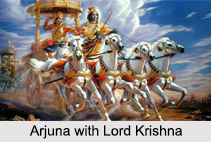
Arjuna: He was the mightiest in skills, matchless in knowledge, skills, and saintly temper, possessed of divine weapons, and the major responsibility of winning the Kurukshetra war was given to him, as he had Lord Krishna as his charioteer and adviser. His divine weapons, when used, vanquished even the most renowned and skilled warrior. He was the best pal of Lord Krishna, and the recipient of the divine knowledge from Krishna, often called the Bhagavad Gita. During their exile, he endured the most severe austerities and sacrifices and pleased Lord Shiva to appear, who willingly presented him with a divine weapon called the Pashupatastra for his war. Arjuna also had command over devastating weapons like the Brahmastra.
 Nakula: The fourth Pandava brother, Nakula, being the son of the Ashvins, was the most skilled with animals, especially horses and elephants. He was compared to the Lord of Love also known as Kamadeva since he looked beautiful. He was steadfast in his conduct, had superior knowledge of health and cures for many of life`s threatening diseases. He, along with his brother Sahadeva, saved Karna"s life during the war on Kunti"s request, when Karna donated his chest weapon to Indra, Arjuna"s father in an act of charity. Nakula was an excellent sword fighter, equipped with the best of knowledge pertaining to sciences, warfare, and unusual weapons.
Sahadeva: The fifth and the youngest brother of the Pandavas, Sahadeva was the wisest of all the Pandava brothers and the most mysterious and introverted. Like Nakula, Sahadeva was a master of sword fighting. He was also skilled in fighting and taming wild bulls. Additionally, he was a skilled cowherd, capable of maintaining cattle, treating their diseases, assessing their health, milking them and in producing milk products. Sahadeva acquired mastery over the science of Dharma, religious scriptures and other branches of knowledge under the tutelage of the Sage Brihaspati, the preceptor of the Gods. Sahadeva had the power of the foresight that gave him strong premonition which often warned him of upcoming dangers. During the Kurukshetra War, Sahadeva slew the wicked Shakuni.
Exile of Pandavas
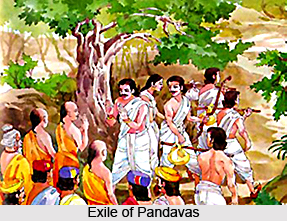 Exile of Pandavas in the forests was a result of their loss of the game of dice. As per the rule which was set before the Pandavas had to go for an exile of twelve years and the thirteenth year should be spend unrecognized. In case they were recognized in the thirteenth year then they would have to go for another twelve years of exile. Thus, when Yudhisthir lost in the game of dice, he along with his brothers and Draupadi went to the forest leaving his kingdom, his wealth and other belongings.
Yudhisthir, after being exiled for twelve year along with his brothers and his wife, and foresaw that at some future time the differences between their cousins and themselves would have to be decided by the fortunes of war. He also remembered that Duryodhana was in actual possession of the throne and treasury, and that all the friends of their youth whose prowess on the field were known all over the world, were devoted to Duryodhana. Dronacharya and his pupils, above all Karna, would fight and die, if need be, not for the Pandavas, but for Duryodhana, son of Dhritarashtra, the reigning king. At that time there came a holy man and he almost read what was going on then in the mind of Yudhisthir. He told the eldest Pandava prince that there was no one in the world who could defeat his brother Arjuna if he goes to the mountains to get the vision of the Great God and it was destined that all his enemies would be killed by him. Thus, Arjuna went to the mountains, and fasted and prayed to the great God and at last was blessed with all the divine weapons and returned to meet his brothers.
Once the twelve years of exile was over, the Pandavas decided to move to the capital city of the King Virata and disguised themselves in order to be unidentified by all. The five brothers disguised relating according to their personality with Yudhisthira assuming the name as Kankanbhata and served the king as his adviser and priest. Bhima became the head cook in the royal kitchen of the king and Arjuna was destined to serve a year as a eunuch as per the curse of Urvasi and thus he became Brihnnala and taught dance and music to the princess Uttara. Nakula was named Granthic and he became the caretaker and guard to the horse stable and Sahadeva named himself as Tantipal. The queen Draupadi disguised herself as Sairandhri and became the chief maid-servant to the queen. Thus, the thirteenth year of unrecognized exile passed well and the Pandavas once more, by their prowess in battle, had revealed themselves to their friends.
Escape of Pandavas from Lakshagriha
Escape of Pandavas from Lakshagriha was made successful with the help of Vidura, the uncle of the Pandavas and the Kauravas. Dhritarashtra once decided to crown Yudhishthira in public as his successor to the throne of Hastinapur. The Pandava princes took their new position more seriously than anyone had foreseen. They were never contented with mere enjoyment, they went out in all directions for the extension of the suzerainty, and constantly sent back to the royal treasury immense spoils. Duryodhana had been jealous of his cousins from his very childhood, and by seeing their great superiority and their growing popularity, he could not sleep out of jealousy. At last, he devised a plan for the extermination of the Pandavas. But the Pandavas also had a watchful friend and adviser in a certain uncle named Vidura, who, though of inferior birth, was a veritable incarnation of the god of justice. Vidura had the gift of reading men`s thoughts from their faces, and easily at that juncture, he was able to understand the mind of Dhritarashtra and his family.
Duryodhana openly approached his father, begging him to banish his cousins to the town of Benaras and during their absence to confer on himself the sovereignty of the kingdom. It was then, under secret instructions from Dhritarashtra the king, that certain members of the court began to praise the beauties of the city of Benaras, in which, they said, the yearly festival of Lord Shiva was already beginning. The Pandava princes, with others, showed some interest and curiosity as to the beauties of Benaras and then Dhritarashtra told them to visit the place once.
Very soon, the grey-haired Kunti set out with her five sons from Hastinapur. Purochanna, the friend and minister of Duryodhana, had, however, left for Benaras earlier to make preparations at that place to receive the princes. He was especially instructed to construct a house for them of highly inflammable materials and fitted with all the costliest furniture and equipments as close to the public arsenal as possible. There Purochanna would live as warden of the city, and watch for a suitable opportunity of setting fire to it, as if by accident. The palace was in fact, made of Lac.
As the Pandavas set forth from Hastinapur, Vidura, accompanied them at the beginning of their journey and was also the last to leave them, and while they parted he told to Yudhisthir in low tones to be alert every time and also told that weapons were not always made of steel and one could escape even from fire by making several outlets to one`s house, and a deep hole would be a wonderful refuge. Yudhishthira understood the symbolic speeches of his uncle and they parted.
The Pandavas were gladly welcomed by the people of Benaras, headed by Purochanna, and were rested for a time in a house outside the city. On the tenth day of their visit to the city, Purochanna described to them a fair mansion that he had erected for them within the city and Yudhishthira went forth with his mother and brothers to take up his quarters in it. On reaching the house he inspected it closely, and, indeed, the smell of Lac, Tar, and oil was strongly perceptible in the new building.
Soon, there came a man who introduced himself as an emissary from Vidura, their uncle, and skilled in mining. It was his opinion that the house in which they were living would be burnt on some moonless night. He thus proposed to dig for them a wide subterranean passage without delay. Pandavas accepted him with great joy, and he at once, began a careful excavation in the chamber of Yudhishthira, covering up its entrance with planks so as to be level with the rest of the floor. And the princes spent their days hunting and ranging the forests in the neighbourhood and at night slept always within closed doors, with their arms beside their pillows.
After the Pandavas stayed in their new abode for a year, it appeared to Yudhishthira that Purochanna was completely off his guard. He thus considered that the time was favourable for them to escape. Thus, on a certain evening, Kunti gave a great feast, and hundreds of men and women came to it. And in the dead of the night, when all had gone to sleep, a great wind began to blow and Bhima at that time came out quietly and set fire to that part of the house which adjoined Purochanna`s quarters in the arsenal. Then he set fire to several other parts, and leaving it all to blaze up of itself, he, along with his mother and brothers, entered the subterranean passage to make their escape. When drowsiness and fear impeded the motion of the Pandavas, the gigantic Bhima lifted his mother to his shoulder, and then, taking two brothers under each arm, he pushed forward along the secret passage, and all of them escaped the house of Lac and came out after a while into the darkness of the forest.
Duryodhana openly approached his father, begging him to banish his cousins to the town of Benaras and during their absence to confer on himself the sovereignty of the kingdom. It was then, under secret instructions from Dhritarashtra the king, that certain members of the court began to praise the beauties of the city of Benaras, in which, they said, the yearly festival of Lord Shiva was already beginning. The Pandava princes, with others, showed some interest and curiosity as to the beauties of Benaras and then Dhritarashtra told them to visit the place once.
Very soon, the grey-haired Kunti set out with her five sons from Hastinapur. Purochanna, the friend and minister of Duryodhana, had, however, left for Benaras earlier to make preparations at that place to receive the princes. He was especially instructed to construct a house for them of highly inflammable materials and fitted with all the costliest furniture and equipments as close to the public arsenal as possible. There Purochanna would live as warden of the city, and watch for a suitable opportunity of setting fire to it, as if by accident. The palace was in fact, made of Lac.
As the Pandavas set forth from Hastinapur, Vidura, accompanied them at the beginning of their journey and was also the last to leave them, and while they parted he told to Yudhisthir in low tones to be alert every time and also told that weapons were not always made of steel and one could escape even from fire by making several outlets to one`s house, and a deep hole would be a wonderful refuge. Yudhishthira understood the symbolic speeches of his uncle and they parted.
The Pandavas were gladly welcomed by the people of Benaras, headed by Purochanna, and were rested for a time in a house outside the city. On the tenth day of their visit to the city, Purochanna described to them a fair mansion that he had erected for them within the city and Yudhishthira went forth with his mother and brothers to take up his quarters in it. On reaching the house he inspected it closely, and, indeed, the smell of Lac, Tar, and oil was strongly perceptible in the new building.
Soon, there came a man who introduced himself as an emissary from Vidura, their uncle, and skilled in mining. It was his opinion that the house in which they were living would be burnt on some moonless night. He thus proposed to dig for them a wide subterranean passage without delay. Pandavas accepted him with great joy, and he at once, began a careful excavation in the chamber of Yudhishthira, covering up its entrance with planks so as to be level with the rest of the floor. And the princes spent their days hunting and ranging the forests in the neighbourhood and at night slept always within closed doors, with their arms beside their pillows.
After the Pandavas stayed in their new abode for a year, it appeared to Yudhishthira that Purochanna was completely off his guard. He thus considered that the time was favourable for them to escape. Thus, on a certain evening, Kunti gave a great feast, and hundreds of men and women came to it. And in the dead of the night, when all had gone to sleep, a great wind began to blow and Bhima at that time came out quietly and set fire to that part of the house which adjoined Purochanna`s quarters in the arsenal. Then he set fire to several other parts, and leaving it all to blaze up of itself, he, along with his mother and brothers, entered the subterranean passage to make their escape. When drowsiness and fear impeded the motion of the Pandavas, the gigantic Bhima lifted his mother to his shoulder, and then, taking two brothers under each arm, he pushed forward along the secret passage, and all of them escaped the house of Lac and came out after a while into the darkness of the forest.
Death of Pandavas
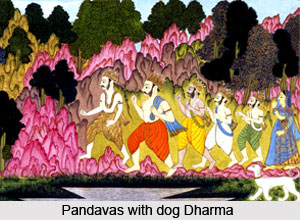
The Pandavas ruled Hastinapur for 36 years and established a righteous kingdom. Shortly after the death of Lord Krishna, they all decided that the time had come for them to renounce the world, as the age of Kali Yuga had started. Together along with Draupadi they left to the path of liberation. For this purpose they all climbed Mount Kailash, which leads to the the Swarga Loka. On their way, all except Yudhisthira slipped and died one by one. Yudhishthira was accompanied by a dog who was none other than Lord Yama himself.
The first one to die was Draupadi as she suffered from the vice of partiality, in her affections for Arjuna. Next was Sahadeva, who suffered from the vice of pride and vanity, though none was equal to him in wisdom. After that, it was the fourth Pandava, Nakula also suffered from the vice of pride and vanity, thinking he was the most handsome person in the world. Arjuna is the next person to die without completing the journey, since he too suffered from the same vice as his other two brothers as he thought he was the most skilled, most powerful warrior in the world. Next was the fall of Bhima, since he suffered from the vice of gluttony. Finally, it was just Yudhishthira and Lord Yama in the guise of the dog and entered through the gates of heaven. He expected to find his virtuous brothers or his wife Draupadi but instead he saw Karna, Bhishma, Dronacharya etc. and their sons.
Yudhishthira was told that his siblings and wife were taken to hell and were experiencing the reactions of their actions but it was temporary. Once the debt had been repaid, they would join Yudhishthira in heaven. Yudhishthira instead went to hell himself and decided to stay there with his family than being in heaven surrounded by his enemies. Eventually this turned out to be another illusion to test him.
The first one to die was Draupadi as she suffered from the vice of partiality, in her affections for Arjuna. Next was Sahadeva, who suffered from the vice of pride and vanity, though none was equal to him in wisdom. After that, it was the fourth Pandava, Nakula also suffered from the vice of pride and vanity, thinking he was the most handsome person in the world. Arjuna is the next person to die without completing the journey, since he too suffered from the same vice as his other two brothers as he thought he was the most skilled, most powerful warrior in the world. Next was the fall of Bhima, since he suffered from the vice of gluttony. Finally, it was just Yudhishthira and Lord Yama in the guise of the dog and entered through the gates of heaven. He expected to find his virtuous brothers or his wife Draupadi but instead he saw Karna, Bhishma, Dronacharya etc. and their sons.
Yudhishthira was told that his siblings and wife were taken to hell and were experiencing the reactions of their actions but it was temporary. Once the debt had been repaid, they would join Yudhishthira in heaven. Yudhishthira instead went to hell himself and decided to stay there with his family than being in heaven surrounded by his enemies. Eventually this turned out to be another illusion to test him.
End of Pandavas
 Mahabharata is a legend about the most dramatic figures; various Gods, seers, and Brahmins, including the Pandavas and the Kauravas. The great Indian epic introduces the Pandavas, their valour and their greatness. The Great Indian Epic has gained immense prominence to the culture of the Indian subcontinent. The story of Mahabharat concludes with a vivid description of the eventual end of Pandavas.
Upon the onset of the Kali yuga and when Krishna left for heavenly abode, the Pandava brothers retired, leaving the throne to their only descendant Parikshita, who was Arjuna`s grandson. After the great battle of Kurukshetra, the Pandavas started ruling the kingdom of Hastinapur. They meanwhile decided to renounce everything and proceed for Pilgrimage. In the Mahabharat an apt description of the five Pandavas living for the Himalayas is found. They went clad only in rags and retired to the Himalaya and climbed towards heaven in their bodily form. A stray dog also accompanied them during their travels. Unfortunately while on the journey, one by one, each Pandava and Draupadi met their end however leaving Yudhishtira and the stray dog.
As each one stumbled, Yudhishtira gave the rest the reason for their fall. Draupadi was partial to Arjuna, whereas Nakula and Sahadeva were proud of their looks, whereas Bhima and Arjuna were proud of their strength and archery skills, respectively. Yudhishtira did not stumble as he was the only virtuous and righteous person. Finally the dog who travelled with Yudhishtira revealed himself to be the god Yama or Yama Dharmaraja. The God took Yudhishtira to the underworld where he found his siblings and wife. Yama explained Yudhishtira about a test which he had succeeded and took him back to heaven. According to Yama it was necessary to expose Yudhishtira to the underworld for the one lie which he had said during his entire life in the battle field of Kurukshetra. The five Pandava brothers thus came face to face with their doom.
Prior to the incident of their retirement to heaven, five brothers and Draupadi once had to face a similar situation where apparently end of Pandavas was revealed. The event demonstrates a situation that killed all the Pandava brothers except Yudhishtira. While drinking water from a lake. The virtuous Pandava was promised by the Yaksha if he would answer each of his questions. Gradually Yudhishtira satisfied the Yaksha and acknowledging his wisdom the Yaksha helped in reviving the dead Pandavas .
After the end of the Pandavas and their final retirement to heaven, Arjuna`s grandson Parikshita when came of age after ruling Hastinapur for quite a long time also faced an eventual end as he was bitten by a snake. Janamejaya, Parikshita`s son was ferocious and decided to perform a snake sacrifice `sarpasttra` in order to destroy the snakes. With an end of Pandavas a curtain was drawn to a significant chapter in Mahabharata.
Recently updated articles in Indian Puranas
Mandakini, Holy River
Mandakini River is a significant Himalayan river in Uttarakhand, renowned for its ecological, cultural, and religious importance. Originating near the...
Kausika, Son of Vasudeva
Kausika is a minor figure in Hindu mythology and is identified in the Vishnu Purana as the only son of Vasudeva and his wife Vaishali. He is recognize...
Tandu, Attendant of Lord Shiva
Tandu is revered as the divine attendant of Lord Shiva and the foremost exponent of the Tandava dance. According to the Natya Shastra, he instructed S...
Niramitra, Mahabharata
Niramitra was a son of Nakula and Kareṇumati in the Mahabharata. A descendant of the Pandavas and the Kuru dynasty, he fought on the Pandava side duri...
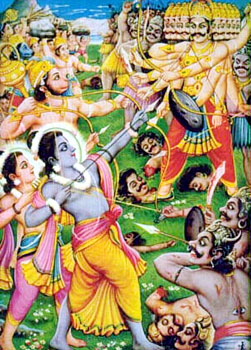
Mahodara, Ramayana
Mahodara was a prominent Rakshasa warrior, minister, and army chief who served under Rāvaṇa during the Battle of Lanka in the Ramayana. Celebrated for...
Related articles in Indian Puranas
Adhyayas in Agni Purana
Adhyayas in Agni Purana are all encompassing. The chapters have dealt with a variety of subjects related to human lives. A large number of chapters ha...
Indian Puranic Tribes
The existence of Indian Puranic tribes is often mixed with mythology and fiction that depict them as superhuman or sub.
Puranic Texts
Puranic Texts are vital according to Hindu, Jain or Buddhist religion; they describe the history of the Universe.

Puranic Shaivism
Puranic Shaivism established during the Gupta Dynasty. This puranic religion developed and expanded, and was accompanied by the development of Brahman...
Nilamata Purana
Nilamata Purana is a Kashmiri Purana that is referred by Kalhana. It is considered as one of the sources of ancient history of Kashmir.