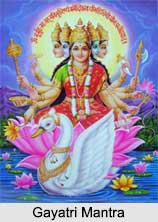
 Gayatri Mantra is a Vedic Hymn which promotes righteous wisdom. It means; may the Almighty illuminate the soul of beings and lead them to righteous path. This Mantra is the most-honoured mantra in Hinduism, based on a Vedic Sanskrit verse of the Rig Veda. It is the most important teaching, and all the problems one faces, can be solved if he possesses the righteous wisdom. Having the far sighted wisdom, a man is neither tangled in calamity nor does he adopt a wrong path. Righteous wisdom starts to issue as soon as Gayatri Mantra is recited.
Etymology of Gayatri Mantra
Gayatri is a Sanskrit word in which "Ga" means to sing and "Yatri" means protection. The first record of Gayatri Mantra is in Rig Veda, written in Sanskrit about 2500 to 3500 years ago and the mantra has been chanted for various generations till now.
Significance of Gayatri Mantra
Gayatri Mantra is the most majestic mantras in Hinduism and bears its reference in all the four Vedas. In the Atharva Veda it is little different from the actual Gayatri Mantra. It is attributed to the Vishwamitra. As the verses of this mantra invoke the Deva Savitr, it is also called the "Savitr Mantra". Goddess Gayatri is regarded as the Shakti or supreme power of Lord Brahma, Lord Vishnu, Lord Rama, Lord Shiva and Lord Krishna. The Gayatri Mantra is also considered to be a verse in Sanskrit language which is scientifically prepared, consisting of two lines with special information for invoking divine powers.
This Mantra is mentioned and repeated widely in Vedic literature, and it is praised in various well-known classical texts of Hinduism like the Bhagavad Gita, the Manusmriti and the Harivamsa. The Gayatri Mantra is also a prominent part of the Upanayana ceremony in Hinduism for young males, and it has been narrated by male Brahmins for long as daily rituals. The modern Hindu reform movements spread the practice of this Mantra by including both men and women belonging to all castes.
Composition of Gayatri Mantra
This Mantra is written in Sanskrit as follows;
"Aum bhoor bhuwah swaha, Tat savitur varenyam,
Bhargo devasaya dheemahi, Dhiyo yo naha prachodayat"
The Gayatri Mantra is having 24 syllables with 3 lines of 8 syllables each. "Aum Bhur Bhuvah Swah" is the first line which is an invocation, and it does not technically form a part of the Gayatri Mantra as it is in the Upanishad. Gayatri Mantra is also called a Vedic poetic meter of 24 syllables or any hymn wrote in this meter.
Four Divisions of Gayatri Mantra
The four divisions of Gayatri Mantra that address the Almighty who is regarded as the protector and is the basis of every living creature in the universe. The supreme God is known to be self-existent, free from any pain and whose contact makes one"s soul free from all troubles. He is also known to spread through the Universe and sustains all. He is the energizer and creator of the Universe, the supplier of happiness, worthy of acceptance, most excellent, pure and also cleans everyone from their sins. This Mantra addresses all to embrace that very God, so that he may guide everyone"s mental faculties in the right path.
Versions of Gayatri Mantra
There are a number of versions of the Gayatri Mantra in which various other deities are invoked apart from Savitr. A number of other Gayatri Mantras are there like a Vishnu Gayatri, a Shiva Gayatri, a Durga Gayatri, an Agni Gayatri, and so on. However, the mantras of the different Gayatri Mantras are similar, and likely derived from the form of the main Gayatri Mantra of the Rig Veda.