Introduction
The Samkhya Philosophy or the school of enumeration is also known as Sankhya, the Sanskrit meaning of which is enumeration. It is one of the 6 schools of Indian orthodox philosophy and is believed that sage Kapila was the original founder of this school of philosophy. The Samkhya Philosophy was one of the earliest Indian attempts towards a systematic philosophy. Samkhya has two schools of philosophy - the theist school and the atheist school of philosophy. Though presently there are no purely Samkhya schools existing in Hinduism, yet its influence is felt in Yoga and Vedanta schools.
Etymology of Samkhya Philosophy
The word Samkhya is composed of 2 words sain, which means "correct or proper" and khya means "all knowing". In the context of ancient Indian philosophies, Samkhya refers to the philosophical school in Hinduism based on systematic enumeration and rational examination.
In a broader linguistic sense, ‘Saṃkhya’ (also transliterated as sankhya) is a Sanskrit term that means “to reckon,” “count,” “enumerate,” “calculate,” “deliberate,” or “reason,” including the idea of reasoning through numerical enumeration or anything relating to number and rational analysis. Within the context of ancient Indian thought, however, Samkhya refers specifically to a philosophical school in Hinduism grounded in systematic enumeration and rational inquiry.
While the word ‘Samkhya’ could earlier denote metaphysical
or empirical knowledge in a general sense, its technical use came to signify
the formal Samkhya school, which developed into a cohesive philosophical system
in the early centuries CE. The system takes its name from its central method
where it “enumerates” twenty-five tattvas, or
fundamental principles of reality. These twenty-five tattvas include ‘Purusha,’
‘Prakriti,’ and twenty-three other components of Prakriti. The ultimate aim of
this enumeration is to achieve the final liberation of the twenty-fifth tattva,
which is Puruṣha or
the soul in its original form.
Founder of Samkhya Philosophy
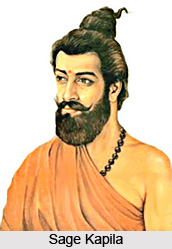
Sage Kapila Muni is traditionally regarded as the founder of
Sankhya philosophy. Described as a descendant of Manu, the primordial human,
and the grandson of the creator-God Brahma, Kapila is also honored as an avatar
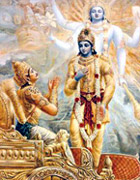
of Lord Vishnu. In the Bhagavad Gita, he appears as a recluse endowed with
profound yogic powers and mastery of the Siddhas.
Kapila’s teachings are closely linked with yoga, and many of the philosophical insights presented in the Gita are attributed to his Sankhya framework. Renowned for his rigorous adherence to yogic discipline, he is said to have generated such intense inner heat (tapas) that he reduced the 60,000 sons of the Vedic king Sagara to ashes. A revered philosopher and teacher, Kapila inspired a lineage of disciples who went on to establish the famed city of Kapilavastu, the birthplace of the Buddha.
Many traditional sources that consistently portray Kapila as
an ascetic sage and the originator of the Samkhya school also identify Asuri as
the first inheritor of Kapila’s teachings, followed by the later scholar
Pancasikha, who is credited with systematizing the doctrine and helping to
spread it widely. Centuries afterward, Isvarakrsṇa is recognized for further
refining Samkhya thought by summarizing and simplifying Pancasikha’s theories,
making them more accessible to subsequent generations.
History of Samkhya Philosophy
Samkhya philosophy's earliest concepts are rooted in texts from around 500-550 BCE, associated with the sage Kapila, although his original writings are lost. It is belived that Sage Kapila wrote two different treaties: ‘Samkhya Pravachana Sutra’ and ‘Tattwa Samasa Pravachana Sutra,’ neither of which exists today. The ‘Samkhya Pravachana Sutra’ was the first treatise in which Kapila expounded the basic concepts of the Samkhya System. In the ‘Tattwa Samasa Pravachana Sutra,’ he expanded on the theories, concerning the tattwas, or the elements and explained that creation is the result of permutation and combination of these elements.
A third generation of disciple, named Ishvara
Krishna, wrote the Samkhya Karika, which describes the entire philosophy of
Samkhya as taught by Kapila. Then after different commentaries have been
written. Gaudapada, the grand-guru of Adi
Sankaracharya, wrote a commentary called Gaudapada Karika.
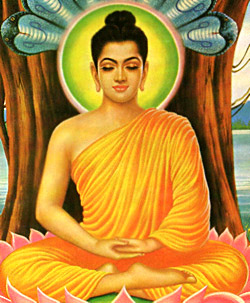
Buddha had studied Samkhya with Rishi Alar Kalam and hence, Samlhya become the
base of Buddhist
philosophy. It is also the basis for Jainism
– Mahavira’s
philosophy, also for the philosophy of Sri Krishna
in Bhagawat Gita, and for Patanjali’s
Yoga Sutra.
Objective of Samkhya Philosophy
The objective of Samkhya is to show how the creation has
evolved and how the final emancipation of the soul is to be achieved. An
attempt is made to set forth the cause of this universal bondage. According to
the Samkhya system, souls are innumerable, immaterial, unmixed, all-pervading
and inactive. The Samkhya philosophy does not recognize God’s existence. The
Sankhya system discriminates between a subtle body and a gross body. The
Sankhya system is called by the name of Mrishwar or godless.
Epistemology of Samkhya Philosophy
Samkhya’s epistemology recognizes three of the six traditional pramaṇas, namely ‘pratyakṣa’ (perception), ‘anumaṇa’ (inference), and ‘sabda’ (aptavacana, the testimony of reliable sources), as the only valid means of acquiring knowledge, a stance shared with the Yoga school. Often described as one of the rationalist traditions of Indian philosophy, Samkhya relies exclusively on reason and does not accept upamaṇa (comparison or analogy), arthapatti (postulation), or anupalabdhi (non-perception) as proper epistemic tools.
Pratyakṣa: Pratyakṣa, or perception, is one of Samkhya’s valid means of knowledge. Hindu texts describe two kinds of perception. One is external, which arises through the five senses interacting with objects, and the other is internal, which involves the mind as an inner organ of perception. Ancient and medieval sources outline four conditions for valid perception, namely ‘indriyarthasannikarṣa’ (direct contact between the senses and the object), ‘avyapadesya’ (non-verbal, meaning it cannot be based on hearsay), ‘avyabhicara’ (non-deviating, free from illusion or sensory error), and ‘vyavasayatmaka’ (definite, free from doubt and not mixed with inference or personal bias).
Anumana: Anumana, or inference, refers to deriving new conclusions from observations and established truths through the application of reason. Accepted as a valid means of knowledge in nearly all Hindu philosophical systems, it operates through a three-part structure described in classical Indian texts as pratijna (the hypothesis), hetu (the supporting reason), and dṛṣṭanta (the illustrative example).
Sabda: Sabda refers to knowledge gained through
words, specifically the testimony of reliable past or present authorities.
Schools that accept this as a valid pramaṇa argue that human beings cannot
directly learn more than a small portion of the vast truths needed for life.
This is because time and ability are limited, individuals must rely on
trustworthy sources to acquire knowledge efficiently and cooperatively, enriching
collective understanding. This knowledge is conveyed through spoken or written
words, and its validity depends entirely on the reliability of the source.
Ultimately, legitimate knowledge through sabda is believed to come from the
authoritative words of the Vedas.
Dvaita Vada Or Dualism in Samkhya System
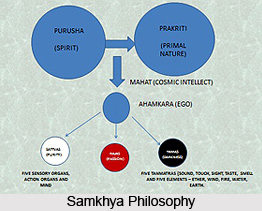
Samkhya philosophy regards the universe as consisting of two eternal realities: Purusha and Prakriti. Purusha is the pure consciousness which has knowledge but does not have capacity to act. Prakriti is the source of all material existence. The Samkhya system is based on dualism wherein nature and conscious spirit are separate entities, not derived from one another. Samkhya is essentially atheistic because it believes that the existence of God cannot be proved. Generally, the Samkhya system classifies all objects as falling under one of the two categories: Purusha and Prakriti. Metaphysically, Samkhya maintains a revolutionary duality between spirit and matter.
Purusha
Purusha is pure consciousness. It is eternal, permanent and unchangeable
and cannot be perceived by the senses. Purusha is Chaitanya, which means
self-awareness, that which is intrinsically aware, luminous and enlightened. It
is beyond pain and pleasure. Purusha is desireless, it has no desire aspect.
Therefore, the law of cause and effect do not bind Purusha.
Prakriti:
Prakṛti refers to matter or nature. It is active yet
unconscious, composed of a dynamic balance of the three guṇas—sattva,
rajas, and tamas. When Prakṛti comes into contact with Puruṣha, this
equilibrium is disrupted, setting the process of manifestation into motion and
giving rise to twenty-three tattvas. These include:
·
Intellect (buddhi or mahat)
·
Five gross elements (Mahabhutas)
- earth, water, fire, air, and space, which arise from the subtle elements
·
Five subtle elements (tanmatras) – sound, touch,
seeing / form, taste, smell
·
The sense of individuality (ahaṃkara)
·
Mind (manas)
·
Five sensory capacities (Jnanendriyas) -
hearing, touch, sight, taste, and smell
· Five action capacities (Karmendriyas) - hands (hasta), feet (pada), speech (vak), anus (guda), and genitals (upastha)
Together, these tattvas form the basis for all sensory experience, perception, and cognition.
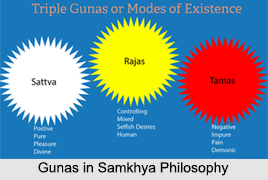
Three Gunas in Prakriti
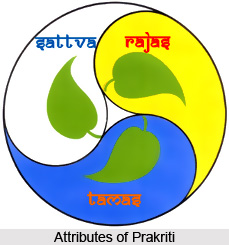
In Samkhya philosophy, guṇa refers to one of three inherent qualities or tendencies - sattva, rajas, and tamas. These guṇas form a foundational framework that many schools of Hinduism use to classify human behavior as well as natural phenomena. The three gunas of Prakriti are:
Sattva: Sattva represents the guṇa of balance, harmony, goodness, purity, universality, holism, creativity, positivity, peace, and virtue. It naturally gravitates toward dharma and jnana (knowledge). A person or action aligned with this quality is described as sattvik.
Rajas: Rajas is the guṇa associated with passion, activity, movement, and dynamism. It is neither inherently good nor bad, but can manifest as self-centeredness, ego, and strong individual drive. Rajas embodies the innate force behind motion, energy, and action, and is often translated as “passion” in the sense of active engagement. It plays a crucial role in actualizing and energizing the other two guṇas.
Tamas: Tamas is the guṇa associated with inaction and
ignorance. It is opposite of sattva and rajas. It manifests through dullness,
inactivity, apathy, lethargy, and sometimes through violence. Among the three
guṇas, it is generally regarded as the lowest or most limiting quality.
In prakriti, these gunas are exactly at 1/3 rd level. There is perfect balance or equilibrium of three guna in prakriti as a whole.

Theory of Causation in Samkhya Philosophy
The Samkhya Theory of Causation is known as Satkaryavada.
According to which, the effect exists in its cause prior to its production. An
effect pre-exists or resides in its cause in a potential state prior to process
of manifestation. Actualization of specific effect requires a specific cause.
For e.g. to produce yoghurt, you require milk. It cannot be made from water.
This specific cause is called Shakti Karana. Further, there must be a catalyst
or an instrument to bring out the effect from the cause. This catalyst is
called Nimitta Karana. In the example of Yoghurt, we also require curd starter
and warm temperature. These curd starter and warm temperature is called Nimitta
Karana whereas Milk is called Shakti Karana. A substance in unmanifested form
is cause where as in the manifested form is effect.
The doctrine of pre-existent effect in the cause is the important part of
Samkhya. It explains that all effects are pre-existent in the cause and the
effect is the manifest cause. Nothing new is ever produced as something cannot
come out of nothing.
Theory of Manifestation
When purusha and prakriti are separate, there is no manifestation or movement. When purusha comes in contact with prakriti, manifestation process starts. It is similar to iron and magnet. Till the time, iron and magnet are separate, there is no movement in iron. But when magnet is brought near to iron, movement in iron starts. Prakriti is in perfect balance or equilibrium state of three gunas. When it comes in contact with purusa, this equal balance gets disturbed which leads to new permutation and combination of three gunas i.e. new creations.
The proximity of purusha to prakriti infuses prakriti with a
reflection of consciousness which is used to start the process of activity. The
conscious factor of Purusha becomes the catalyst to create the first evolute of
Prakriti i.e. Mahat, where the permutations and combinations of the gunas take
place. All gunas exist in Mahat. When sattva is predominant the qualities of
knowledge, wisdom, virtue, non=attachment and excellence manifests. When tamas
predominates, the qualities of mahat are ignorance, vice, imperfection,
attachment and impotence. Rajas vitalizes the process.
Mahat or buddhi is responsible for emergence of ego. The first self-awareness
develops in buddhi and as a sense of identity, ahamkara, the ego principle
arises. Different permutation and combination of gunas give rise to different
units / ahamkaras. That is why two individuals or elements of nature are never
exactly same. When ahamkaras are sattwic, it gives rise to knowledge, wisdom,
excellence etc., but it is opposite when ahmkaras are tamasic.
With the jnanendriyas, humans derive understanding through seeing, hearing, smelling, tasting and touching. This understanding gets stored in unconscious mind / ego in the form of impression or sanskaras. Based on this accumulated samskaras and impressions, buddhi decide about the reaction to any situation. This reaction gets executed by manas through karmendriyas. Which gets transform into tanmatras and mahabhutas.
Thus, the permutation and combination of three gunas (sattva, rajas and tamas) get changed every moment internally as well as externally. This gives rise to different experiences and forms.
Manifestation of elements: Tamasic ahamkaras are responsible for the manifestation of elements. These elements are either gross or subtle. The gross elements are mahabhutas and subtle elements are known as tanmataras.
From the tanmatra of sound comes the mahabhuta of space. From tanmatara of sound and touch, the mahabhuta of air emerges. From tanmatra of sound, space and form, the mahabhuta of fire emerges. From tanmatra of sound, touch, form and taste, the mahabhuta of water emerges. From tanmatra of sound, touch, form, taste and smell, mahabhuta of earth emerges. It is important to note that three gunas exists in all tanmatras but in different proportion.
Bondages / Bandha
Whenever three gunas are active, there is a disharmony. And dealing with the disharmony causes struggle or pain. The pain can steam from material causes, personal causes or cosmic or divine influences.
We interact with pain and pleasure as the samskara or
impressions stored in our ahamkara / ego. Then we end up either getting
attached to it (if it is a pleasure) or getting detached to it (if it is pain),
This gives rise to raga or dvesha. Thus, we further get entangled in karma.
The association of Purusha with Prakriti causes bondage through false identification. It is like reacting to dream. In a dream that somebody is chasing you with stick to hit you, you experience fear and anxiety. But when you wake up, you realize that it was just a dream and your anxiety is vanished.
This bondage can be understood with another example. When we
are sitting alone in the room and introspect, then we are absorbed in the
thoughts. We are focused on our thoughts. But when somebody comes in the room
and start communicating with us, we get involved in that. At this point our
mind and jnanedriyas get attached to that communication. Thus, with every activity,
these bondages get strong and these samakaras forms our sense / ahamkara. In
this way, Purusha becomes totally identified with buddhi and ahamkaras. Thus,
all subsequent actions are performed with that attachment and hence, the person
is not able to see the things as it is.
Kaivalya / Liberation
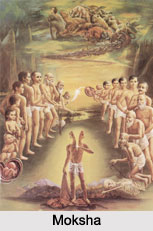
At the time of reversal or dissolution, all the five
mahabhootas, five tanmatras, the five karmendriyas, five jnanendriyas and manas
merge back into ahamkara. Then ahamkara merges back into mahat and mahat merges
back into Prakriti. Kaivalya or separation of Purusha from Prakriti then takes
place. This is achieved by complete concentration / samadhi. At this point, one
achieves many siddhis. He gets the knowledge of past, present and future.
Samkya explains that repeated contemplation and practices are necessary to
attain higher knowledge. And then Purusha re-establish itself in the original
state of pure consciousness.
It is important to note that even after kaivalya, one continues to live on. The karma accumulated from the past have to be discharged, so that the body lives. After kaivalya, when one continuous contemplation, then his subsequent actions are performed in detached way which does not generate any bondage or re-action. However, past balance karmas / samskaras has to be discharges and that is way body continues. The moment past karmas are exhausted, the Purusha is separate from Prakriti and rests in its original state of pure consciousness.
This accumulation of samakaras and its deletion can be explained with the example of black board. If black board is full of writings on different subject, we do not get clarity about any single subject. Our mind is full of different thoughts / impression / samskaras. When we become introvert and practice meditation, new writing is stopped. And gradually, we wipe out old samskaras one by one. As the whole writing on the board cannot be wiped out with single wipe, the samskaras cannot be removed in one birth. With each wipe we erase some content on the board, same way when we maintain detached state, in each life we remove old karmas / samskaras. If this state of detachment with contemplation is continuous, all old samskaras are removed, as with multiple wipes, at the end, the entire board becomes clear. At this time, the purusha rests in its original state.
This knowledge or doctrine was founded by sage Kapila who
gave it to Asuri. Asuri gave it to Panchashikha and through him it was
propounded extensively.
Influences of Samkhya Philosophy
Samkhya philosophy has also influenced many ancient theories of soul in Vedic as well as non-Vedic texts. The mention of the ideas, developed under Samkhya philosophy, has been found in the early Hindu scriptures like Bhagavad Gita, Upanishads and Vedas. The Indra-Vritra myth of Rig Veda, compiled in second millennium BCE, also has the mention of dualism. The hymns of Purusha sukta and the emphasis of duality in the Nasadiya sukta of Rig Veda have been influenced by this philosophy. Hymns of the Atharvaveda also mention the concept of Purusha.
Major Upanishads written in 900-600 BCE has speculations
similar to the classical Samkhya philosophy. The concept of ahamkara
has been illuminated in Chandogya Upanishad and Brhadaranyaka Upanishad. The idea of
pure consciousness was developed by Upanishadic sages, Yajnavalkya
and Uddalaka Aruni. Samkhya has enumeration of tattvas which can be traced in Taittiriya Upanishad, Brihadaranyaka
Upanishad and Aitareya Upanishad. Samkhya philosophy
has also influenced Buddhist and Jain concepts.
Influence on Buddhism and Jainism
Jainism underwent major reorganization in the 9th century BCE, and Buddhism emerged in eastern India by the 5th century BCE. It is likely that these traditions, together with the earliest forms of Samkhya, interacted and influenced one another. One notable parallel between Buddhism and Samkhya is their shared emphasis on suffering (dukkha) as a core concern in developing their soteriological frameworks, a focus far more pronounced than in many other Indian philosophical systems. In fact, the centrality of suffering in later Samkhya texts suggests that this emphasis may have been shaped, at least in part, by Buddhist thought.
Similarly, the Jain doctrine of the plurality of individual souls (jiva) may have informed Samkhya’s conception of multiple puruṣhas. Yet, it is unlikely that the Samkhya idea of numerous puruṣhas depended solely on the Jain notion of jiva. Instead, Samkhya was more plausibly shaped by a wider range of ancient theories about the soul found across both Vedic and non-Vedic traditions.
The 12th chapter of the Buddhacharita, a Buddhist text composed in the early second century CE, indicates that the Samkhya school had already developed its philosophical methods of reliable reasoning by around the 5th century BCE. This suggests that key elements of Samkhya’s analytical approach were firmly established long before the text was written.
Influence on Upanishad
The Katha Upanishad (5th–1st century BCE) presents an early conception of Puruṣha along with several ideas that later became central to Samkhya philosophy. The Shvetashvatara Upanishad also references Samkhya, pairing it with Yoga to explore metaphysical and spiritual themes. In the Katha Upanishad, Puruṣha, the cosmic spirit or pure consciousness, is envisioned as identical to the individual soul (Atman, the Self), reflecting an early articulation of ideas that later evolve within the Samkhya system.
Influence on Bhagavad Gita and Mahabharata
The Bhagavad Gita associates Samkhya with the pursuit of understanding or true knowledge. While it also discusses the three guṇas, it does not employ them in the same technical sense later found in classical Samkhya. Instead, the Gita weaves Samkhya principles into a broader synthesis that includes the devotional (bhakti) orientation of theistic traditions and the notion of the impersonal Brahman central to Vedanta.
The Mokshadharma section of the Shanti Parva in the Mahabharata, composed between 400 BCE and 400 CE, further elaborates Samkhya concepts alongside other philosophical viewpoints. This chapter also honors a range of thinkers for their contributions to Indian philosophical thought, and among them are at least three figures associated with early Samkhya- Kapila, Asuri, and Pancasikha.
Samkhya may have begun with both theistic and non-theistic
interpretations, but by the time its classical form was systematized in the
early first millennium CE, the question of a deity had become largely
irrelevant to its framework. Closely linked to the Yoga school of Hinduism,
Samkhya provides the theoretical foundation upon which Yoga philosophy is
built, and its ideas have significantly influenced several other Indian
philosophical traditions.