The first chapter describes the creation of the universe by God or the Almighty. It deals with the creation of the creation of the worlds, of the soul of the mundane egg. The god is its different parts. The man is the microcosm of the universe, and food is for the preservation of the world. Here The Aitareya Upanishad depicts the
Atman or inner self as the divine creator. The individual soul penetrates the man, where it abides in three places or states, viz., the states of awaking, dream and sound sleep. Reflecting, however, on the universe and its relation to it, the individual soul finds no other reality but the supreme spirit. It is the same with itself i.e. the individual soul.
First Section of Aitareya Upanishad : The first section of the first chapter of Aitareya Upanishad begins with a salutation to the Almighty. It states that the `self` was the only existent object in the beginning and nothing else was active. It then thought of creating the world. He made the worlds, viz, the sphere of water, the sphere of the sunbeams, the sphere of death, and the sphere of the waters. The sphere of water lies above the heaven that supports it. The light rays are the space or atmosphere, the earth the world of death and that lying below id also water. The water is thus expression of life, awareness and consciousness. The light is the expression of divinity. Death is common for earthly life. The objects that are below may either refer to elements like fire, water or may also reflect the nether worlds lying below the earth that is also made of water.
The self thought now that he has created the world he needs to create its protectors. He thus created the
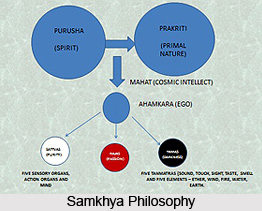
Purusha out of the waters and gave him a human form he meditated upon him. When he was heated the mouth like the egg burst out. From the mouth speech came out, and from speech fire or Agni, the presiding deity of speech. The nostrils next burst out. From the nostrils breath and from breath air or Vayn, the presiding deity of breath. The eyes too burst out and from eyes sight and next the sun or
Aditya, the presiding deity of the eye. The ears burst out and from the ears hearing, and from hearing the eight directions of space. The skin was next separated, from the skins the hairs were created and from hair the plants and trees. The heart also burst out, from the heart the mind and from the mind the moon. The naval was separated, from the navel the vital air which goes downwards, and from this death. The reproductive organs were also separated and from it the generation seeds and then the seed waters.
Second Section of Aitareya Upanishad : When the creation was over, all the divinities so created fell into the ocean of life. The Self then subjugated them to hunger and thirst. The verse here explains about the evolution of man. According to the verse the God first created a cow and put all the sense organs into it but divinities were unhappy with it. He then created the horse but they were again unsatisfied with it. Finally God created the human form that was the most appropriate creation that helped in the accurate functioning of all the divinities.
The divinities like the fire, wind, sun, directions of space, herbs, moon and the water entered the body and established themselves as different personalities like speech, breath, sight, hearing, hairs, mind and then heart and the semen. Hunger and thirst that stand for desires were also created for the functioning of the organs. Man being divine achieved an important status among the creation of God. He thus contains all the divinities of the nature and thus enjoys a better position among all. He is the Purusha who has the capability to perfectly perform all duties and is capable of transcending greater heights.
Third Section of Aitareya Upanishad : The Self now thought of creating food for the worlds. Food here does not mean the common things that one eats. It here states the desire for enjoyment of life and of sense objects. All these sense objects form a part of the food. The material things on which human beings depend for his survival can be considered as food. Life is also a form of energy that is sustained in the body through breathing.
The form so created wished to run away hence the being tried to capture it with speech, breath, sight, hearing, skin and mind but to catch it. He then tried to capture it without breath and soon seized it. Thus, one who lives on food is verily of the nature of air. Food is the desire for enjoyment. These desires do not satiated through the functioning of the sense organs as they only increase the desire further. The outgoing breath refereed to as death put an end to these desires. The food created by God thus can be seized only by out going breath. The being that resides in the body can be referred to as the nature of air. Here the soul is related to air as air moves freely, is invisible and has no form.
The sense objects and the organs become useless until there is any enjoyment inside the body. The body requires a sense of purpose to function together. The purpose thus helps in controlling them.
The verse in this section states about the location of the
Sahasrara Chakra. It is the highest chakra or the divine centre in the body. This chakra being located at the tip of the head remains connected to the higher divinities and other energies.
Lord Indra has been regarded as the lord of sense organs within the man. The man also is the lord of his senses as he enjoys it. The section thus describes him as Idandra.
Chapter one thus reflects on the soul as the divine creator that created the human form.

 The Aitareya Upanishad is one of the older and ancient Upanishadas annotated by Shankara. It is a main or `Mukhya` Upanishad affiliated with Rigveda. The Aitareya Upanishad is a short prose containing three chapters and thirty-three verses in total. The second book is Aitareya Aranyaka, that is an older Vedic text and comprises three chapters the fourth, fifth and sixth chapters.
 The second chapter of Aitareya Upanishad gives a detailed description of the three births of man. It relates about the need of liberating one`s self from all desires to obtain the true knowledge.
 The Third chapter explains the nature of true knowledge and of the soul. The soul is not the instruments of perception (as the eye, ear), it is not the mind; it is completely knowledge. The several acts of knowledge are modifications, to be comprehended by knowledge alone. The soul, as knowledge, is the foundation of the whole world; it is Lord Brahma the creator, it is the creation, the gods, the elements and all the beings that are produced from them.