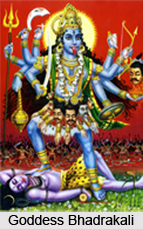
 Bhadrakali is considered as the most auspicious form of Goddess Kali. Bhadra word in Sanskrit means blessed, auspicious, air, beautiful, fortunate and prosperous. Bhadrakali is the popular form of devi worshiped in Kerala. Bhadrakali is considered as the consort of Lord Shiva in the form of Rudra. There is also a legend that she is the consort of Virabhadra, who was born of the wrath of Rudra.
Bhadrakali`s origin is attributed to Devi`s wrath according to Vayu Purana and the Mahabharata. Devi was enraged when Daksha insulted Shiva, during the great Ashvamedha Yagna. According to Tantra Rahasya, she arose from the North face of Shiva, which is blue in colour and has three eyes.
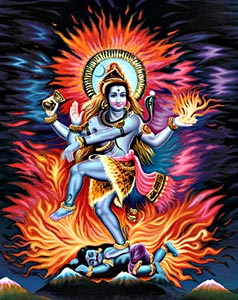
Bhadrakali is considered as a local deity that was assimilated into the mainstream Hinduism, particularly into mythology of Shiva. She is represented with three eyes and four, twelve or eighteen hands that carries several weapons, with flames flowing from her head and a tusk that protrudes from her mouth.
Nair and Kodavas communities worship this deity. Certain weapons are also worshipped at their temples which they believe to be the weapons used by the goddess Bhadrakali. She is also the tutelary deity of the Nadar caste of Tamil Nadu.
Atharvana Bhadrakali is also known as Prathyangira Devi who is popular in Tamil Nadu. Her origin is also attributed to the Puranas. It is believed that she can ward off the effects of black magic.
Kerala has a tradition of rituals that are associated with worship of Devi in the form of Bhadrakali. These are performed in small temples. Themes centre on the triumph of Bhadrakali over the demon Daruka and other evil characters. The dance types are: Theyyam, Thiyyattu, Patayani, Poothanumthirayum, Mudiyettu and Kuthiyottam
Famous Bhadrakali Temples
* Ancient Bhadrakali Temple in Hanamakonda, Andhra Pradesh.
* Thirumandhamkunnu temple at Angadippuram, Kerala
* Kodungallur Bhagawati Temple at Kodungallur, Kerala
* Bhadrakali Temple in Kathmandu, Nepal
* Chettikulangara Devi Temple, near Mavelikkara, Kerala
* Panayannarkavu, near Mavelikkara, Kerala
* Kadinamkulam Padickavilakom Bharanicadu Sree Bhagavathi Temple in Kerala
* Pattupurakkavu Bhagavathi temple, Pandalam
* Bhadrakali temple, Bajna, Malwa
* Bhadrakali Temple at Bhadran, Gujarat.
* Bhadrakali Temple in Gokarna. This deity is said to be the protector of Gokarna.
* Bhadrakali Temple in Kurukshetra, Haryana
* Bhadrakali Temple in Bhadrak, is one of the oldest shakti shrine of Orissa. The name of this ancient town derived from the name of goddess Bhadrakali.
* Bhagwati Bhadrakali Shaktipeeth Ashram, Rajaldesar, Churu, Rajasthan.
* Bhadrakali Temple at Itkhori, Jharkhand
* Bhadrakali Temple in Hanumangarh , Rajasthan
* Shree Devi Bhadrakali Temple in Revandi north of Malvan, Sindhudurg district, Maharashtra.