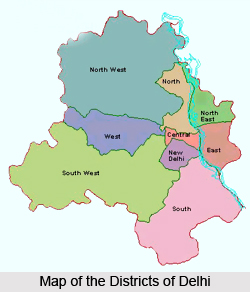
 Districts of Delhi are categorized broadly into 11 types. These districts are headed by a District Magistrate. Districts of Delhi include New Delhi District, North Delhi District, North West Delhi District, West Delhi District, South West Delhi District, South Delhi District, South East Delhi District, Central Delhi District, North East Delhi District, Shahdara District and East Delhi District. The present system of administration in Delhi can be traced back to 1803, when Delhi came under the rule of British East India Company and later the British Empire in India.
Administration of Delhi
Delhi had a Deputy Commissioner who was the Chief District Officer, having revenue and registration powers. He was also the head of urban administration, being President of the District Board and the Municipality. Till Independence of India in 1947, Delhi had a Chief Commissioner as the administrative and executive head, with the Deputy Commissioner reporting to him. He had three Assistant Commissioners to share responsibilities such as case work of revenue and criminal appeals, municipal and minor criminal cases, and administration of the Municipality.
There are two major changes which greatly diluted the role of Deputy Commissioner`s Office. The first was the separation of the executive and the judiciary in 1969, after which crimes were dealt with by Sessions Courts and other offences including IPC offences were dealt with by Judicial Magistrates. The Executive Magistrates were to look after executive and administrative matters.
In the year 1978, Delhi Police Act was promulgated, by which Delhi came under the Commissioner of Police System. This was the situation in 1996 when the exercise of decentralizing the Deputy Commissioner`s office by setting up 27 Sub Divisional Magistrate offices and nine Deputy Commissioner`s offices were started. While the Sub Divisional Magistrates were put in place in mid-1996, the Deputy Commissioners began functioning from 1st of January, 1997.
Central Delhi District
Central Delhi District is spread over an area of 25 sq kilometers. Connaught Place, a thriving commercial centre lies in Central Delhi District. Delhi Fort and the Jama Masjid are the popular tourism attractions in Central Delhi District.
East Delhi District
East Delhi District is situated on the banks of Yamuna River. This district is a densely populated area in Delhi. It has some of the busiest commercial areas in Delhi like Vikas Marg, Gandhinagar and Lakshminagar. Gautam Buddha Nagar District, Ghaziabad District (Uttar Pradesh) and Shahdara are connected with East Delhi. Akshardham Temple, Sanjay Lake, Gandhi Nagar Market, Laxmi Nagar Market and Yamuna Sports Complex are the popular attractions of East Delhi District.
New Delhi District
New Delhi District covers on the eastern side of the Yamuna River. The special attractions of New Delhi District include the Rashtrapati Bhavan, the one-time imperial residence of the British Viceroys and the India Gate. 
North Delhi District
North Delhi is surrounded by Yamuna River on the east and by the districts of North West Delhi to the north and western part, West Delhi to the southwest, Central Delhi to the south, and North East Delhi to the east across the Yamuna River. Gurgaon of Haryana is easily accessible in this region.
North West Delhi District
North East Delhi District is largely rural and sub urban area. It is dominated with the model township projects of residential parts. It spread over an area of 60 sq. kilometres. North East Delhi District is surrounded by Yumana River on the north eastern part, North Delhi District to the east, West Delhi to the south, Jhajjar District of Haryana to the west, Sonipat District of Haryana to the North West, Baghpat District and Ghaziabad District of Uttar Pradesh to the north east across the Yumana River.
North East Delhi District
North East Delhi has the rural and urban areas like Babar Pur, Sonia Vihar, Karawal Nagar, Mustafabad, Sadat Pur Gujran, Ziauddin Pur, Dilshad Garden, Jaffrabad, Mir Pur Turk and Sadat Pur Gujran.
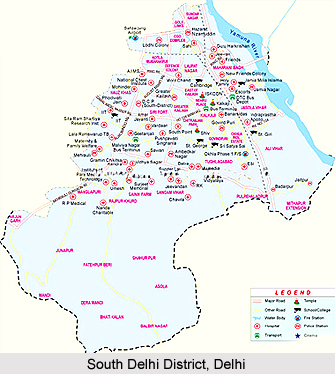
South Delhi District
South Delhi District is an idyllic tourist destination. The major tourist attractions include Qutub Minar, Balban`s tomb, Humayun`s Tomb. It is also dotted with a number of temples, which are Kalkaji Temple, Lotus Temple, Chattarpur Mandir and Shri Sai Baba Temple.
South West Delhi District
South West Delhi District is spread over an area of 420 sq km and has a distinguished historical background. Dwarka Sub City, Najafgarh (popular for Najafgarh Lake) and Kapas Hera are the three sub divisions of South West Delhi District. Delhi Cantonment of South West Delhi District is connected with the railways and roadways.
South East Delhi District
South East Delhi District is a revenue district of Delhi, the National Capital Territory of India. The Defense Colony, Kalkaji and Sarita Vihar are part of South East Delhi District.
West Delhi District
West Delhi District covers an area of 129 sq. km with a population density of nearly 14,000 persons per square km. Patel Nagar, Rajouri Garden, and Punjabi Bagh are the three sub divisions of West Delhi District. Rajouri Garden, Patel Nagar, Kirti Nagar, Meera Bagh, Bali Nagar and Vikaspuri are the popular tourism destinations.
Shahdara District
Shahdara District is a part of geographical region of Shahdara. Shahdara District is one of the oldest localities of Delhi. It was an integral part of Purana Dilli or Old Delhi. Shalimar Park, Vishawas Nagar, Subhash Park, Subhash Park Extension, Panchsheel Garden, Mohan Park, Jyoti Colony, Indira Niketan, Shivaji Park, Nathu Colony, Mansarovar Park and Babarpur are the popular attractions in Shahdara District.
Tourism in Districts of Delhi
Delhi is the national capital city of India and the districts are well- known for its excellent tourist spots, recreational facilities and rich cultural tradition. It is situated on the banks of the Yamuna River and covers an area of 1,485 sq km. The National Capital of India is also the centre of trade, commerce and industry and the centre of Indian politics. Offices of central governments are also located here. Its rich cultural and historic tradition is manifested in the numerous historical monuments that are scattered throughout this Union territory of India. Prominent among them are the Red Fort, Qutub Minar, Purana Quila, Tughlaqabad Fort, Tomb of Humayun, Firoz Shah Kotla Stadium, India Gate, Lodi Garden, Jama Masjid, Rajghat, Jantar Mantar and Safdarjung`s Tomb.