
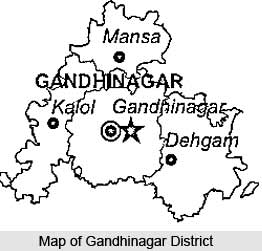
 Gandhinagar district is the administrative capital of Gujarat. The total area of the district is 2,163.48 sq. km. As per 2001 census, the population of this district is 13, 34,731 with a population density of 617 Persons per sq. km. The district headquarters is at Gandhinagar. The district has four talukas, viz. Gandhinagar, Kalol, Dehgam and Mansa. Gandhinagar is divided into 30 sectors formed by roads laid in a rectangular grid with each sector having its own shopping, health, housing colonies and community centers.
Gandhinagar District
Gandhinagar District, the administrative capital of the state of Gujarat was carved out of Ahmedabad district in late 1960s.
Introduction
Gandhinagar district is the administrative capital of Gujarat. The total area of the district is 2,163.48 sq. km. As per 2001 census, the population of this district is 13, 34,731 with a population density of 617 Persons per sq. km. The district headquarters is at Gandhinagar. The district has four talukas, viz. Gandhinagar, Kalol, Dehgam and Mansa. Gandhinagar is divided into 30 sectors formed by roads laid in a rectangular grid with each sector having its own shopping, health, housing colonies and community centers.Geography of Gandhinagar District
Geographical location of Gandhinagar District is 23.0 degree to 23.6 degree North (Latitude) and 72.3 degree to 73.7 degree East (Longitude). The maximum temperature of this district is 45 degree centigrade and the minimum temperature is 7.5 degree Centigrade. Sabarmati, Khari, Vatrak and Meshvo are the major rivers of this place. Average rainfall of Gandhinagar district is 667 mm.
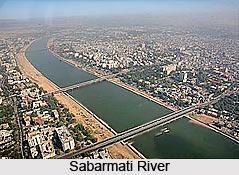
Location of Gandhinagar : Gandhinagar is situated on the west bank of the Sabarmati River and is the district headquarters of the Gandhinagar district of Gujarat. Gandhinagar is located between 23.22 degree North latitude and 72.68 degree East longitude at a height of 81 metres (265 feet) above mean sea level.
Location of Gandhinagar : Gandhinagar is situated on the west bank of the Sabarmati River and is the district headquarters of the Gandhinagar district of Gujarat. Gandhinagar is located between 23.22 degree North latitude and 72.68 degree East longitude at a height of 81 metres (265 feet) above mean sea level.
Education in Gandhinagar District
Gandhinagar district houses some prestigious research and educational institutes such as the Institute for Plasma Research, Indian Institute for Advanced Research and National Institute of Fashion Technology (NIFT). The Institute for Plasma Research in Gandhinagar is an autonomous plasma physics research centre that focuses on research in various aspects of plasma science for industrial applications. The establishment and development of National Institute of Pharmaceutical Education and Research (NIPER) in 60 acres of land in Gandhinagar is in progress. Other premier institutes in Gandhinagar include Dhirubai Ambani Institute of Information & Technology, Entrepreneurship Development Institute of India (EDI), National Law University, Dental College, Santej and Karnavati School of Dentistry.
Climate of Gandhinagar
Gandhinagar has a dry climate and during the summer months temperature varies from 36 degree Celsius to 42 degree Celsius. The southwest monsoon winds bring a humid climate from mid June to mid September. The Sabarmati river dries up during the summer season and leaves a thin track.
Demography of Gandhinagar
 According to the Population Census in the year 2001, Gandhinagar had a population of 195,891 inhabitants. The males constitute 53 percent of the population and females constitute 47 percent of the population. In Gandhinagar, 11 percent of the population is less than six years of age. The city has an average literacy rate of 78 percent which is much higher than the national average literacy rate of 59.5 percent. The male literacy rate is 82 percent and the female literacy rate is 73 percent.
Culture of Gandhinagar
Major festivals in Gandhinagar celebrated are Uttarayan, an annual kite-flying day on 14th and 15th January, Navratri Festival, which is celebrated with people performing Garba Dance, the most popular folk dance of Gujarat, at venues across the city. Diwali and Gujarati New year are celebrated. Diwali is celebrated with the lighting of lamps in every house, decorating the floors with rangoli, and the lighting of firecrackers. Holi is a festival of colours celebrated here. The folk dances of Gujarat like Garba Dance of Gujarat, Raas Dance, and Dandiya Dance have been successful in breaking the confinements of locality, and the festival of Navratri brings together the whole of India. Special dancing competitions and lavish feasts are organised during the holy festival of Navratri.
Akshardham Temple in Gandhinagar
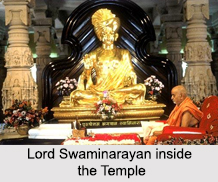
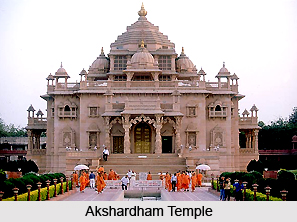
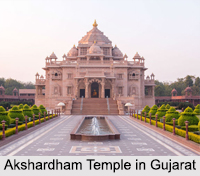 Akshardham Temple is an inimitable cultural complex built in the honour of Lord Swaminarayan. Inspired by H.D. Pramukh Swami Maharaj, and his organisation Bochasanwasi Akshar-Purushottam Swaminarayan Sanstha (BAPS) of India, Akshardham is the successful end product of unquestionable service and devotion of thousands of volunteers. The entire monument was built without the use of steel. Besides a 7 feet gold leafed idol of Lord Swaminarayan and his holy ruins, there are three exhibitions on Indian culture with light and sound shows. Akshardham Swaminarayan Temple opened its doors to visitors on 2nd November 1992. The inaugural ceremony coincided with the centenary celebrations of Yogiji Maharaj and was conducted by Pramukh Swami Maharaj himself.
Structure of Akshardham Temple : Six thousand tons of pink sandstone, used in the construction of the temple, did not go unnoticed; it stands tall at a height of 108 feet and is 240 feet long, 131 feet in breadth. The porch around the monument measures 1751 feet in length alone. The garden surrounding the sanctum sanctorum is known as Sahajanand Van and represents a unique intermingling of reflective garden and children`s park. A marble statue of Lord Swaminarayan is placed in the garden premises also.
Akshardham Centre for Applied Research in Social Harmony : The Akshardham temple complex has its own research centre, Akshardham Centre for Applied Research in Social Harmony (AARSH). The research facility has an extensive library, study stations and archives. However, it is only open to enlisted scholars who receive the benefits. The first floor of the temple has a museum, with a gallery of over 500 `parahansas`. The other items displayed are, the letter to Swaminarayan`s guru, Ramanand, an art object from an old tree from Chapaya, Swaminarayan`s used shawl and an image of the Lord seated on a horse. The exterior galleries serve as the venue for artistic exhibition and offer Chez Integrovision shows, audio-visuals, multi-media and the works of Lord Swaminarayan from the Hindu epics.
Exhibition Halls in Akshardham Temple : There are three permanent exhibition halls inside the complex, set up with the aim of educating masses on spiritual matters and BAPS movement:
 Hall 1 (Sahajanand) of Akshardham Temple: This hall hosts the Sahanand exhibition and uses imaginative props to illustrate the life of Lord Swaminarayan. The exhibition portrays `travel in time` through creative visualisation, a fibre-optics cosmos, miniature recreation of Chhapiya village, in addition to three `light-n-sound` shows, etc.
Hall 2 (Sat-Chit-Anand) of Akshardham Temple: This holds the Sat-Chit-Anand exhibition in a 14-screen multimedia representation. Apart from that, there is the `integrovision`, an elucidation of Vedic philosophy and of man`s search for the eternal truth, `Tunnel of Mirrors`, a glass mosaic and a dancing musical fountain.
Hall 3 (Nityanand) of Akshardham Temple: It has walk-through dioramas and fibre glass figurines portraying messages from the Upanishads, Ramayana and Mahabharata. An audio animatronics show, a re-created Hastinapur palace (Mahabharata), a re-created serene Gurukul, compositions of saint-poets and an exposition of `Harmony of world religions` are some of the other magnets of the exhibition.
Abhishek Mandapam in Akshardham Temple : The temple has an Abhishek Mandapam; it is an area designated for all visitors to perform abhishek on the murti of Neelkanth Varni - a yogic form of Swaminarayan. The murti of Neelkanth Varni was established in 2014 by Pramukh Swami and the Abhishek Mandapam was inaugurated on 14th December 2015 by Mahant Swami. The Abhishek ritual begins with the tying of a Kalava on the visitor`s wrist along with the recitation of Hindu shlokas. This Kalava is a sacred thread for Hindus.
Tourism in Gandhinagar District
 Tourism in Gandhinagar District, Gujarat includes various exciting tourist attractions like Akshardham Temple, Sarita Udyan, Adalaj Stepwell, Indroda Dinosaur and Fossil Park, Childrens` Park, Capital Complex and Craftsmens` Village amongst several others.
Akshardham Temple : Akshardham Temple is a sacred temple which is thronged by innumerable devotees throughout the year and is created with the aide of white marble and pink sandstone. It occupies an area of about 9 hectares and is one of the major tourism spots of the western Indian state of Gujarat. The Narayan Sarovar present inside the premises of this famous temple is known to contain waters from as many as 151 lakes and rivers. It was built by 1000 craftsmen.
Adalaj Step Well : This historical structure is believed to have been constructed by Queen Ruda, who was the wife of Vaghela chief Vikramsinh as a resting place for weary travelers in the year 1499. The unique architectural marvel of the Adalaj Step Well is manifested through its elaborately carved interiors which consist of 5 stories and these architectural patterns are floral as well as animal motifs. It is situated about 150 km away from National Highway of Gujarat.
Indroda Dinosaur and Fossil Park : Indroda Dinosaur Park is considered to be the second largest dinosaur park in the entire world. Numerous dinosaur eggs are existent in this beautiful park. The Geological Survey of India is said to have constructed this park and it is the only dinosaur museum in India.
Sarita Udyan : Located in Sector 9 on the riverfront, Sarita Udyan is a picturesque spot which is ideal picnic spot and is well equipped with modern amenities for recreational purposes. The main attraction of Sarita Udyan is the gigantic Deer Park which is located close to this region, at the village of Indroda. Children as well as adults are drawn to this park.
Craftsmens` Village : The Craftsmens` Village is present on the banks of Sabarmati River, particularly in Pethapur village, at a distance of nearly 7 km from the capital. This region was once celebrated for its attractive `Bandhani sarees, and also wooden printing blocks which used to be exported to Singapore. Rajkot, Jetpur and Ahmedabad are some of the famous printing centres in the whole country.
Capital Complex : Situated in Sector 10, Capital Complex comprises important government offices and the legislature. A grand building known as Vithalbai Patel Bhavan exists near the Vidhan Sabha and located close to it is the Sardar Bhavan wherein several departments of Narmada Bhavan and State Secretariat are located.
Childrens` Park : Children as well as tourists love paying a visit to the Childrens` Park which is adorned with a mini train and provides boating facilities in its lake.
Recently updated articles in States of India
Bandare Waterfalls, Meghalaya
Bandare Waterfalls in South Garo Hills, Meghalaya, is a secluded natural attraction surrounded by dense subtropical forests and rugged mountain terrai...
History of Thissur District
Early History of Thissur District explains flourishing of the port cities. Now these port cities are transformed into archaeological sites.
Tippi Orchid Research Centre, Arunachal Pradesh
Tippi Orchid Research Centre in Arunachal Pradesh is renowned for its rich collection of exotic and endangered orchids. Surrounded by lush rainforest...
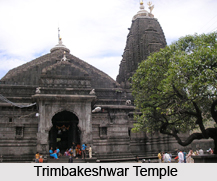
Tourism in Nashik District
Pilgrimage tourism in Nashik district involves visiting the various places of Hindu and Jain worship located here. Some of the holiest sites for Hind...
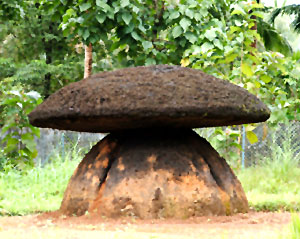
Mangadu, Kerala
Mangadu in Kerala’s Kollam district is a significant megalithic site known for its urn burials, cist burials, menhirs, and stone circles. Excavations...
Related articles in States of India
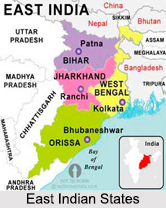
East Indian States
East Indian States comprises of Bihar, Jharkhand, West Bengal, Odisha and also the Union Territory of Andaman and Nicobar Islands. It defines the cult...
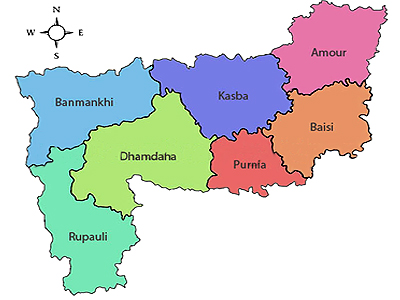
Purnia District in Bihar
Purnia District is located in Bihar and extends from River Ganga to Nepal. The district has a rich Hindu history and glorious past.
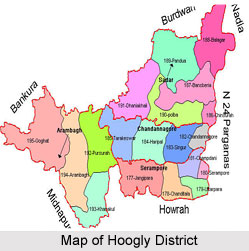
Hooghly district
Hooghly District along the bank of the river Hooghly is one of the principal trading ports of West Bengal.
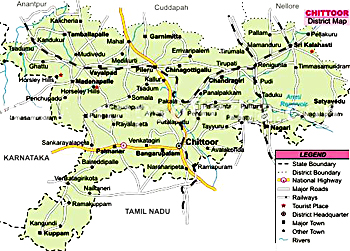
Geography Of Chittoor District
Geography of Chittoor district is spread along the topography of the land which is divided into two natural divisions; Chittoor has a dry and healthy...
Districts of West Bihar
Districts of West Bihar is comprised of medieval monuments that were built by the different governors of Mughal era.