
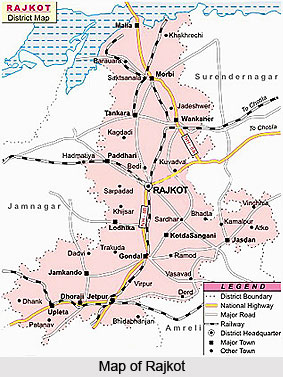
 Rajkot district is located in the south-west region of Gujarat. The district has 14 talukas of which the major talukas are Rajkot, Morbi, Jetpur, Wankaner, Upleta and Dhoraji. Rajkot is considered the economic, industrial and educational hub of the region. The district boasts of a stock exchange, which is linked with exchanges in Mumbai, Kolkata and New Delhi. Engineering and Auto ancillary industry is viewed as the growth engine of the district. The area of the district is 11203 sq. km. As per 2001 census, the population of this district is 31, 68,392.
Rajkot District
Rajkot District is located in the south-west region of the state of Gujarat. The district headquarter is Rajkot city.
Introduction
Rajkot district is located in the south-west region of Gujarat. The district has 14 talukas of which the major talukas are Rajkot, Morbi, Jetpur, Wankaner, Upleta and Dhoraji. Rajkot is considered the economic, industrial and educational hub of the region. The district boasts of a stock exchange, which is linked with exchanges in Mumbai, Kolkata and New Delhi. Engineering and Auto ancillary industry is viewed as the growth engine of the district. The area of the district is 11203 sq. km. As per 2001 census, the population of this district is 31, 68,392.History of Rajkot District
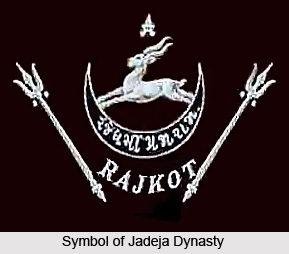 History of Rajkot District is interwoven with the regime of rulers belonging to several dynasties and a gradual transition period which witnessed changes in the economic, cultural and industrial scenario. During the Indian independence movement, Rajkot, which is Gujarat`s fourth largest city, had played an active role. Various historical anecdotes mark the history of Rajkot, which was known to be the former capital of the region of Saurashtra. Rajkot is situated on the banks of Aji River, in the western portion of India.
Early History of Rajkot District
Thakore Sahib Vibhoji Ajoji Jadeja, the grandson of Jam Shri Satarsal (Sataji) Vibhaji Jadeja of Nawanagar, belonging to Jadeja clan is said to have founded Rajkot during 1620. Prior to Jadeja rule, Mohammad Ghaznavi of Ghaznavid Empire and Mahmud Begada of Muzaffarid Dynasty were the earliest rulers of Rajkot. During 1590 CE, Vibhoji Jadeja was defeated by the Mughals and was taken prisoner, before being ordered to be placed under the leadership of Jodhaji Soda, his maternal uncle. Ardoi, Kalipat, Rib and Ribda were offered to Jadeja after he had cooperated with Shah Jahan in a war against Vaghelas from Sardhar. These areas were transformed into a principality by this ruler and he was succeeded by his son, who was awarded large tracts of land in return for his imperial services. Raju Sandhi was a co-founder of Rajkot, so it also said that this place was also named in his honour.
History of Rajkot during Nawabi Rule
In the year 1720, a deputy of the Nawab of Junagadh named Masum Khan conquered Rajkot and renamed it as `Masumabad`. He had also erected a gigantic fortress during 1722, to safeguard Rajkot from the conquests of other kings. Masumabad was guarded by Eight Gates, which were embedded with iron spikes for better defense. Ruins of fort walls can still be noticed in Ramnath para region. In 1892, Sir Robert Bell Booth, an engineer of the British Agency modified Raiya Naka Gate and Bedi Gate. Masum Khan reigned for a period of 12 years, till he was defeated and captured by Thakore Sahib Ranmalji Mehramanji in 1732.
History of Rajkot during Jadeja Rule
The name Rajkot was given to the region soon after Thakore Sahib Ranmalji Mehramanji had conquered Masumabad during 1732. Darbargadh Palace was created by Bavajiraj Jadeja and this was said to be very first palace of Rajkot. Lakhoji I succeeded Ranmalji in 1746. During 1794, his eldest son, who was about to ascend the throne died and therefore he continued ruling Rajkot. However, his grandson Ranmalji II was discontented with such an action and deported his grandfather to Nawanagar. The royal family soon acknowledged British protection in the year 1818 and the area of Rajkot gradually developed into a beautiful modern town under the British Political Agent. It emerged into a major centre of education, and numerous reputed educational institutes were constructed here.
Modern History of Rajkot District
Lang Library, The Rajkumar College, Masonic Hall, Connaught Hall and Watson Museum are some of the magnificent colonial structures which had been constructed in Rajkot during the British rule. Thakore Saheb Dharmendrasinhji Lakhajiraj came to the throne during 1930. Unlike his father, he imposed heavy taxes on his subjects, which resulted in a high rate of inflation in his kingdom. He was a spendthrift who spent half of the amount received as state funds to finance his own interests. Soon, political parties like Congress and others initiated rebellions and protests against his deceitful ways. In 1939, Mahatma Gandhi performed fasting to persuade the people to create people`s council, for the purpose of liberation of the regional inhabitants of Rajkot. The subjects were immensely relieved when Sahib Dharmendrasinhji met his death in the year 1940, when he had gone for hunting lions in Sasan Gir. Rajkot served as the capital of the state of Saurashtra till 31st October, 1956, right from 15th April, 1948, before it was joined with Bombay State during 1st November, 1956. On 1st May, 1960 Rajkot was declared a part of Gujarat from Bombay State. Manoharsinhji Pradyumansinhji, the son of Thakore Saheb Pradyumansinhji became the next ruler of Rajkot after his father died in 1973. He was the Member of the Gujarat Legislative Assembly for sometime and also served as the state Minister for Health and Finance.
Geography of Rajkot District
Geographical location of Rajkot District is 20.58 degree to 23.08 degree North (Latitude) and 70.20 degree to 71.40 degree East (Longitude). Maximum temperature of the place is 41 degree centigrade and the minimum temperature is 9 degree centigrade. Bhadar, Machh and Aji are the main rivers of this region and the average rainfall is 540 to 600 mm.
Demography of Rajkot District
According to the Population Census in the year 2011, Rajkot District had a population of 3,804,558 of which male and female were 1,974,445 and 1,830,113 respectively. The population of Rajkot District constituted 6.29 percent of total population of Rajkot District. The population density of Rajkot district for 2011 is 340 people per sq. km. The average literacy rate of Rajkot in 2011 was 80.96 compared to 74.16 of 2001. If things are looked out at gender wise, the male and female literacy rate was 87.07 and 74.43 respectively. The total literate in Rajkot District were 2,725,056 of which male and female were 1,514,075 and 1,210,981 respectively.
Education in Rajkot District
There are 1845 Primary Schools, 426 Secondary Schools and 40 higher secondary schools in Rajkot district. Saurashtra University is a major is well known for several departments such as journalism, economics, biosciences, pharmaceutical science, electronics, and chemistry, among several others. There are 5 engineering colleges in the district offering courses in computers, electronics and communication, instrumentation and control, mechanical, IT, and electrical engineering. Various Industrial Training Institutes provide training in areas like electronics, instrument and motor mechanic, wielding, dress making, tailoring and cutting, painting, stenography, carpentry and Wood working, oil engine and tractor repairing and others.
Economy of Rajkot District
Economy of Rajkot District of Gujarat is primarily based on manufacturing and service sector. About 42 percent of workers are engaged in service activities and 34 percent in manufacturing activities.
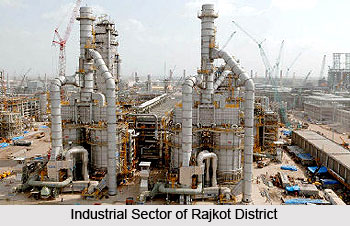 Manufacturing activities are concentrated in two main industrial estates, Aji and Bhaktinagar. The current drift of industrial expansion in the district is towards the Engineering and Auto ancillary sector. In this sector, diesel engine is the most important business with around one hundred and five manufacturing units operational in the district. The district also has a variety of manufacturing units for machine tools, metallurgical industries, industrial equipments, electronics, lathe machines, engineering and auto ancillary sector.
Small and medium industries are subjugated by foundries, engineering and automobile works, handicrafts, spices, textile related units gold and silver jewellery, medicines, and wall clocks. Jetpur taluka of the district is well-known for dyeing and printing business and Paddhari taluka for ginning and pressing business in the entire State. Rajkot district is the leading producer of cotton in the State. It is the second largest producer for oil seeds with groundnut being the most important oil seed. Main fruits produced in the district include mango, chikoo, citrus and papaya. Rajkot is the second major producer of onions and spices in the state of Gujarat. Garlic and cumin are main spice crops in the district with 27 percent share to the total production.
Rajkot district is affluent in minerals such as fireclay, chalk, perlite and limestone. Rajkot taluka is the largest producer of fireclay in the district. Due to profuse availability of fireclay in the district, firebricks and ceramic related industries (crockery) businesses have developed in Wankaner and Morbi talukas. In India, perlite used for horticulture and construction applications only occurs in Rajkot district. Other minerals available in the district comprise black trap, silica sand, brick sand, calcite and red clay. There are approximately seventy three medium scale and large scale industrial units in Rajkot. Majority of the industries are concentrated in Rajkot, Morbi and Kotda Sanghani talukas of the district. The industrial units are present across engineering, forging, casting, solvent plants, ceramics, paper, milk products, and electronics and pharmaceuticals sectors.
There are more than 30,463 small scale industries working in Rajkot district. Major industries comprise machinery, glass, textiles, food products and ceramics, and metal products. Maximum numbers of SSI units (5,283 Units) belong to machineries followed by textiles (4,389 Units). Rajkot is one of the biggest centers for engineering industry. Special Economic Zone (SEZ) for engineering sector is planned in the district, which will further enhance the development of engineering sector as well as increase the industrial output and exports of the district. Growth in real estate in Rajkot is quite rapid due to the large investments made by top realty players in projects such as development of commercial complexes, townships, group housing, and IT Parks. This will increase the investments and employment opportunities in the infrastructure sector as well.
The State Government has identified different industrial clusters to fuel the industrial expansion in the district. Most important industries identified are engineering (diesel engine, machine tools, and electric motors, casting and forging), gems and jewellery, ceramics and floor tiles, textiles, ginning and oxidised metals. Development of these clusters will lead to industrial growth in the district. The district has enormous reserves of minerals, in particular fireclay which has led to the development of specific industries such as fire bricks and ceramics.
Manufacturing activities are concentrated in two main industrial estates, Aji and Bhaktinagar. The current drift of industrial expansion in the district is towards the Engineering and Auto ancillary sector. In this sector, diesel engine is the most important business with around one hundred and five manufacturing units operational in the district. The district also has a variety of manufacturing units for machine tools, metallurgical industries, industrial equipments, electronics, lathe machines, engineering and auto ancillary sector.
Small and medium industries are subjugated by foundries, engineering and automobile works, handicrafts, spices, textile related units gold and silver jewellery, medicines, and wall clocks. Jetpur taluka of the district is well-known for dyeing and printing business and Paddhari taluka for ginning and pressing business in the entire State. Rajkot district is the leading producer of cotton in the State. It is the second largest producer for oil seeds with groundnut being the most important oil seed. Main fruits produced in the district include mango, chikoo, citrus and papaya. Rajkot is the second major producer of onions and spices in the state of Gujarat. Garlic and cumin are main spice crops in the district with 27 percent share to the total production.
Rajkot district is affluent in minerals such as fireclay, chalk, perlite and limestone. Rajkot taluka is the largest producer of fireclay in the district. Due to profuse availability of fireclay in the district, firebricks and ceramic related industries (crockery) businesses have developed in Wankaner and Morbi talukas. In India, perlite used for horticulture and construction applications only occurs in Rajkot district. Other minerals available in the district comprise black trap, silica sand, brick sand, calcite and red clay. There are approximately seventy three medium scale and large scale industrial units in Rajkot. Majority of the industries are concentrated in Rajkot, Morbi and Kotda Sanghani talukas of the district. The industrial units are present across engineering, forging, casting, solvent plants, ceramics, paper, milk products, and electronics and pharmaceuticals sectors.
There are more than 30,463 small scale industries working in Rajkot district. Major industries comprise machinery, glass, textiles, food products and ceramics, and metal products. Maximum numbers of SSI units (5,283 Units) belong to machineries followed by textiles (4,389 Units). Rajkot is one of the biggest centers for engineering industry. Special Economic Zone (SEZ) for engineering sector is planned in the district, which will further enhance the development of engineering sector as well as increase the industrial output and exports of the district. Growth in real estate in Rajkot is quite rapid due to the large investments made by top realty players in projects such as development of commercial complexes, townships, group housing, and IT Parks. This will increase the investments and employment opportunities in the infrastructure sector as well.
The State Government has identified different industrial clusters to fuel the industrial expansion in the district. Most important industries identified are engineering (diesel engine, machine tools, and electric motors, casting and forging), gems and jewellery, ceramics and floor tiles, textiles, ginning and oxidised metals. Development of these clusters will lead to industrial growth in the district. The district has enormous reserves of minerals, in particular fireclay which has led to the development of specific industries such as fire bricks and ceramics.
Monuments of Rajkot
 The historical city of Rajkot is the capital of the of the Rajkot district. A number of museums and temples comprise the monuments of Rajkot. It lies 24 miles from Gondal in the Kathiawar peninsula. The founder of the beautiful city of Rajkot is Thakur Saheb Vibhaji Ajoji Jadeja in the year 1612. It was once the capital of the princely state of Saurashtra. The city has also been home to the great Indian Freedom Fighter Mahatma Gandhi. He lived at Rajkot for the early period of his life during which time his father was the Diwan to one of the Saurashtra Nawabs. Until 1947 it was the headquarters of the local British Resident for the Western India States. Today it is an important industrial centre.
A number of monuments are found strewn across the landscape of Rajkot. Though not in the form of forts and palaces, these monuments of Rajkot still figure in importance due to their historical significance.
One of the most visited among Rajkot`s attractions is the Kaba Gandhi No Delo. This is the place in Rajkot where Mahatma Gandhi had stayed in the early years of his life. The name has been derived from the name of Mahatma Gandhi`s father who was known as Kaba Gandhi. The construction of the house follows the old and traditional style of architecture used in house building in Gujarat. There is now held an exhibition here which displays the Gandhi Smriti. The Kaba Gandhi No delo has been converted into a museum which displays photographs, items and belongings of the Great Indian leader.
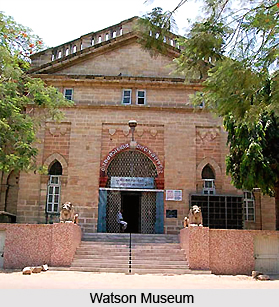
Another major attraction of Rajkot is the Watson Museum. Built in 1888, it has an interesting collection of local paintings, weapons and products. There are contained here precious objects of colonial period of India and history of Rajkot. It is one of the largest museums in the state of Gujarat, and in fact the most valuable in the whole of Saurashtra. Apart from these exhibits, the museum offers state-of-the-art facilities like guide service, reference library etc which makes it a top draw among tourists.
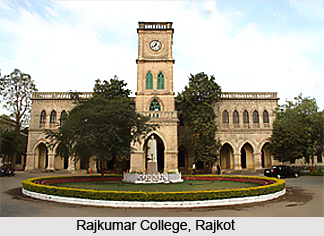
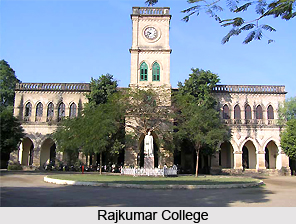
The Rajkumar College was founded in 1870 by Colonel R. H. Keating, VC, for the education of the sons of the local princes and other gentlemen, a sort of Indian Eton. The ground-floor hall is fine. There is a rectangular tower over the east entrance and two circular towers over the west. West of the quadrangle are the houses of the Principal and Vice-Principal. I front of the college building stands the statue of the first principal of the college. The Rajkumar College is still a prestigious public school in Rajkot.
A fort was built here by Masum Khan, the Deputy Faujdar of Junagadh in 1772 AD. Most of the fort is now in ruins and only the gates still remain. Two gates- Raiya Naka and Bedi Naka- were renovated by Sir Robert Bell Booth, the Chief Engineer of a British Agency in 1892. He installed the three storey clock tower there. The Kaisar-i-Hind Bridge was also designed by Booth, who has been responsible for most of the public buildings in the state. The bridge was financed by the Maharajah of Bhavnagar.
 Religious Monuments of Rajkot
A number of religious monuments, mainly temples are also found at Rajkot.
Among the most popular religious sites here is the Iswariya Temple. It is a small temple dedicated to Lord Shiva, situated on the outer fringes of town, along the Jamnagar highway. There is a shivling worshipped here which is believed to be Swayambhu. The temple structure is rather beautifully constructed, and the location is one of peace and serenity. There is a pond nearby where people take a dip while offering prayers. The Iswariya temple is of immense spiritual value, and is visited by the locals as well as by tourists. A small fair is organized here every year attended by many.
The Jagat Mandir is another beautiful temple situated in Rajkot. It has been carved in Red stones and is dedicated to Sri Ramkrishna Paramhansa. The Garba Griha or the main shrine has a white marble statue of Bhagwan Sri Ramkrishna seated on a Lotus Vedi. The temple is a rather modern structure built along the principles of all the major religions- Hinduism, Christianity, Buddhism and Islam.
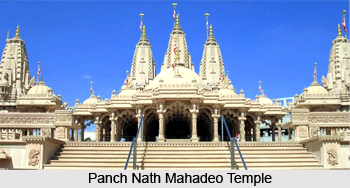
One of the oldest temples in Rajkot is the Panch Nath Mahadeo temple dedicated to Lord Shiva. A number of devotees throng the temple premises everyday. One of the most important events of the temple is the Shiv Maha Puja held in the month of Shraavana.
A number of mandirs were established by Swaminarayan Sampraday, are also located at Rajkot. Known as the Swaminarayan temple, these temples are a part of the Swami`s philosophy on deity worship and theism. The temple is well known for the hand carved stone with which the temple has been constructed. The chief idol at the temple is that of Lord Swaminarayan. It is a white idol of the Lord beautifully clad in a white cloth.
The monuments of Rajkot indicated the very composite nature of the city. Modernity and tradition exist simultaneously here in the form of industrial centres on the one hand and a continuation of Indian religious tradition on the other.
Temples in Rajkot
 Rajkot in Gujarat is a place which is one of the most visited places of India for its several religious places. This place is flocked by tourists throughout the year who visit this place to enjoy the iconic temples and the spirituality of them.
Temples in Rajkot
The temples in Rajkot are bound with magnificent history and social belief of the local people of the place. The temples are:
Shri Nageshwar Parswanath Jain Temple: A classic temple, built in honour of Lord Parswanath, is located on the Rajkot-Jamnagar Highway near Ghanteshwar. It is a stunning example of Panchtirth.
Swaminarayan Temple: This temple is another specimen of Swaminarayan Sampradaya. It is situated on Bhupendra Road. This temple is popular for its astounding architecture and beautiful shrine. People visit this place to experience the architecture of the temple.
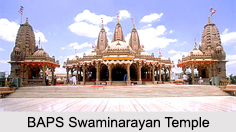
BAPS Swaminarayan Temple: This particular temple from the Swaminarayan sect was built in 1998-99. It is situated on the rapid developing Kalavad Road near Mahila College. This temple has one of the largest auditoriums in the state having a capacity of 1000 people for the `Ravi-Sabha` and `Yuvak-Sabha`.
Ramakrishna Ashram: Built on the Dr. Yagnik Road in 1934 on the land donated by Late Shri Dharmendrasinghji, Ramakrishna Ashram is the second most imperative place for the followers of Swami Vivekananda, after Kolkata. Nearby, there is a Jagat Mandir, a marvelously carved temple built in honour of Shri Ramakrishna Paramhansa, in red stone.
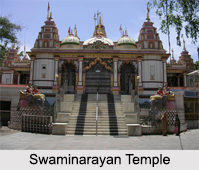 Jadeshwar Temple: Jadeshwar Temple is situated on the Jadeshwar town; the temple is dedicated to Lord Shiva. The town Jadeshwar is situated at a distance of 60 km from Rajkot. The temple was built by Baroda`s Vithoba Diwan in the early years of 19th century.
Jalarambapa Temple: This temple is situated in Virpur, a small town located at a distance of 60 km from Rajkot. Virpur is believed to be the birthplace of Jalarambapa, a celebrated saint worshipped by the Lohana community of Gujarat. He is also revered by many other Gujarati communities. It is a tradition in Jalarambapa Temple to serve sumptuous food to the devotees and believers, who come here. And for such a reason, the temple trustees do not accept any donations.
Chamunda Mataji Temple: The notable Chamunda Mataji Temple is situated at Chotila, which is a small town located exactly midway between Ahmedabad and Rajkot. Chamunda Mataji Temple is the `kuldevi` (family goddess) of most of the Hindus in the Saurashtra region. Chamunda is also known as Ambaji, Mahakali, Bhuvaneshwari and Chamundma. The main temple is atop a hill, which is 1250 feet high.
According to Hindu shastras, Mahakali Mataji had vanquished two demons, Chand and Mund here in Chotila hill and presented the heads to Ambamata. Ambaji was pleased to see these demons killed and said that Mahakali Ma shall be worshipped as Chamunda Mataji here forever. However, everybody is bound to return back to his or her respective places from this Chamunda temple site before night time, because it was the desire of Mataji that no one shall stay here overnight. The temple structure is very spacious, with the statue of Mataji standing resplendently. During the time of Navratri, festivals are organized which go on for nine days, with full mirth and fervour.
Gayatri Mandir: Gayatri Mandir of Rajkot is made of stone and the temple is the replica of the twelve jyotirlingas. The temple is surrounded by beautiful decorative arts and vegetation.
Panchnath Mandir: This temple is located in Limda Chowk in Rajkot. Panchnath Temple, dedicated to Lord Shiva, is made of white marble stone with beautiful architecture.
Other Temples in Rajkot
Apart from the temples mentioned above, there are some other temples in Rajkot which are equally beautiful and popular among tourists and those are Ashapura Temple, Ashapura Dham, Balaji Temple, Mahakaleshwar Temple, Sankirtan Temple, Iskcon Mandir, Ishwarya Mahadev Temple, Ramcharitmanas Mandir, prem Mandir etc.
Tourism in Rajkot District
Rajkot district houses the Kaba Gandhi no Delo, the house built by Mahatma Gandhi in 1880-81 and this has been declared as a national monument. Watson Museum inaugurated in 1888, has an excellent collection of archaeological and ancient traditional items like Indus Valley artefacts, textiles, paintings and colonial memorabilia. The Rotary Dolls Museum gives an overview to the culture and traditions of the world at large through the medium of dolls. Other places of interests include Mukti dham - Crematorium, Ram Krishna Temple, Swaminarayan Temple, and Aji Dam.
How to reach Rajkot District
By Air:
The district has a domestic airport at Rajkot city, which operates flights to major cities such as Vadodara, Bhuj, Mumbai, Delhi, Ahmedabad, and Jamnagar.
By Road:
Rajkot is well connected to other cities through National Highways (NH) and State Highways (SH). The district is connected to Ahmedabad (225 km), Vadodara (294 km), Surat (461 km), Mehsana (299 km), Bhavnagar (175 km), Jamnagar (92 km), Vapi (549 km) and Ankleshwar (388 km). The regional network includes NH -8a that links Kandla, NH -8b that links Porbandar and Gandhinagar and NH 8d that connects, Jetpur, Junagadh with Rajkot.
By Rail:
Rajkot is well connected by rail network to important cities in Gujarat and India like Delhi, Mumbai, Cochin, Coimbatore, and Bhopal.
By Port:
Navlakhi, the only port in Rajkot has good rail and road connectivity. It is connected to Morbi by road and national highway. The port is connected by broad gauge railway line with rest of India via Maliya.
How to reach Rajkot District
By Air:
The district has a domestic airport at Rajkot city, which operates flights to major cities such as Vadodara, Bhuj, Mumbai, Delhi, Ahmedabad, and Jamnagar.
By Road:
Rajkot is well connected to other cities through National Highways (NH) and State Highways (SH). The district is connected to Ahmedabad (225 km), Vadodara (294 km), Surat (461 km), Mehsana (299 km), Bhavnagar (175 km), Jamnagar (92 km), Vapi (549 km) and Ankleshwar (388 km). The regional network includes NH -8a that links Kandla, NH -8b that links Porbandar and Gandhinagar and NH 8d that connects, Jetpur, Junagadh with Rajkot.
By Rail:
Rajkot is well connected by rail network to important cities in Gujarat and India like Delhi, Mumbai, Cochin, Coimbatore, and Bhopal.
By Port:
Navlakhi, the only port in Rajkot has good rail and road connectivity. It is connected to Morbi by road and national highway. The port is connected by broad gauge railway line with rest of India via Maliya.
Rajkot Airport
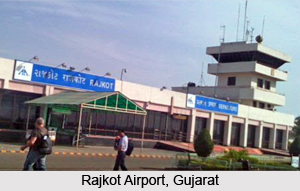 Rajkot airport is located at a distance of a few miles from Rajkot, Gujarat. The airport has parking apron for two B-737 with 250 terminal capability. Jet Airways, Air Deccan and Indian Airlines are the only domestic airlines that operate regular flights from the airport. Presently Rajkot Urban Development Authority and Rajkot Municipal Corporation jointly proposed a plan to extend the airport runway from 5,400 feet to 6,000 feet. Thus it will bring more connectivity from Rajkot to other major cities of India. The airport is situated at a distance of 4 km from the city.
Rajkot airport has reached its ultimate point due to residential and commercial buildings coming up around it. The airport authorities have plans to extend the airport, which is in the process of construction. With the present availability of 5,400 feet runway, the airstrip is not adequate to enable bigger aircrafts like Boeing and A320 to land here. To avoid jeopardisation of air safety, the airport should have at least a 6,000 feet runway. Civil aviation minister Praful Patel has proposed to build a new bigger airport to be developed on 500 acres of land on Rajkot-Gondal-Jamnagar highway around 10 km away from the city near Khirasara village.
Rajkot Railway Station
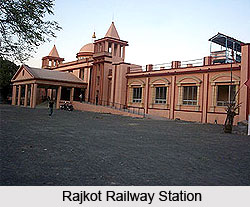 Rajkot Railway Station is situated in Rajkot in the Indian state Gujarat. Rajkot has another railway station other than Rajkot Railway Station, namely the Bhaktinagar Railway Station. Rajkot Railway Station is also known as Rajkot Junction. It is also considered the primary terminus of rail transport for the city of Rajkot in Gujarat and an important centre of the Western Railways zone of the Indian Railways. Just like other railway stations, Rajkot Railway Station also has countless tea stalls, snack bars, medical shops, enquiry desk. The station also has an ATM counter run by the State Bank of Saurashtra. The railway authorities also have planned to incorporate a cyber cafe, various ATMs, Vending-machines, Cafeteria, urban waiting rooms and rest rooms in the railway station. For that reason the station is undergoing large-scale automation and infrastructural development.
Rajkot Railway Station has a history behind its formation. The city was the erstwhile capital of the Princely State of Rajkot. Rajkot Railway Station was formerly situated on the northeastern bank of the Aji River. But at the time of British Raj, the station was shifted to Sadar bazaar. At that time only metre gauge and narrow gauge rails were in vogue and the station was only connected to few princely states like Gondal and Navanagar. At present though the station has broad gauge rails. The Rajkot Railway Station is located on the west bank of Aji River and also connected to major roads. The zonal office of Rajkot Railway Station is situated in Kothi Compound under the Western Railways.
One can avail trains from Rajkot Railway Station to reach Gujarat- Ahmedabad, Vadodara, Surat, Jamnagar, Bhavnagar, Porbandar, Okha, Bhuj, Mehasana, Himatnagar, Anand, Nadiad, Amreli, Junagadh, Palanpur, Gandhidham; Maharastra- Mumbai(Central), Mumbai(Bandra), Pune, Nagpur, Kolhapur, Nasik, Aurangabad, Satara/Sangli, Bhusaval; Rajasthan- Jaipur, Jodhpur, Ajmer, Udaipur, Jaisalmer, Abu Road, Falna, Kota, Bikaner,Nana Beda; Karnataka- Bangalore, Mangalore, Mysore, Hubli, Belgaum; Tamil Nadu- Chennai, Madurai, Kanyakumari, Coimbatore; Kerala- Trivandrum, Kochi, Ernakulam, Calicut; Andhra Pradesh- Hyderabad, Vishakapatnam; Orissa- Bhubaneshwar, Puri; West Bengal- Kolkata; Madhya Pradesh- Bhopal, Indore, Satna, Jabalpur; Uttar Pradesh- Lucknow, Varanasi, Gorakhpur, Bareilly, Agra, Gaziabad, Allahbad; Delhi; Punjab- Amritsar, Chandigarh; Jammu and Kashmir- Jammu; Bihar- Patna, Ranchi.
Trains that pass by the Rajkot Railway Station are-- Saurashtra Mail (9005-9006); Saurashtra Janata Express (9017-9018); Saurashtra Express (9215-9216); Somnath Express (9221-9222); Veraval Jabalpur Express (1463-1464-1465-1466); Porbandar Howarh Express (2905-2906); Puri Okha Express (8401-8402); Okha Guwahati Express (5635-5636); Okha Varanasi Express (9569-9570); Okha Gorakhpur Express (5045-5046); Uttaranchal Express (9265-9266); Okha Eranakulam Express (6337-6338); Veraval Trivandrum Express (6333-6334); Rajkot Secunderabad Express (7017-7018); Rajkot Coimbatore Express (6613-6614); Jamnagar JammuTawi Express (2477-2478); Hapa JammuTawi Express (2475-2476); Porbandar Delhi Express (9263-9264).
Recently updated articles in States of India
Bandare Waterfalls, Meghalaya
Bandare Waterfalls in South Garo Hills, Meghalaya, is a secluded natural attraction surrounded by dense subtropical forests and rugged mountain terrai...
History of Thissur District
Early History of Thissur District explains flourishing of the port cities. Now these port cities are transformed into archaeological sites.
Tippi Orchid Research Centre, Arunachal Pradesh
Tippi Orchid Research Centre in Arunachal Pradesh is renowned for its rich collection of exotic and endangered orchids. Surrounded by lush rainforest...
Tourism in Nashik District
Pilgrimage tourism in Nashik district involves visiting the various places of Hindu and Jain worship located here. Some of the holiest sites for Hind...
Mangadu, Kerala
Mangadu in Kerala’s Kollam district is a significant megalithic site known for its urn burials, cist burials, menhirs, and stone circles. Excavations...
Related articles in States of India
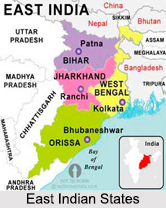
East Indian States
East Indian States comprises of Bihar, Jharkhand, West Bengal, Odisha and also the Union Territory of Andaman and Nicobar Islands. It defines the cult...
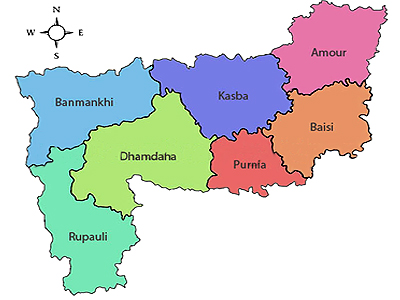
Purnia District in Bihar
Purnia District is located in Bihar and extends from River Ganga to Nepal. The district has a rich Hindu history and glorious past.
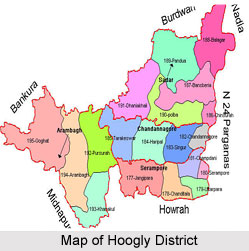
Hooghly district
Hooghly District along the bank of the river Hooghly is one of the principal trading ports of West Bengal.
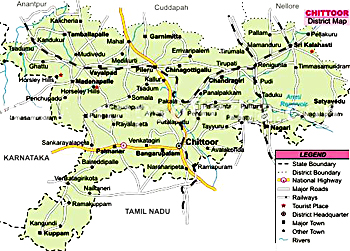
Geography Of Chittoor District
Geography of Chittoor district is spread along the topography of the land which is divided into two natural divisions; Chittoor has a dry and healthy...
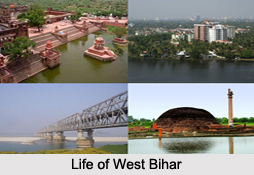
Districts of West Bihar
Districts of West Bihar is comprised of medieval monuments that were built by the different governors of Mughal era.