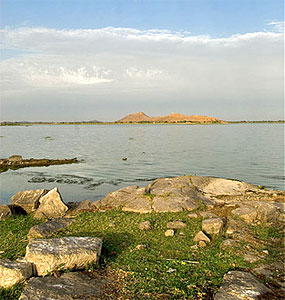
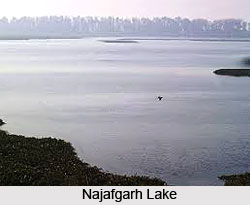
 Najafgarh Lake is fresh water lake, located in South West Delhi. This fresh water lake was connected with Yamuna River by a natural "nullah" or drain called the Najafgarh nullah.
Najafgarh Lake is now widened after 1960, when Flood Control Department of Delhi took the project to save Delhi from flood. The rain water accumulating in Najafgarh Lake has been recorded to have occupied more than 300 square kilometres or 120 square miles.
Najafgarh Lake is now serving as ecotourism site in Delhi. With recent advancement in ecological understanding, Najafgarh Lake protected the urbanisation of South West Delhi and its neighbourhood from devastating flood.
Najafgarh Lake, recorded as wetland ecosystem area, is the abode of several migratory birds and local birds. Najafgarh Lake came to be recognised as an important wildlife habitat after a local naturalist studying the area during 1986-87 to 1988-89.
Najafgarh Lake is a very rich wetland ecosystem flourished with rich local and migratory bird life. On the surrounding lands of Najafgarh Lake, there is plenty of local wildlife. In the British colonial period, large hunting parties of local and British colonial elites descended on the lake yearly. At that time, the local villagers were employed as guides and assisted with the camping duties in the hunting camps. The endangered species like famous Pink-headed Ducks and the Siberian crane are the main visitors in this lake, which adds the beauty.
Najafgarh Lake or Najafgarh nullah has been much widened over the past decades. Now the lake has thick mud embankments on both its sides to channel the waters and protect Delhi from floods. These embankments have been planted with thick forest cover which serve as a much needed habitat for remnant local wildlife occurring in nearby and surrounding farmlands including common foxes, jackals, hares, wild cats, nilgai, porcupines and various reptiles and snakes including the dreaded cobras. Many local birds and the migratory birds as well roost and nest in the urban forestry.
The Delhi Tourism Department had identified this site for Chhawla Water World and Ecopark development. A number of local and migratory birds have been observed at the upstream location of Najafgarh drain from Chhawla up to Dhansa regulator. The water level of this lake is maintained by the Irrigation and Flood Control Department, New Delhi.
Chhawla is located on Bijwasan-Najafgarh Road at about 10 kilometres from Gurgaon National Highway-8 on Rajokri crossing. The catchment area of Najafgarh Lake spreads in Delhi-Gurgaon border located 1 to 2 km distance from Jhatikra. Najafgarh Lake is the largest surface water body in Delhi, spread over in an area of 6 kilometres.