
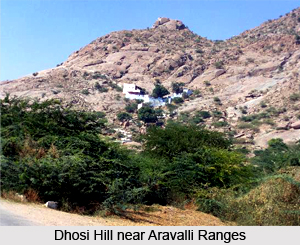
 Dhosi Hill is located on the north-western part of the Aravalli Mountains, particularly along the southern portion of Haryana and northern part of Rajasthan and is renowned for being an extinct volcano. Visitors will come across a distinctive crater and lava lying over Dhosi Hill, which also bears a religious significance as this spot is believed to be associated with the growth of the `Sanatana Dharma`, the oldest religion of the entire world, now recognised as Hinduism. Dhosi Hills have been mentioned in the Puranas, Brahamanas and also the Mahabharata. It is here that the `ashram` of Rishi Chyavana (for whom the famous Ayurvedic tonic `Chyawanprash` was made) existed, which dates back to over 10, 000 years. The Rajasthan area of Dhosi Hill is situated in Jhunjhunu District while the Haryana part of the Dhosi Hill, Mahendragarh District is based at a distance of nearly 5 kms away from Narnaul, on Singhana Road. However Dhosi Hill is referred to as `Pahadi Dhusran` or `Hill owned by `Dhusars`. Dhusars are said to be Brahmins and Vaishyas who are descendants of Bhrigu Rishi and Chyavana Rishi.
Dhosi Hill
Dhosi Hill near Aravalli Mountain, also known as Brahmavarta is famous for being an extinct volcano which had erupted prior to the age of Mahabharata. The Ayurvedic herbal remedy Chyawanprash was manufactured here for Chyavan Rishi and the ruined fortress of Hemu is also located here.
Introduction
Dhosi Hill is located on the north-western part of the Aravalli Mountains, particularly along the southern portion of Haryana and northern part of Rajasthan and is renowned for being an extinct volcano. Visitors will come across a distinctive crater and lava lying over Dhosi Hill, which also bears a religious significance as this spot is believed to be associated with the growth of the `Sanatana Dharma`, the oldest religion of the entire world, now recognised as Hinduism. Dhosi Hills have been mentioned in the Puranas, Brahamanas and also the Mahabharata. It is here that the `ashram` of Rishi Chyavana (for whom the famous Ayurvedic tonic `Chyawanprash` was made) existed, which dates back to over 10, 000 years. The Rajasthan area of Dhosi Hill is situated in Jhunjhunu District while the Haryana part of the Dhosi Hill, Mahendragarh District is based at a distance of nearly 5 kms away from Narnaul, on Singhana Road. However Dhosi Hill is referred to as `Pahadi Dhusran` or `Hill owned by `Dhusars`. Dhusars are said to be Brahmins and Vaishyas who are descendants of Bhrigu Rishi and Chyavana Rishi.Eruption of Dhosi Hill
Dhosi Hill had erupted during the initial phase of the `Treta Yuga`, according to the accounts of Mahabharata, as explained by Guru Shashank who had given the Pandavas company during their exile about 5100 years ago. This region was known for having erupted, and later Munis and Rishis started inhabiting Dhosi Hill.
Floods in Dhosi Hill and Composition of Manusmriti :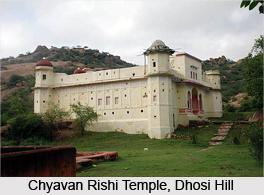 Due to the rapid melting of glaciers and rivers throughout the world during the first part of the Holocene age and towards the conclusion of the last Ice Age which can be traced back to more than 10, 000 years ago, floods occurred in Dhosi Hill. This caused violent destruction which finds a mention in `Avesta`, a Persian book as well as in numerous Vedic Granths or Sanskrit journals. This area of land was recognised as `Brahmavarta` and also `Devbhumi` following the floods, in the `Manusmriti` and they were believed to have asked the seer Manu to guide them as to how to tolerate the various calamities and complications which life poses now and then, in a simplified and systematic manner. It was a conglomeration of famous saints of that time, held in Brahmavarta. Bhrigu and Manu had narrated the different spheres of life which had been composed into a written document called Manusmriti.
Floods in Dhosi Hill and Composition of Manusmriti :
Due to the rapid melting of glaciers and rivers throughout the world during the first part of the Holocene age and towards the conclusion of the last Ice Age which can be traced back to more than 10, 000 years ago, floods occurred in Dhosi Hill. This caused violent destruction which finds a mention in `Avesta`, a Persian book as well as in numerous Vedic Granths or Sanskrit journals. This area of land was recognised as `Brahmavarta` and also `Devbhumi` following the floods, in the `Manusmriti` and they were believed to have asked the seer Manu to guide them as to how to tolerate the various calamities and complications which life poses now and then, in a simplified and systematic manner. It was a conglomeration of famous saints of that time, held in Brahmavarta. Bhrigu and Manu had narrated the different spheres of life which had been composed into a written document called Manusmriti.History of Dhosi Hill
 History of Dhosi Hill is evident from that fact that Dhosi Hill was directly linked to the birth and growth of the `Sanatana Dharma` or `Vedic Sanskriti` in the form of `Manusmriti`. Dhosi Hills, which is located on the north-western part of Aravalli Mountains, covering the northern part of Rajasthan and southern portion of Haryana is ancient volcanic eruption site, wherein a volcano erupted at the start of `Treta Yuga`, as explained by Guru Shashank who had walked along with the Pandavas in their exile or `Agyaatwas`, over 5100 years ago. This area was populated by many `Rishi` and `Muni` in ancient times and even today solidified lava can be observed on the hill slopes.
Dhosi Hill is revered as a great Ayurvedic centre since the ages of the Vedas due to the existence of virgin and fertile soil, which helps the growth of various unique Indian herbs here. The world famous Ayurvedic solution named `Chyawanprash` was manufactured at Dhosi Hill by royal vaids, by combining 46 herbs, to offer respite to Chyavana Rishi who was suffering from skin diseases. It is said that Chyavana Rishi started appearing refreshed and much younger after he consumed this magical herbal solution. Chyavanprash is quite sought after even today for its rare medicinal properties. Not only is it popular in India but is also quite popular in the overseas market.
Dhosi Hill is also the source of the renowned `Kayakalp` which is an effectual natural treatment that helps the human skin to emerge fresher and much younger. This had made Chyavana Rishi attain a youthful look and the tale has been described vividly in the Puranas, Brahmanas and also the Mahabharata. The procedure of this process was invented by the Ashwini brothers who utilized several herbs to make it possible. Vedic books contain references of the process of Kayakalp and the water of the pond located at the top of Dhosi Hill is considered to be a rejuvenating and purifying agent even today. Pilgrims from different parts of the country pay visit to this pond to take a dip in its waters which is said to possess traces of copper and dissolved herbs. Water rich in copper content is believed to work wonders for digestion, eyes and also the skin.
King Hem Chandra Vikramaditya, also known as Hemu had established a fort in Dhosi Hill about 500 years ago, whose ruins can be seen today. It is heavily fortified with thick walls which reach till a height of 25 feet and are as much as 40 feet in width.
Dhosi Hill as an Ayurvedic Centre
Since the Vedic period, Dhosi Hill was a crucial Ayurvedic spot mainly due to the presence of fertile soil on this volcanic hill. Numerable types of unique herbs are found here though presently the Panchayat herbs are getting destroyed due to activities like indiscriminate chopping of trees and also grazing by animals. The Chyawanprash was manufactured here with the aide of 46 herbs and is the most ancient and effective Ayurvedic herb during 10, 000 years ago by `Ashvini Kumar` brothers who were `Raj Rishis` or royal `Vaids` for curing skin ailment of Chyavana Rishi. This place is also revered for possessing the `Kayakalp` which enables one to obtain a glowing and nourished skin and this tonic is believed to have granted a youthful appearance to Chyavan Rishi. This was made possible by the Ashwini brothers who had prepared it, which has been spoken about in the Puranas, Mahabharata and the Brahmanas. Even today the water of the local pond near the hilltop is said to be beneficial for rejuvenation. This water is enriched with copper and dissolved herbs which make it immensely helpful for digestion and healing skin and eyes.
Fort of Dhosi Hill
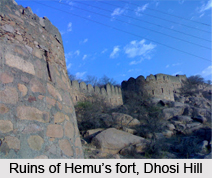 The remnants of a 500-year old fort are visible at several points of the Dhosi Hill, an extinct volcano standing alone in the northwest end of the Aravalli Mountain Ranges, at altitude varying from about 345 to 470 metres from the surrounding land and 1,170 metres above the sea level. The fort was built by Samrat Hemchandra Vikramaditya, who was known as Hemu, about over 500 years ago on the hill. The Dhosi Hill is situated in the ancient Vedic state of Brahmavarta, presently an area called Shekhawati on the borders of Indian states Rajasthan and Haryana. The hill, in addition to having temples, ponds and caves on the top and forest around it, also has the ruins of the fortress constructed by Hemu, fortified by a strong wall measuring about 25 feet (7.6 metres) in height and 40 feet (12 metres) in width, on even the steepest slopes and the top of the volcano. The fort was erected to safeguard the heritage and ashrams on the hill against the frequent Muslim invasions and attacks, during the medieval period.
`Dhusar` was the other name of emperor Hemu and since he belonged to this region, the communities are referred to as Dhusar even today. During the 1890s, a fort was constructed on the Dhosi hill, which resembled the temple of Chyavana Rishi, to replace the old temple. The fort was built at the crater of the hill by the Bhargava community, also called Dhusar Brahmins.
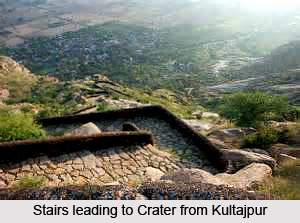
Stone and lime plaster stairs have been made, suitable for all kinds of weather, on the sides of Thana and Kultajpur villages. However, currently the pony pathway leading from the Thana village and the way from the Dhosi village are in ruins. The stairs on the side of Kultajpur are one of the most convenient ways of reaching the summit of Dhosi Hill, being very wide, enabling visitors to relax along their journey. While journeying along the stairs of the fort, one shall be greeted with splendid views of the adjoining villages lining the Aravalli Ranges. Spectacular Shekhawati paintings are existent in the Chyavana Rishi Temple, in the Garbhagriha which is used as a resting place by the pilgrims. The `Chandrakoop` portion of the hillside fort is amongst the notable points, wherein the Raj Rishis had prepared a herbal solution for treating the skin maladies of Chyavan Rishi. Near the fort premise is also present an ancient well supplying drinking water to pilgrims and visitors. The Government of Haryana has also made arrangements for providing clean drinking water by lifting water mechanically from Thana village.
Shiva Kund and Sankrit Sansthan of Dhosi Hill
A sacred water reservoir called `Shiv Kund` is existent on the summit of Dhosi Hill near Kultajpur village. The regional Mittal community manage the Shiv Kund. There also present a Sanskrit Vidyalaya close to it which was completely functional even till three decades back.
Sarovar of Dhosi Hill
Dhosi Hill also contains an old reservoir or `Sarovar` which is utilised for conserving rainwater used for the purpose of bathing of the pilgrims. It is believed that the rainwater preserved in this sarovar is enriched with medicinal properties which are great for curing skin ailments. The water of this sarovar is actually herbal due to the presence of copper in it. The reservoir is disilted frequently. A concrete dam was constructed on the site. A plaque placed above the dam which demarcates that the reservoir can be used by Hindus including Sikhs, Buddhists, Jains, Harijans, Arya Samajis and people of Sanatan Dharma for bathing.
Religious Significance of Dhosi Hill
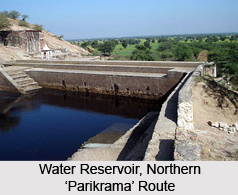 The Hindus respect Dhosi Hill ever since its eruption and most of the devotees perform a `parikrama` of this Indian hill. Guru Shashank had asked the Pandavas to practise a parikrama of this hill, and demonstrated how this must be performed. Land slides have brought about the destruction of the majority of the parikrama regions.
Swami Vivekananda`s Association with Dhosi Hill
The renowned Hindu saint and reformer Swami Vivekananda had resided in a guest house at Dhosi Hill atleast thrice during his visit to the Raja of Khetri Ajit Singh. This was during the period around 1890`s, and the stay was for three months.
Tourism of Dhosi Hill
The crater can be approached from three or four routes and two of them are from Thana village. One can avail ponies from the side of Thana village, though this pathway is presently destroyed at several places due to land slides and soil erosions. The ideal route to ascend up the hill is from the fourth pathway from the end of Kultajpur village which is equipped with broad stairs.
Recently updated articles in Geography of India
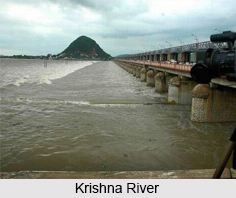
Krishnaveni River
The Krishnaveni River, presently known as the Krishna River, is one of India’s major rivers. Originating in the Western Ghats of Maharashtra, it flows...

Wakal River
The Wakal River is an important tributary of the Sabarmati River, originating in Rajasthan’s Aravalli Range and flowing through Rajasthan and Gujarat....
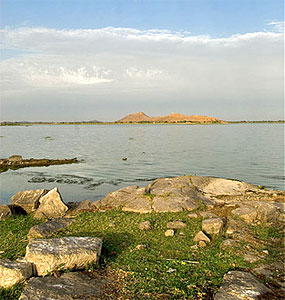
Pahuj River
Pahuj River is an important tributary of the Sindh River that flows through the Indian states of Madhya Pradesh and Uttar Pradesh. Originating in the...
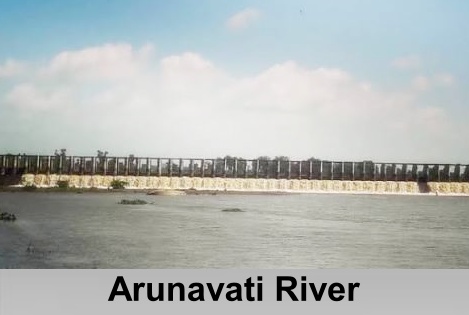
Arunavati River
Arunavati River is a seasonal right-bank tributary of the Tapi River, flowing through parts of Madhya Pradesh and Maharashtra. Originating in the Satp...
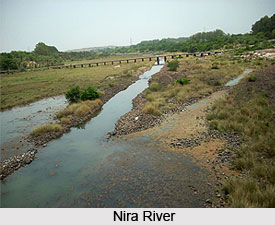
Nira River
Nira River is an important tributary of the Bhima River flowing through Maharashtra. Originating in the Western Ghats, it traverses Pune, Satara, and...
Related articles in Geography of India
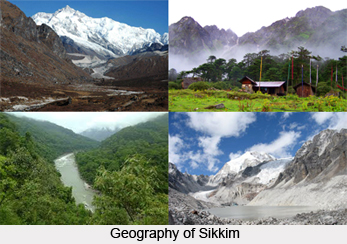
Geography of Sikkim
Geography of Sikkim is characterised by a vast array of magnificent hillock that extends from one corner of the state to the other.
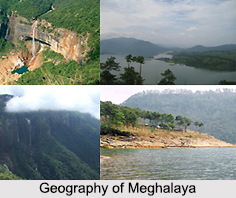
Geography of Meghalaya
The suitable climate, highland plateaus, rivers and the flora and fauna together forms the geography of Meghalaya.
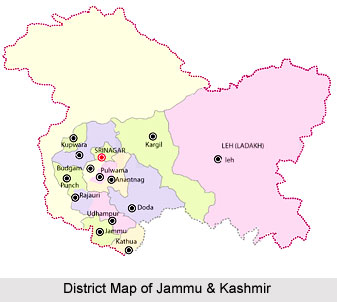
Geography of Jammu & Kashmir
Jammu and Kashmir is encompassed by valleys. Some of the dominant valleys of the state are Kashmir Valley, Tawi Valley, Chenab Valley, Poonch Valley,...
Narmada River
Narmada River is regarded as the 5th longest river of India and the life line of Madhya Pradesh. Narmada River basin spreads over an area of about 98,...
Bhima River
The Bhima River is the largest tributary of the Krishna River and is significant in the western and southern Indian states.