Types of Indian climate are many due to India`s unique geography and geology. They are responsible for the variation in weather in different parts of the Indian subcontinent. Variety in Indian climate can be comprehended from the presence of Himalaya Mountain in north India and the Thar Desert in the northwest and is strongly influenced by them. The Himalayan Mountain, along with the Hindu Kush Mountain in Pakistan prohibit cold Central Asian katabatic winds from blowing in the country, thus keeping the Indian subcontinent warmer than most places in similar latitudes. The Thar Desert attracts moisture-laden southwest summer monsoon winds between June and October, which is responsible for majority of India`s rainfall. Although the Tropic of Cancer is the boundary between the tropics and the subtropics and passes through the middle of India, the whole country is considered to be a tropical country. Three major climatic groups or types of Indian climate exist which have been further divided into seven climatic types. They have been designated by experts on the basis of features such as temperature and precipitation. The different types of Indian climate are described below.
Tropical Wet Climate
Tropical wet climate covers regions experiencing constant warm or high temperatures, which usually do not fall below 18 degree Celsius. India`s two island groups namely, Lakshwadeep and Andama and Nicobar Islands witness tropical wet climate. This climate is divided into two climatic subtypes, that is, the tropical wet and dry or humid climate and tropical wet and dry or savannah climate.
•Tropical Wet and Dry or Humid Climate Tropical wet and dry or humid climate is experienced in the western coastal lowlands, Western Ghats and southern Assam. This climate is characterized by seasonal, but heavy rainfall of over 78 cm in a year.
•Tropical Wet and Dry or Savannah Climate Tropical wet and dry or savannah climate is experienced in the maximum portion of the plateau of peninsular India. This climate is characterized by very hot summers. The annual rainfall ranges between 75 and 150 cm.
Dry Climate
Dry climate is dominant in the regions where the rate of evaporation of water is more than the rate of moisture obtained through precipitation. This climate is divided into three climatic subtypes namely, the tropical semi-arid steppe climate, sub-tropical arid desert climate and sub-tropical semi-arid steppe climate.
•Tropical Semi-Arid Steppe Climate Tropical semi-arid steppe climate predominates over areas located south of Tropic of Cancer and east of Western Ghats and Cardamom Hills. These regions are susceptible to famines with very undependable rainfall. The rainfall ranges between 40 and 75 cm, annually.
•Sub Tropical Arid Desert Climate Sub tropical arid desert climate is experienced in maximum portion of western Rajasthan. Here, rainfall is less than 300 millimeters. This type of rainfall is a result of cloud bursts. Such bursts take place when monsoon winds arrive in the region during July, August and September.
•Sub Tropical Semi-Arid Steppe Climate Sub tropical semi-arid steppe climate is experienced in the region east of the tropical desert, from Punjab and Haryana to Kathiawar. This climate is characterized by annual rainfall ranging between 30 and 65 cm. There are chances that the maximum temperature of about 45 degree Celsius may be reached during summers and during winters, temperature may fall down to freezing point.
Sub-Tropical Humid Climate
Sub-tropical humid climate is experienced in most of northeastern India and much of north India. These regions experience hot summers. Temperatures during the coldest months fall between 18 and 0 degree Celsius. In most of these regions, very little precipitation takes place during winters. Summer rainfall, high wind speed with powerful thunderstorms associated with the southwest summer monsoon and occasional tropical cyclones also occur. This climatic condition is divided into two subtypes, that is, the sub-tropical humid (wet) with dry winters and mountain climate.
•Sub-Tropical Humid (Wet) With Dry Winters Climate Sub-tropical humid (wet) with dry winters climate is experienced in the foothills of the Himalayas, Punjab-Haryana plain adjacent to the Himalayas, Rajasthan (east of the Aravalli Range), Uttar Pradesh, Bihar, northern part of West Bengal and Assam. The rainfall is received mostly in summer. The winters are mainly dry and the summers are hot.
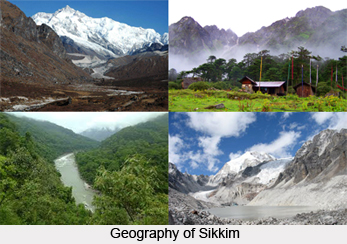
•Mountain Climate Mountain climate or alpine climate is experienced in the northernmost lands in India. Sharp temperature contrasts between sunny and shady slopes, high diurnal temperature variability, temperature inversions and altitude-dependent variability in rainfall are common in the regions experiencing mountain climate.