Introduction
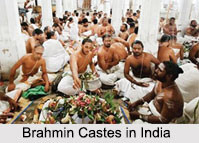 Brahmin Caste in India refers to the class of educators, law makers, scholars, priests and preachers of Dharma in Hinduism. The concept of Brahmin caste had started from the Vedic times. Brahmins are the members of the highest of the four varnas. According to Hindu mythology, Brahmins are the creations of Lord Brahma, God of knowledge and education.
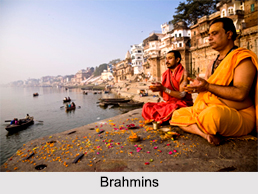 Brahmin is considered as a member of the priestly caste of the country. In Hinduism, there is the concept of "Varna" system where the society is stratified into four "Varnas" or castes - Brahmin, Kshatriya, Vaishya, Sudras. The Brahmin occupies the highest level in the "Varna" system and is considered to be the priest class in the Varna system of ancient India. The word "Brahmin" has been derived from the Sanskrit word "Brahmana". Besides Hinduism, Brahmins are also found in Buddhism. Dhammapada has a list on the Buddhist Brahmin section. Brahmin Bhikshus were quite common with this religious sect. Other sects like Jainism, Islam and Sikhism also bear testimony to the existence of Brahmins within their religious sects.
Brahmins during Vedic Period
The Vedic period, a crucial phase in ancient Indian history, witnessed the emergence of a class of individuals known as Brahmins, who played a pivotal role in shaping the social and religious fabric of the time. The earliest reference to Brahmins can be traced back to the Rigveda, particularly in the renowned hymn called Purusha Sukta. Within this sacred text, the Brahmins are depicted as having originated from the mouth of Purusha, signifying their association with the realm of words and knowledge.
However, scholars now believe that the Purusha Sukta varna verse was likely inserted into the Vedic text at a later date, possibly as a charter myth. The Rigveda itself does not provide evidence for an elaborate caste system, and the varna system appears more as an aspirational social ideal rather than an established reality.
In the context of their societal role, the Grhya-sutras highlight the distinctive duties and privileges of Brahmins, which encompassed Yajna (ritual sacrifice), Adhyayana (the study and teaching of the Vedas), and dana pratigraha (accepting and giving gifts). These responsibilities were considered inherent to the Brahmin class, setting them apart in their contributions to religious and educational domains.
It is important to note that the term "Brahmin" in ancient Indian texts did not solely denote a priestly class based on birth but rather emphasized personal qualities of virtue and goodness. This broader definition aligned with the principles of Hinduism, particularly the concept of Sannyasa or the renunciate stage of life dedicated to spiritual pursuits. As such, Brahmins were often associated with asceticism, embodying the values cherished during this phase.
The Dharmasutras and Dharmashastras, canonical texts of Hinduism, expounded the expectations, duties, and responsibilities of Brahmins in society. Drawing parallels with Greek virtue-ethics, these texts portrayed the virtuous Brahmin as one possessing practical wisdom and moral uprightness, akin to the philosophers of the Greek tradition. Nonetheless, the distinction lay in the Brahmin`s sacred role as a priest and custodian of religious rituals.
One of the distinguishing features of Brahmins during the Vedic period was their obligation to perform all six Vedic duties, unlike other twice-born individuals who performed only three. These duties encompassed Adhyayan (the study of the Vedas), participation in Yajana (ritual sacrifice), Dana (giving gifts), Adyapana (teaching of the Vedas), conducting Yaajana (acting as priests during sacrifice), and Pratigraha (accepting gifts).
History of Brahmin
Some parts of India were also ruled by Brahmin Kings. From Vedic times on, the Kings acted in close relationship with Brahmins and relied on them as their advisors. The Brahmins had become an influential and powerful group in India and were famous for discriminating against `lower` castes. The history of the Brahmin community in India starts with the Vedic religious conviction of early Hinduism which is now frequently referred to by Hindus as Sanatan Dharm. Vedas are the main source of knowledge for Brahmin practices. Most "sampradayas" of Brahmins have taken motivation from the Vedas.
The Brahmins only show up in the historical evidence around the time of the Gupta Empire, which ruled from the 4th to the 6th century CE. The caste system has clearly been more flexible, in terms of suitable work for Brahmins, than one might anticipate. With the sovereignty of the Maratha Dynasty, members of the Brahmin caste served as administration and military leaders, occupations more characteristically associated with the Kshatriya.
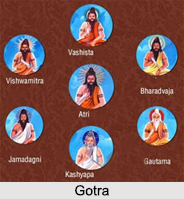
The Muslim rulers of the Mughal Dynasty also used Brahmins as advisors and government officials, as did the British Raj in India. The ancient Hindu caste system is divided on the basis of occupation. With the Vedic religion in ancient India the history of the Brahmin community actually begins. In chapter ten of the Rig Veda, Brahmins were created from the mouth of Purusha. The primary source of knowledge for all Brahmin tradition, both orthodox and heterodox lies in the Vedas. The origin of the Brahmins can be traced back to 6000 B.C. the earliest references are found in Vedas. Brahmins are known as Vedic People. Vedas depict them as a population originating in North India, Pakistan and Afghanistan. Sages like Vishwamitra, Agastya, Brihaspati, Daksha, Kashyapa, Manu, Parasara, Vashishta, Vyasa and Yamaand and several others are mentioned in the mythological texts and Vedas. They imparted education and led a life of simplicity. The life of an Indian Brahmin is divided into four stages - Brahmacharya, Grihastha, Vanaprastha and Sannyasa.
Culture of Brahmin
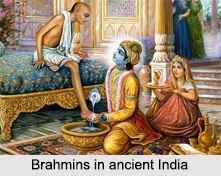 The Brahmin"s conventional occupation is that of a priest. In Odisha, West Bengal, and Uttar Pradesh, many Brahmin have land and practice agriculture with the administration facility, business, household industry and astrology. No one apart from a Brahmin can be a socially accepted priest. Brahmins were the foremost to act in response to English education and the first to benefit from political and managerial power.
The Brahmin caste is mainly the strict vegetarians. In Punjab and Himachal Pradesh, the younger generation eats meat. Rice, wheat and maize are the staple cereals. In dry regions such as Rajasthan, coarse cereals like bajra and jowar, seasonal vegetables and fruit and milk and dairy products are staple food for Brahmins.
The adequate age for marriage of women is 18 and older for men. Marriages are in order by the parents and monogamy is the standard. The family property is inherited equally by sons only, the eldest son following to the head of the family. Wives spread vermilion powder known as "sindur" along with the hair parting and wear toe rings. Payment of dowry is both in cash and goods. Divorce is rare and remarriage for widows is forbidden. Widowers however, are allowed to remarry.
The Brahmans are alienated into 10 major protective divisions, 5 of which are connected with the north and five with the south. The northern group consists of "Sarasvati", "Gauda", "Kannauj", "Maithil", and "Utkal" Brahmans, and the southern group comprises of Maharashtra, Andhra, Dravida, Karnata, and Malabar.
Types of Brahmin Caste in India
The Brahmin caste in India has been broadly divided into two divisions based on regions. They are "Pancha-Gauda Brahmins" from North India and "Pancha-Dravida Brahmins" from the South India.
The Pancha-Gauda Brahmins have further been divided into five classes. They are;
1. Saraswat Brahmins
2. Kanyakubja
3. Maithili Brahmins
4. Gauda Brahmins
5. Utkala Brahmins
The Panch Dravida Brahmins are also divided into five classes. They are;
1. Andhra
2. Dravida
3. Karnataka
4. Maharashtra and Konkan
5. Gujarat
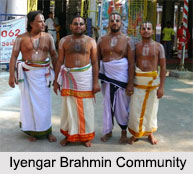 Various Brahmin Castes in India
In different states of India, the Brahmin caste appears with individual names and individual practices. Some of the well known Brahmin castes in India are Anavil Community, Andhra Brahmin Community, Ayyangar Brahmin, Ayyar Brahmin, Chitpavan Brahmins, Deshastha Community, Karhada Community, Kashmiri Brahmin Community, Madhava Community, Mohyal Community, Nagar Brahmins, Rarhi Brahmins, Barendra Brahmins, Dhadich Brahmins, Bhumihar Brahmins and a lot more.
Anavil Community: This community of Brahmins date back to era of Ramayana. They claim that their lineage is linked to the sages of the Yajur Veda. They were mostly concentrated in South Gujarat and have flourished in administrative services.
Andhra Brahmin Community: The origin of the Andhra Brahmins can be traced back to the 2nd Century BC. This erudite community proved to be a lot of help as counsels to the ruling class. Today they are concentrated in Andhra Pradesh. The cultural contribution of Andhra Brahmins has been immense.
Ayyagar Brahmin Community: They are the followers of Ramanuja"s principles. This sage advocated Visistadvaita. This community has also been witness to the Bhakti cult. They are generally quite orthodox about their religion and social set up. They are also considered one of the most talented Brahmin communities.
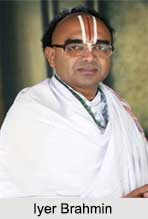
Ayyar Community: The biggest Brahmin community in South India constitutes of the Ayyars. They are mainly concentrated in Kerala and Tamil Nadu. They are in love with their age old traditions and customs. Indian literature is indebted to this community for their literary contribution.
Chitpavan Brahmins: This particular community belongs to Maharashtra. Their origin is steeped into legends. Historically it was during the Maratha rule that they came into prominence. They are also popular for their contribution in the nationalist struggle.
 Deshastha Brahmins: The region around the Krishna and the Godavari rivers and plateau of the Sahyadri Hills are hailed as the birth land of the Deshastha Brahmins. Today they have settled in the states of Maharashtra, Andhra Pradesh and Karnataka.
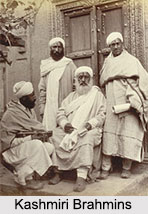
Kashmiri Brahmins: As their name suggests they have originated from the valley of Kashmir. Till date they have successfully stuck to their Vedic Aryan root. India has always had some Kashmiri Brahmin or the other to serve her in the form of poets, scholars, statesmen and diplomats.
Madhava Brahmins: Madhava community is the follower of Lord Vishnu or simply, Vaishnavites. They are settled in Karnataka, Tamil Nadu, Andhra and parts of Maharashtra and are also known as Tuluva Brahmins. They have been influenced greatly by the principles of Madhavacharya and his Dvaita Philosophy.
Brahmins in Buddhist and Jain Texts
The term "Brahmin" finds frequent mention in ancient and medieval Sutras and commentary texts of both Buddhism and Jainism. It is essential to note that the usage of the term in these contexts does not necessarily imply a reference to the caste system prevalent in Hindu society. Rather, it carries diverse connotations, such as "masters" (experts), guardians, recluses, preachers, or guides of any tradition. In the non-Hindu traditions, an alternative synonym used for Brahmin is "Mahano."
Scholars have examined these ancient texts closely, shedding light on the nuanced interpretation of the term "Brahmin" within the context of Buddhism and Jainism. It becomes evident that the term is employed to signify individuals who possess expertise, knowledge, or authority in specific domains, rather than being solely associated with their social status or lineage.
In the Buddhist tradition, "Brahmin" denotes individuals who have achieved mastery in certain aspects of their spiritual practice or teachings. They may act as guides for others on the path of spiritual enlightenment and serve as guardians of sacred knowledge. It is worth emphasizing that the Buddhist understanding of Brahmin transcends the boundaries of caste and instead focuses on one`s spiritual attainments and wisdom.
Similarly, within Jainism, the term "Brahmin" is used to designate learned and enlightened individuals who have attained profound knowledge of Jain scriptures, ethics, and philosophical principles. These Mahanos or Brahmins in Jain texts assume the role of spiritual mentors, guiding their disciples toward righteous conduct and spiritual progress.
Brahmins during Social Reform Movements
Throughout history, Brahmins have played a pivotal role in shaping the spiritual landscape of India, particularly during the Bhakti Movement and subsequent social reform movements. The Bhakti Movement, which emerged during the medieval era, sought to foster a direct and personal connection between individuals and their chosen deities, transcending rigid religious hierarchies.
In the realm of the Bhakti Movement, Brahmins stood as prominent thinkers and early proponents. Figures such as Ramanuja, Nimbarka, Vallabha, and Madhvacharya of Vaishnavism, along with the devotional poet sant Ramananda, were instrumental in nurturing this transformative movement. Ramananda, born into a Brahmin family, epitomized the inclusive spirit of Bhakti, welcoming all seekers regardless of gender, class, caste, or religion, including Muslims. His spiritual teachings were expressed in vernacular poems, accessible to people from various walks of life. Today, Ramananda is revered as the founder of the Hindu Ramanandi Sampradaya, one of Asia`s largest monastic renunciant communities.
Similarly, other medieval-era Brahmins contributed significantly to spiritual movements that rejected social and gender discrimination. Notable figures like Andal, a 9th-century female poet, Basava of Lingayatism in the 12th century, Dnyaneshwar, a Bhakti poet from the 13th century, Vallabha Acharya, a Vaishnava poet from the 16th century, and Chaitanya Mahaprabhu, a Vaishnava saint from the 14th century, stood as beacons of inclusivity and devotion.
In the wake of the Bhakti Movement, the 18th and 19th centuries witnessed several Brahmins leading religious movements that openly criticized idolatry and sought reform. For instance, Raja Ram Mohan Roy, an illustrious Brahmin, spearheaded the Brahmo Samaj, a socio-religious reform movement emphasizing monotheism, rationality, and social equality. Another influential Brahmin, Dayananda Saraswati, took the lead in establishing the Arya Samaj, advocating for Vedic teachings, denouncing caste-based discrimination, and promoting educational reform.
In more recent times, Lokmanya Bal Gangadhar Tilak, a prominent Brahmin, played a key role in popularizing the festival of Ganesh Chaturthi, which involves the worship of Lord Ganpati in the form of an idol. His efforts helped make this celebration a unifying event that transcended barriers of caste and creed.
Brahmin in different states
In Andhra Pradesh, the Brahmins are categorized into two groups - Vaidika and Niyogi, Bihar Brahmins are divided into two broad groups namely Bhumihar Brahmins and the Maithili Brahmins. In Karnataka, the Brahmins are divided into three major groups namely Smarthas, Madhvas (or Vaisnavas) and Sri-Vaishnavas (Iyengars).
Brahmins are classified into two groups in Kerala, while the major priestly activities are performed by Namboothris and the other activities associated with the temple is performed by Pushpaka Brahmins. In Rajasthan, Brahmins are mainly classified into Dahima Brahmin, Gaud Brahmin, Sri Gaud Brahmin, Khandelwal Brahmin, Gujar-Gaud Brahmins.