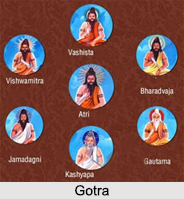
During their sojourn in Goa the Saraswat Brahmins made a significant contribution to cultural life and built some of the many beautiful temples in the western region. These temples were dedicated to their deities, particularly, Mangesh, Mahalakshmi, Shantadurga and Ramnath. One of the customs followed by the community is that a Saraswat couple visiting the Kuladevta (family deity) for the first time after their marriage. Here they are remarried in the deity`s presence.
When Goa became Portuguese, the Saraswat families began migrating south to the Kanaras for fear of being forced to accept Christianity. The Goud Saraswats went as far as Cochin and Travancore (now Kerala).
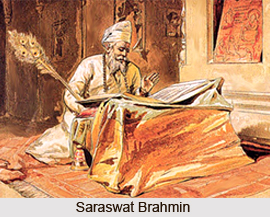
Some Saraswat families remained in their original homes so that there still are Saraswats in Kashmir, Goa, West Bengal, and Kanara. Later, under the influence of the teachings of Madhava, many became Vaishnavites. In an age when the means of communication were very limited, these sub-communities tended to lose track of each other and only 3 emerged: Shenvis, Goud Saraswats {Vaishnavites) and Chitrapur Saraswats, each owing allegiance to a different math. The chief maths of the Goud Saraswats are in Pertagali and Kasi and that of the Chitrapur Saraswats in Shirali. All the maths have their own guru `paramparas` (traditions) and are centers for learning Sanskrit as well.
At the beginning of the 20th century the Saraswats began to migrate from the Kanaras to the cities, chiefly Mumbai and now only a few Saraswat families are to be met within the villages. Their ancestral homes are set in mango, jack fruit and cashew groves. The local people still refer to them as Shambhagru, Shenoy or Patel.
Since independence, the Saraswats have become an urban phenomenon. Almost every Saraswat is literate; those who are well educated become civil servants, teachers, writers or journalists. Young Saraswat men and women have in recent years done well in engineering, medicine, law, industry, publishing and research. They have written and produced Konkani, Kannada and Marathi plays, contributed to music and received national acclaim. There have been well-known painters, film directors, actors and dancers.
The first people in India, many say in Asia, to plan and execute a scheme for a co-operative housing project, the Saraswats have successfully operated many types of co-operative activities such as holiday homes, schools, housing projects, banks, libraries, buying and selling co-operatives, religious shrines and social welfare or self-help units.

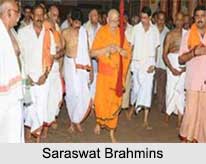 Saraswat Brahmins are a small, highly urbanized community. Saraswat Brahmins are the most revered and esteemed amongst all the Brahmin sub-castes. They form the absolute Apex amongst all the Brahmins sub-castes because they were the original teachers and propagators of the Vedas. They are mentioned in ancient historical texts such as the Bhagwat Gita, Mahabharata, Ramayana and Vedas. This particular group can be divided into 3 main groups:
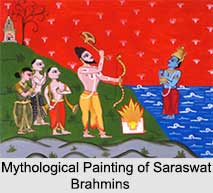 Quite possibly, the Saraswat Brahmins migrated from Kashmir to Goud (