
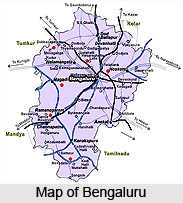
 Bengaluru is the capital city of Karnataka. It is located on the Deccan Plateau towards the south-eastern part of Karnataka. Bengaluru is one of the most developed cities of the Indian sub-continent and is rightly called the Silicon Valley of India. The city of Bengaluru can be called a perfect blend of natural beauty and man-made wonders. It is the fifth most populous urban conglomerate and is the third most populated city in the country. Bengaluru can be called a seat of cultural melting pot because people from far and wide throng the city to use its advancement for growth and progress.
Bengaluru
Bengaluru, the capital of Karnataka, is the most cosmopolitan, urbane and developed city in India.
Introduction
Bengaluru is the capital city of Karnataka. It is located on the Deccan Plateau towards the south-eastern part of Karnataka. Bengaluru is one of the most developed cities of the Indian sub-continent and is rightly called the Silicon Valley of India. The city of Bengaluru can be called a perfect blend of natural beauty and man-made wonders. It is the fifth most populous urban conglomerate and is the third most populated city in the country. Bengaluru can be called a seat of cultural melting pot because people from far and wide throng the city to use its advancement for growth and progress.History of Bengaluru
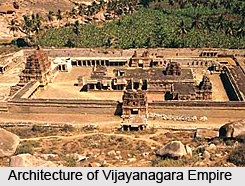
The history of Bengaluru dates back to 1537 when Kempe Gowda I had undertaken the architecture of this modern city. He had made present Bengaluru a province of the Vijayanagar Empire. During the British rule, Bengaluru had become an important seat of colonial rule. The Bangalore Cantonment was established during this time. As a result migrants from various parts of the country started coming in.
Geography of Bengaluru
Bengaluru is placed at the heart of the Mysore Plateau. It is at an elevation of 920 meters above sea level.
 The city of Bengaluru is positioned at the juncture of 12.97 degrees north latitude and 77.56 degrees east longitude. It encompasses an area of 741 square kilometers. The topology of the city is more or less flat except for the central ridge that runs from north-eastern part of the city to the south-western part of the city. No major river cuts the city and it has only a very few fresh water lakes and water tanks.
The vegetation of the city is mainly of the deciduous variety with very few coconut trees.
Due to its favourable geographic position the city of Bengaluru enjoys a moderate climate throughout the year. Occasional heat waves make the city uncomfortable during the summer months. The hottest month experienced by the people of Bengaluru is April and the coldest month is January during which temperatures dip as low as 15.1 degrees of centigrade.
The city of Bengaluru is positioned at the juncture of 12.97 degrees north latitude and 77.56 degrees east longitude. It encompasses an area of 741 square kilometers. The topology of the city is more or less flat except for the central ridge that runs from north-eastern part of the city to the south-western part of the city. No major river cuts the city and it has only a very few fresh water lakes and water tanks.
The vegetation of the city is mainly of the deciduous variety with very few coconut trees.
Due to its favourable geographic position the city of Bengaluru enjoys a moderate climate throughout the year. Occasional heat waves make the city uncomfortable during the summer months. The hottest month experienced by the people of Bengaluru is April and the coldest month is January during which temperatures dip as low as 15.1 degrees of centigrade.
Population of Bengaluru
The year 2009 has reported a population of 5.3 million in Bengaluru. As a result it has become the third most populous city in India and ranks 28th in the world. Between the years 1991 to 2001 Bengaluru has witnessed a growth of 38 percent population growth. The main language which is used by the people of Bengaluru is Kannada and English. Apart from these two languages the other languages that are spoken in the city are Tamil, Telegu and Hindi. According to the 2001 census around 79 percent of the Bengalurean population comprises Hindu. Muslims, Christians and Jains comprise 13.37 percent, 5.79 percent and 1.05 percent respectively. The Anglo- Indians are an important community in the city of Bengaluru. Around 47.5 percent of the city`s population is women.
 The fact that Bengaluru is sufficiently developed can well be understood from the fact that it has a literacy rate of 83 percent making it rank second in the country and only around 10 percent of the city`s population dwell in slums.
The fact that Bengaluru is sufficiently developed can well be understood from the fact that it has a literacy rate of 83 percent making it rank second in the country and only around 10 percent of the city`s population dwell in slums.Education in Bengaluru
Until the early nineteenth century education in Bengaluru was conducted by religious leaders but gradually education in the city became secular in nature. Today Bengaluru is home to many of the reputed institutes in India. Rather it can be said that the education system in Bengaluru is quite advanced and as a result lot of students flock in the city to pursue higher education. The reputed institutes of Bengaluru are as follows, the Indian Institute of Science, the Indian Institute of Management, Indian Statistical Institute, National Law School of India, and the National Institute of Mental Health and Neuro Sciences. Thus it can be said that Bengaluru is a cultural melting pot not only due to the various industries which have been set up in the city but also due to the various academic institutes which have grown up in the country.
Economy of Bengaluru
Bengaluru is a major economic hub of the Indian sub-continent. The city has an economic growth as high as 10.3 percent and it is the fourth largest market for fast moving consumer goods in India. The city is also home to a large number of rich people. Around 60,000 super rich people have invested an amount of nearly 4.5 crores in the city. Bengaluru is home to several public sector undertakings as well as a number of major IT hubs. It can be said that the IT giants have aided the escalation of the economy in Bengaluru to a large extent.
Culture of Bengaluru
 The important festivals in the city of Bengaluru are Dussehra, Karaga Shaktyotsava and Diwali. These festivals transcend all religious boundaries in the city and people from multiple backgrounds participate in these festivals with a lot of vigour and enthusiasm. Other Indian festivals like Ganesh Chaturthi, Id-ul-Fitr and Christmas are also celebrated in the city with a lot of pomp and show.
The Kannada film industry has added to the cultural heritage of the city. The culture of theatre is also very popular in Bengaluru. Apart from the traditional theatres, art and dance forms, it is believed that Bengaluru has been home to a number of international rock concerts in the recent years. As a result it has earned the name the `Pub Capital of India`.
The cuisine of the city is also largely varied and reflects the different cultures which have been transported to the city from various parts of the country.
Hence, it can be said that Bengaluru has brought the entire country of India under its realm by attracting people from various parts.
Libraries in Bengaluru
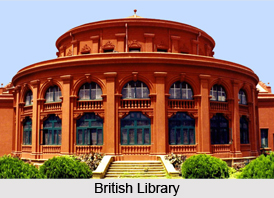 Libraries in Bengaluru serve the people of the city with a sea of knowledge that gives a deep insight about every aspect of the world, be it history, science, art and culture, astrology and others. They provide reading materials to the readers belonging to all age groups and diverse choices. Apart from books, newspapers, periodicals, journals, magazines and manuscripts are also available in the libraries. Libraries in Bengaluru host a number of unique and rare collections which have been preserved since ages. These libraries form a significant part of the society by greatly enriching the knowledge base of the people.
British Library : British Library, situated in Kasturba Road of Bengaluru, was established in the year 1960. It serves as a cultural link between India and UK. It houses a rich collection of books encompassing all possible disciplines including medicine, management, law, information technology, engineering, economics, history, science and technology, fiction, English literature and arts. A fine collection of DVDs and periodicals from UK are also found in the library. Information about studies in Britain can also be obtained from the library.
The Indian Institute of World Culture : The Indian Institute of World Culture is a famed public library situated in B.P Wadia Road of Bengaluru. It was founded in August 1945 and hosts a collection of books related to every branch including art, culture, science and literature. The library serves the people belonging to all age groups. The entire collection of books in the Indian Institute of World Culture numbers around 45,000 with a good collection of English and Kannada ancient literature. It also serves the students with its plethora of academic books. It also has a separate section for children which comprise 10,000 books.
Other Libraries in Bengaluru : Other Libraries in Bengaluru include Digital Library of India, Bangalore Surgical Trust Medical Library, Book Boutique, Children`s Library, City Central Library, Eloor Library, Government Secretariat Library, J.R.D Tata Memorial Library and many others.
Temples around Bengaluru
 Bengaluru, the capital city of Karnataka, is one of the most developed cities of the Indian sub-continent and is rightly called the Silicon Valley of India. The city of Bengaluru can be called a perfect blend of natural beauty and man-made wonders. Bengaluru is blessed numerous historical temples which has made the city one of the prominent tourist destinations of the country. Besides the temples in Bengaluru there are ancient shrines that are located adjacent to this Tech City in Karnataka as well. Both the pilgrims and tourists can drop in at these religious places. Few of the notable temples in and around Bangalore are:
Nandi Bull Temple : The bull temple, dedicated to Nandi bull, the vahana of Lord Shiva, was constructed to appease a bull that was wreaking havoc by consuming crops that are cultivated locally. Apparently, the bull gradually stopped damaging the crops, and the Kadalekai Parase or the Groundnut Fair started in the vicinity of the temple. The temple is located in Basavanagudi.
Kolaramma Temple : This temple was built during the pre-Chola period and renovated subsequently. A holy stream called Antaragange flows nearby. Sri Neelakanteshwara Temple is situated at the foothills.
Sivaganga : This holy hill with an altitude 5000 feet is to be found near Tumkur. It has been a popular pilgrim spot for ages. The hill appears as a huge Nandi, while resembling Ganesha or Lingam from other angles. Sri Gangadheeswara temple is situated inside a cave-like structure. It is said that when ghee is offered during `Abhisheka` or coronation, it turns to butter. This is a rare phenomenon. This butter is considered to possess medicinal properties.
Goddess Honnadevi, standing on Rakta Beejasura, is in another temple. Adi Sankara had installed a Sri Chakram in front of the Devi. Sapta Mathas, Chandikeswara, Dikbalakas and Navagrahas have separate shrines. On top of the hill, there is a shrine dedicated to Sri Virupaksheswara inside a cave with a perennial spring, known as Patala Ganga or Olakkal Theertham. In Hebbur (Tumkur taluk), there is another shrine that is dedicated to Goddess Kamakshi Sharadambal.
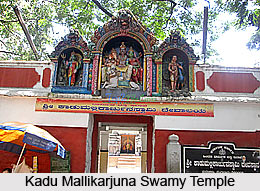
 Kadu Mallikarjunaswamy : According to legends, it is considered as one of the oldest temples in Bengaluru, built by the step brother of Chatrapati Shivaji, who built the temple after he stumbled upon a Shiva lingam. It is believed that the temple was set up in 1669, in Malleswaram one of the few oldest regions in bengaluru.
Devarayanadurga : This hill temple near Tumkur is dedicated to Narasimha, installed by Dhurvasa. There are separate shrines for Lakshmi Devi, Dhurvasa and Sri Ramanuja. Opposite to this hill, there is another shrine of Narasimhaswamy, whose image was installed by Brahma.
Ghati Subramanya : The temple of Lord Subramanya (17 km from Dodaballapur) is visited by thousands of pilgrims throughout the year.
Nandi Hills : This is a popular hill resort situated at an altitude of 1,478 metres. Rivers Pennar, Palar and Arkavati originate here. There is a temple of Yoga Nandiswara. At the Nandi town at the foot of the hill, there is a shrine of Bhoganandiswara, which dates back to the period of the Kings of Vijayanagara, Cholas, Banas etc. Arunachaleswara and Umamaheswara are also located here.
Yediyur : Sri Siddhaligeswara temple is situated in Yediyur, 52 km from Tumkur. The annual festival during March-April is largely attended by devotees.
Dodda Ganesha Temple : The Ganesh temple, situated at Basavanagudi, boasts a huge 18 feet long Ganesh idol. The idol is decorated in various fashions through out the week. The most famous being the process of coating the idol with butter, which requires around 100 kgs of purified butter.
Shiva Temple : The Shiva statue on the Airport Road is almost 65 feet in height and portrays Lord Shiva in the Lotus position, sitting atop Mount Kailash. This temple was constructed in 1995. The temple is very popular among the locals and tourists because of its opulence and beauty.
Several other temples around Bangalore are as follows:-
Temples of Ganesha and Someshwara at Kurudumale (12 km)
 Anjaneya Temple, Mulbagal (29 km)
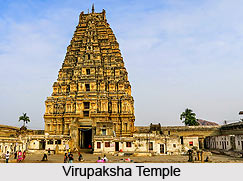
Virupaksha Temple
Rameshwara Temple, Avani
Shankaranarayana Temple, Malur (32 km)
Markandeshwara Temple, Vokkalery hill
Anjaneya Temple, Tekal
Venkataramanaswamy Temple, Guttahalli
Chandeshwari Temple at Srinivaspur
Chandramouleeswara Temple, Chintamani
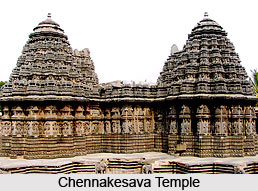
Veerabhadra and Channakeshava Temples, Chikballapur
Monuments of Bengaluru
 The monuments of Bengaluru include a host of religious as well as secular monuments. While the temples display the native style of construction, the secular monuments mostly date back to the British Empire. These buildings, as a result, reflect the Gothic architectural pattern. As far as the city of Bengaluru in Karnataka is concerned, it is one of the fastest-growing cosmopolitan cities in the world. Home to over 2,500,000 people, Bengaluru was founded by Kempe Gowda in the early 16th century. It went on to become an important fortress under Hyder Ali and Tipu Sultan in the late 18th century. With the storming of Seringapatam in 1799 and the demise of Tipu Sultan, the Wadiyar family were restored to power by Wellesley. In 1881 the state passed from British control to an adopted heir, although the large cantonment area was assigned to the British government for military use. By the end of the century Bengaluru was a well-established and flourishing garrison town.
Though the cantonment was initially separated from the old town by a strip of open land, the two areas have since merged into a large whole. However the character of the cantonment can still be distinctly felt.
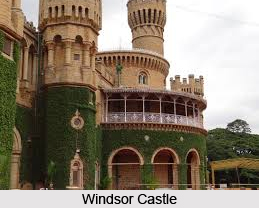
The architecture and monumental constructions of the area can also viewed from this perspective- those in the Cantonment area and those in the city. The Maharaja`s palace lies in the North West of the Cantonment area. It was originally built for a local British Merchant, but later taken over and extended for use by the Maharaja of Mysore. It is quite similar to the Windsor Castle in outline, with a romantic skyline of machicolated and crenulated towers. Adjoining the entrance is a large semicircular bay crowned by an elegant cast-iron veranda.
 A steep staircase with a carved Gothic balustrade runs on the inside, enriched with bronze figures and overlooked by hunting trophies. The ballroom, reception rooms and bedrooms are remarkably done as is the splendid tiled multiple lavatories. There is a Dower House in the extensive grounds, together with an interesting cast-iron conservatory.
The suburbs of Cleveland Town, Fraser Town and Richards Town lie to the North East of the Ulsoor tank. In Cleveland Town arc St. Xavier`s Roman Catholic Church and St John`s Anglican Church, in the cemetery of which is the Tomb of General J. W. Cleveland, after whom the area is named.
The oldest Mosque in the city is the Jama Masjid. It was earlier known as Sangian Jamia Masjid. Located in the busy K.R. Market area, the mosque is renowned for its beautiful architecture. It was built sometime in the 19 century. The prayer hall of the Jama Masjid stands on an elevated ground and is adorned with high, ornate granite pillars. The structure is made of brick and mortar, and the fa‡ade of the Mosque is embellished with elaborate jali-work and floral motifs.
There are spherical domes above the balconies and grand twin minarets inside the Masjid that reach almost as high as the domes. These minarets have been decorated with a large number of pigeonholes. A delicate pattern that was previously concealed under successive layers of white paint was discovered a few years back inside the Jama Masjid. During the festive season the entire mosque is beautifully lit up with lights which further add to its beauty.
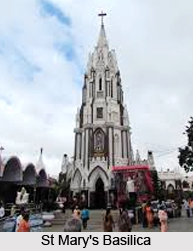 The St Mary`s Basilica was initially built as a small chapel by Abbe Dubois in the year 1818. Later, Reverend L.E. Kleiner converted it into an ornate Gothic style church. A number of stained glass windows were imported from Paris in 1882 in order to adorn the Bascilica. Though these were removed during World War II, and they were again restored in 1947. The St.Mary`s Basilica has Gothic style pointed arches and an imposing tower. The status of a Basilica was given to it in 1973 through a papal order by Pope John Paul the sixth. The Feast of St. Mary is the greatest attraction of the Basilica when devotees from far and wide come to attend the feast.
Trinity Church, off the Old Madras Road, contains some fine memorials. There is a half-length marble statue of General Clement Hill, who served through the Peninsular War and later commanded the Mysore Division, before his death in 1845. To the west of Trinity Church lie the Wesleyan Chapel, the Public Offices and Mayo Hall. This is a handsome Italianate stucco building with rusticated quoins and a typical crested roof. To the south are St Joseph`s College, the Gothic Roman Catholic Cathedral and All Saints` Church.
At the west end of the Parade Ground is St Mark`s Church (mid-19th century). It is situated on the busy M.G. Road of Bangalore. The construction work of the church was completed in 1812 even though the foundation of this cathedral was laid down in the year 1808. However, it was only in 1816 that St. Marks Cathedral got consecrated by the Bishop of Calcutta. The cathedral was expanded first in the year 1901 and later reconstructed in 1927. The 17th century St Paul`s Cathedral is the chief inspiration behind the architecture of St. Mark`s Cathedral.
It is built in the colonial style of architecture, and is adorned with a semicircular chancel, with a huge, magnificent dome. Further splendour is added to the church by means of the various Roman arches embellishing the walls of the cathedral. Saint Mark`s Cathedral boasts of having one of the best-maintained external bells amongst all the churches in the Bangalore city of India. The intricate carving and exquisite woodwork merge beautifully with its elegant ceilings and domes. The stained glasswork of the cathedral further magnifies its beauty. This is an interesting building, a distinguished stucco edifice with a shallow dome over the crossing and a domed apse. A memorial tablet to Lieutenant-Colonel Sir Walter Scott of Abbotsford (the second baronet), who died at sea in 1847 is kept inside the Church.
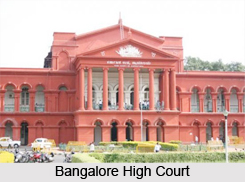
The High Court (formerly the Public Offices) is yet another impressive construction in the cantonment area. It has a long, low, arcaded range enriched with Ionic porticos. Finished in Pompeian-red stucco, the building was designed by Colonel {later Sir) Richard Sankey between 1864 and 1868. On the other side is the Vidhana Sabha, wherein are located the Secretariat and State Legislative. It is a huge neo-Dravidian granite building and in fact one of the most impressive modern buildings in India. The huge door to the Cabinet Room is made entirely of sandalwood.
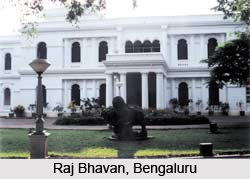
The Public Offices are a huge building in front of which is a statue of Sir Mark Cubbon, Commissioner of Mysore (1834-61). To the North of the public offices lies the Raj Bhavan, the former Residency (early 19th century), a low stucco building in a beautifully landscaped compound
 Besides these the public library is housed in the Sir Sheshadri Iyer Memorial Hall. The Government Museum, founded in 1866, is also located in the park. Here there are relics from Tipu`s palace at Sermgapatam and sections on geology, numismatics and art. Upstairs is a remarkable collection of stuffed animals and fish. A Memorial Statue of Queen Victoria, unveiled by the Prince of Wales (later George V) in 1906, and, a statue of Edward VII are also to be found here.
There are a number of historical monuments here too. Petta is the name by which the city of Bengaluru is known. It was named after the deep ditch and thorn hedge which protected the area until 1898. The fort lies to the South of the Petta on Krishnarajendra Road. It was originally built as mud brick structure by Kempe Gowda in 1537 .It was later reconstructed by Tipu Sultan in 1761.It is oval in shape, 731 m (2,400 ft) from north to south and 548 m (1,800 ft) from east to west. Only the Delhi Gate remains. The fort contains an Arsenal and fragments of Tipu Sultan`s palace, but little else of any consequence. It fell in British hands after it was captured by Cornwallis on 21 March 1791 after a fierce battle.
Tipu Sultan`s Summer Palace, completed in 1791, is now a dilapidated ruin next to a temple at the junction of Krishnarajendra Road and Albert Victor Road.
Tourism in Bengaluru
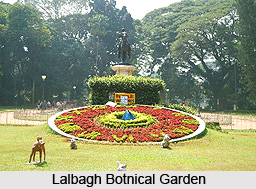
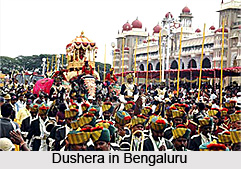 As far as tourism in Bengaluru is concerned, it attracts large number of visitors throughout the year. The city is known as the `garden city` of India and hence, is well known for the lush greenery in which the city takes pride. Not only is Bengaluru blessed with natural beauty it has a lot of artificial cultural as well as historical heritage which has made the city one of the prominent tourist destinations of the country. The main attractions of the city are The Bull Temple, Lalbagh Botnical Garden, Vidhaan Soudha, Tipu`s Palace, Attara Kacheri, Bangalore Palace, Cubbon Park, Government Museum, Visveswaraiah Industrial and Technological Museum and Jawaharlal Nehru Planetarium. In addition to these there are several parks in the city.
It can be concluded that Bengaluru is a cosmopolitan city which has brought people from various backgrounds close to each other. It is one of the most developed cities in the continent of Asia and can be called the gateway to Indian economy. Discover local businesses including manufacturers, suppliers, and dealers across industries in Bengaluru Yellow Pages.
Recently updated articles in Cities of India
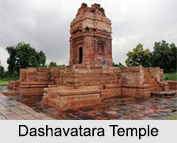
Places of Interest in Deogarh Uttar Pradesh
A place of historical and archaeological significance, Deogarh is a site with few popular places of interest.
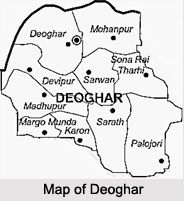
Deoghar in Jharkhand
Deoghar is the divisional headquarters of Santhal Parganas located in Jharkhand and is popular for the famous Baidyanath temple and Shiva Temples.
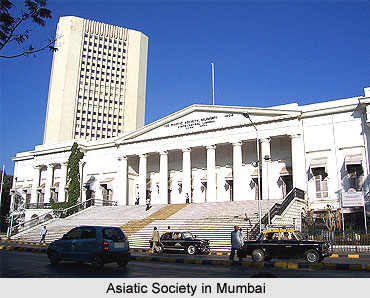
The Asiatic Society of Mumbai
Asiatic Society in Mumbai is the temple of Asian Studies from the time of British rule in India.
Vasco da Gama / Vasco City
Vasco da Gama / Vasco is the biggest city of Goa and is one of the most visited for its perfect amalgamation of business as well as leisure options.
Agriculture of Ladakh
Agriculture in Ladakh is primarily practiced in the short summer season due to its cold desert climate. Farmers grow hardy crops like barley, wheat, p...
Related articles in Cities of India
Holy Cities of North India
Holy Cities of North India are having the rich history of Hinduism and the entire civilization was grown up with the hands of beliefs, rituals and the...
Holy Cities of South India
Holy Cities of South India gives the detailed cultural formation of Dravidians from the early era, which later developed to the world by the Pallavas...
Holy Cities of West India
Holy Cities in West India were established by the rulers of Rajputs and the Satvahana Dynasty and the medieval rulers of Junagadh.
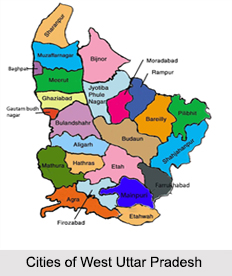
Cities of West Uttar Pradesh
Cities of West Uttar Pradesh include Meerut, Bulandshahr, Ghaziabad, Saharanpur, Muzaffarnagar, Bijnor, Bareilly, Rampur, Agra, Aligarh, Mathura and m...
Port Cities of South India
Port Cities of South India are developed from the early phase of colonial era when the Portuguese and the French traders came to India