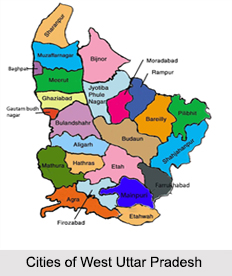
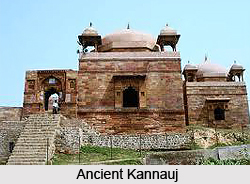
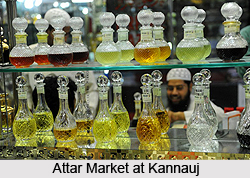
 Kannauj is a city, administrative headquarters and a municipal board in Kannauj district in the Indian state of Uttar Pradesh. It included as a new district of Uttar Pradesh on September 18, 1997. Kannauj is known for the distilling of scents and is a market center for tobacco, perfume and rose water. Kannauj is "a city which raised its head to the skies and which in strength and beauty might boast of being unrivalled". It was the most beautiful city of India ruled by various rulers. It`s a place of historical importance. The city`s name is traditionally derived from the term "Kanyakubja" which means "The city of the hunchbacked maidens". Kannauj is an ancient city, in earlier times the capital of Emperor Harshavardhana. It is said that Kanyakubja Brahmin`s are originally from Kannauj. It has given its name to a distinct dialect of the Hindi language known as "Kannauji".
Geography of Kannauj, Uttar Pradesh
Kannauj is located at an average elevation of 456 feet. The main river that flows through the district is Ganga, Kali and Ishan River. The Ganga River flows through the North East border of the district. Summer is very hot and dry in Kannauj while winter is cold and pleasant here. The average rainfall experienced by the state is 80 cm.
Demographics of Kannauj
As of 2001 India census, Kannauj had a population of 71,530. Males constitute 53% of the population and females 47%. Kannauj has an average literacy rate of 58%, lower than the national average of 59.5%: male literacy is 64%, and female literacy is 52%. In Kannauj, 15% of the population is under 6 years of age.
History of Kannauj
Kannauj is one among the most ancient place of India having rich archeological and cultural heritage. The traditional history of the district from the earliest times till the end of the Mahabharata war is gleaned from the Puranas and Mahabharata.
Kannauj town is known to have been an important city during the Gupta Empire. It was a centre of Hindu culture and political status for centuries. Kannauj is frequently referred to in the epic Mahabharata and is alluded to by Patanjali in the 2nd century B.C. In the year 405 A.D. when great Chinese pilgrim Fa-hien visited the city it had only 2 Buddhist monasteries and it was not very large. When Hiuen Tsang visited the city in 636 A.D., however, Kannauj had grown large. Hiuen Tsang stayed in Kannauj for 7 years.
Kannauj reached the pinnacle of its glory in the 7th century under Emperor Harshavardhana. He made Kannauj his capital and united his people, the Jats, as one nation under it. At that time it had earned the name of "Mahodaya Sree" due to its grandeur and prosperity. Kannauj then had a teeming population, with hundreds of Hindu and Buddhist temples and monasteries, extending along the east bank of the Ganges for about 4 miles. It had beautiful gardens and tanks, and was strongly fortified. Harshavardhana, however, was greatly weakened after being defeated by the Chalukya Emperor Pulakesin II; his empire fell apart soon after his death.
 By the end of the 8th century, Kannauj became the focus of a three-way contest by the three dominant dynasties of the time, the Pratiharas and Bargujar Kings of Kannauj, the Rashtrakutas of the Deccan, and the Palas of Bengal. The Pala King Dharmapala installed a proxy king at the end of the 8th century. When the Pratihara king Nagabhata II conquered Kannauj in the 9th century Kannauj became the Pratihara capital for nearly 200 years. The Rashtrakuta king Indra III captured Kannauj in 916.
In 1019, the town was sacked by Mahmud of Ghazni, beginning a chaotic period for the city. After this sacking of Kannauj, the area came to be dominated by the Chandela clan of Bundelkhand. The Gahadvala dynasty, descended from former vassals of the Pratiharas, established themselves as rulers of Kannauj at the end of the 11th century.
Places of interest in Kannauj, Uttar Pradesh
The Archaeological Museum of Kannauj was famous like Mathura, Kashi and Kaushambi for its art and culture. The clay models and idols found here are very progressive and give us a detailed description of antiquity. This place is worth to be visited.
Lakh Bahosi Bird Sanctuary is a beautiful sanctuary in the district of Kannauj. From November to March, are the months for bird watching here. There are about 49 bird families in this sanctuary. The other places of interest are Gauri Shankar Temple and Annapurna Temple.
How to Reach Kannauj
The most convenient way of reaching Kannauj will be to fly to Kanpur then drive the 80 km to Kannauj.