
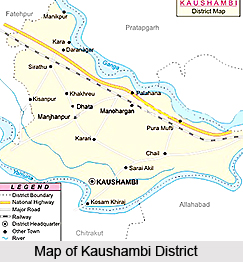
 Kaushambi District, an administrative district of Uttar Pradesh, is situated in the west of Allahabad District. This district forms a part of Allahabad Division. Kaushambi District is bounded by district Pratapgarh in the north, by Chitrakoot District in the south, by Allahabad in the east and by Fatehpur district in the west. Total geographical area occupied by Kaushambi District is 2012.8 sq kms. Manjhanpur is the district headquarters. Manjhanpur is situated in the south-west of Allahabad on the north bank of the Yamuna River.
Kaushambi District
Kaushambi District of Uttar Pradesh is known for its deep history. This administrative district is a part of Allahabad Division.
Introduction
Kaushambi District, an administrative district of Uttar Pradesh, is situated in the west of Allahabad District. This district forms a part of Allahabad Division. Kaushambi District is bounded by district Pratapgarh in the north, by Chitrakoot District in the south, by Allahabad in the east and by Fatehpur district in the west. Total geographical area occupied by Kaushambi District is 2012.8 sq kms. Manjhanpur is the district headquarters. Manjhanpur is situated in the south-west of Allahabad on the north bank of the Yamuna River.History of Kaushambi District
 History of Kaushambi District states that this district was carved out from Allahabad District on 4th of April, 1997. According to historical accounts, this district of Uttar Pradesh has a very glorious past. In ancient India, hundreds of years before Christ, Kaushambi was the capital of Chedi-Vatsa Janapada, one of the prominent janapadas into which Indo-Aryan people were divided. As some of these janapadas figure prominently in the Brahmanas and Upanishad, it is not unlikely that the antiquity of Kaushambi goes back to the period of the Brahmanas. Shatapatha Brahamana, Hindu Scripture mentions a person called Proti Kaushambeya, a native of Kaushambi. This ancient antiquity of the city is confirmed by Mahabharata and Ramayana, the former ascribing its foundation to Kusamba, son of Kasu.
Further, according to the history of Kaushambi District, Kaushambi was the hermitage of the sage Kosamba, after whom it came to be known by that name. According to Indian Puranas, Nicaksu, the sixth in line from Parikshit, transferred his capital from Hastinapur to Kaushambi, as Hastinapur was ravaged by flood, invasion of locusts and upheavals in the Kuru family itself. Evidently, according to the legend, the city of Kaushambi was important enough to be selected as the new capital of the scion of the Pandavas. The legend thus corroborates the antiquity of the city as recorded in the Brahmanas, Mahabharata and Ramayana. There are several legends associated with the origin of the name of Kaushambi District. One legend suggests that Kausambi was so named because in course of its foundation, a large number of Kusamba trees were uprooted.
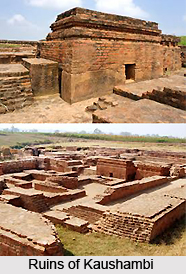
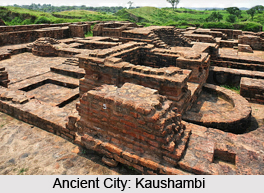
History also suggests that during Buddha`s time Kaushambi was one of the six most important and prosperous towns of India. It was the centre of ancient Indian communications as the principal routes from north to south and east to west met at the city. It was a terminus of river traffic and an important emporium of Madhyadesa. The city retained its importance at least up to sixth century AD, as it was visited by the Chinese pilgrims Fa-Hien and Yuan-Chwang. The ruins of the well-known site of Kaushambi are situated on the left blank of the Yamuna River at a distance of around 51 kms from Allahabad in a south-westerly direction. The remains of the ancient city give the impression of an imposing hillock reveals itself as a chain of rolling mounds, standing high above the surrounding plains, girdled on the south by the Yamuna. With the passage of time, the habitation level inside the city increased.
Geography of Kaushambi District
Ganga River and Yamuna River are the main rivers flowing through Kaushambi District.
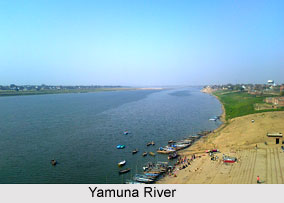 The plain area of the district is situated in between Ganga and Yamuna so these rivers play a very pivotal role in the agricultural development of the district. Kaushambi District has a moderate climate. Atmosphere of the district is pleasant. In the summer season weather is too hot and in the winter the weather is very cold. But in the rainy season the weather is good and pleasant. Soil of Kaushambi District is highly fertile.
The plain area of the district is situated in between Ganga and Yamuna so these rivers play a very pivotal role in the agricultural development of the district. Kaushambi District has a moderate climate. Atmosphere of the district is pleasant. In the summer season weather is too hot and in the winter the weather is very cold. But in the rainy season the weather is good and pleasant. Soil of Kaushambi District is highly fertile.Administration of Kaushambi District
Administration of Kaushambi District is divided into three tehsils namely Manjhanpur, Sirathu and Chail. These tehsils are further divided into Development Blocks. Sarsawa, Manjhanpur and Kaushambi are the three main development blocks in Manjhanpur tehsil, whereas Kada and Sirathu are the development blocks in Sirathu Tehsil, Chail, Mooratganj, Newada are the development blocks in the Chail tehsil.
Economy of Kaushambi District
Kaushambi District is mainly an agricultural district and economy is mainly agrarian in character. Main crops cultivated in the district are wheat and rice. In some areas, pulses are also cultivated like Arhar, Urad and Chana. The very famous Allahabad variety of Guava is actually the specialty of Kaushambi District. The principal sources of irrigation are canals and tube wells.
Tourism in Kaushambi District
 Tourism in Kaushambi District is rich in historical places. In this district, Kara, Prabhas Giri and Kaushambi are the main historical centers. This district of Uttar Pradesh is full of temples in which Sheetla temple of Kara Dham and the Jain temple of Prabhosa are the main attractions.
Major attractions of Kaushambi District are as follows -
Sheetla Temple of Kara: Historical and religious importance of Kara is very old. This place is situated in the north-west of Allahabad about 69 kms away. There are so many temples in Kara among which Sheetla Mata temple, Chhetrapal Bhairav temple, Hanuman temple and Kaleshwar Mahadev temple are famous. Sheetla Mata Temple is situated on the bank of Ganga River. It is a major Shakti Peeth. Kara has been a religious pilgrimage centres since 1000 AD. Kara was also an important township in the kingdoms of medieval kings of the northern India. Even today one can see the remains of the fort of king Jaichand, the last king of Kannauj. Kara is also the birth place of famous saint Malukdas (1631 - 1739 AD).
Prabhas Giri: Prabhas Giri or Prabhosa is famous as a religious historical place on the bank of Yamuna River. It is located at the Manjhanpur Tehsil about 50 kms away in the north of Allahabad.
 It is also said that Lord Krishna died at this place. In the earlier days there was a big Jain temple here. There is a cave which is around 9 feet long and 7 feet wide. In this cave, some records are found in Brahmi script of second century before Gupta dynasty.
Kaushambi: Kaushambi is considered as one of the two important sites in Ganga valley, the excavation of which would unravel the early history of the Indian people.
Durga Devi Temple of Manjhanpur: This temple is situated about 1 km away in the south-west of Manjhanpur town. In this temple there is an idol of black stone of Goddess Durga and Lord Shiva. It is believed that these idols are of the time of Lord Buddha. On the occasion of Navratri, large number of devotees gathers here.
Kamasin Devi Temple: This temple is situated on the bank of a pond about 10 kms away in the west of Manjhanpur. Local people have great faith on the divine powers of this temple.
All these tourist sites of Kaushambi District are worth visiting and they attract large number of travellers from far and wide.
Recently updated articles in States of India
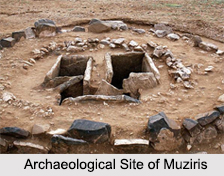
History of Thissur District
Early History of Thissur District explains flourishing of the port cities. Now these port cities are transformed into archaeological sites.
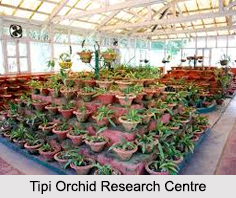
Tippi Orchid Research Centre, Arunachal Pradesh
Tippi Orchid Research Centre in Arunachal Pradesh is renowned for its rich collection of exotic and endangered orchids. Surrounded by lush rainforest...
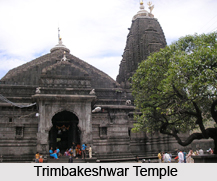
Tourism in Nashik District
Pilgrimage tourism in Nashik district involves visiting the various places of Hindu and Jain worship located here. Some of the holiest sites for Hind...
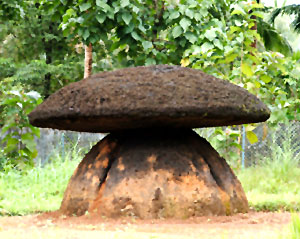
Mangadu, Kerala
Mangadu in Kerala’s Kollam district is a significant megalithic site known for its urn burials, cist burials, menhirs, and stone circles. Excavations...

Devaswom
History of Devaswom is not very ancient and can be dated back to late seventeenth century.
Related articles in States of India
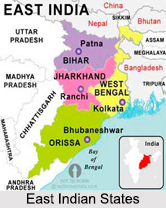
East Indian States
East Indian States comprises of Bihar, Jharkhand, West Bengal, Odisha and also the Union Territory of Andaman and Nicobar Islands. It defines the cult...
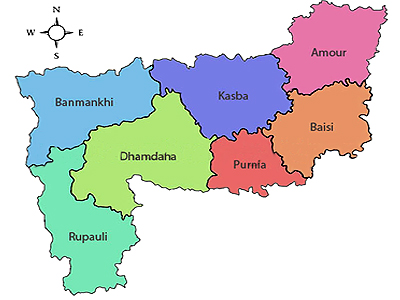
Purnia District in Bihar
Purnia District is located in Bihar and extends from River Ganga to Nepal. The district has a rich Hindu history and glorious past.
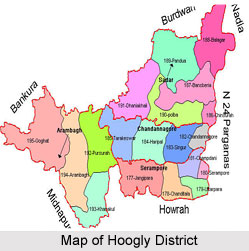
Hooghly district
Hooghly District along the bank of the river Hooghly is one of the principal trading ports of West Bengal.
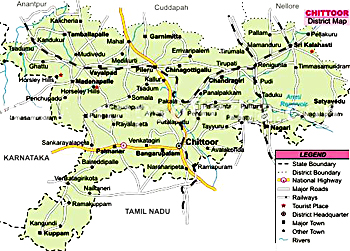
Geography Of Chittoor District
Geography of Chittoor district is spread along the topography of the land which is divided into two natural divisions; Chittoor has a dry and healthy...
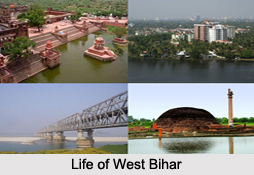
Districts of West Bihar
Districts of West Bihar is comprised of medieval monuments that were built by the different governors of Mughal era.