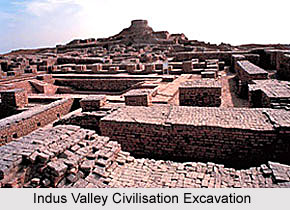
 Indus Valley Civilisation, also known as `Harappan Civilisation`, was discovered as a consequence of the excavations conducted in 1920. The culture of Indus Valley Civilization manifested the growth of an ancient society which evolved and thrived during the Bronze Age in the North-West region of India and its subcontinent. The civilization was named after the Indus River, along the banks of which the civilization developed. Geographically, the Indus Valley Civilization covered the territory of Pakistan, the states of Rajasthan and Punjab, the valleys of Narmada and Tapti in Gujarat, with intrusions into the upper Ganga-Yamuna Doab. Collectively they constitute an area of about 8, 40,000 sq miles, which is much bigger than that of any contemporary civilization in other places. The origin, culture and decline of the Indus Valley Civilization are shrouded in mystery and have fascinated the historians and common populace as well. It is estimated by experts that the society existed between 3300 BC and 1700 BC.
Origin of Indus Valley Civilisation
The origin of Indus Valley civilisation is devoid of any kind of battles or conflicts. The people of Indus Valley rather made deals instead of war and created a stable peaceful and prosperous culture. The Harappa Civilization has its significance for not only historians and archaeologists but for the people in general. It was best known for its spectacular city planning, its drainage system and had surpassed all other contemporary civilizations.
As far as the origin of the word Indus is concerned, scholars are of the opinion that the name Indus is the origin of the word Hindu. Though the original Indian name of the river is Sindhu, the Greeks referred to the river as the `Indos` while the later Arabs referred to it as `Al-Hind.` Eventually the name came to be applied to the people of the subcontinent, namely, the `Hindi,` the `Hindus` and the `Indians.` It is believed that the Indus Valley Civilization belonged to the copper age as the presence of iron tools and implements has not yet been established at any part of this civilization.
 The oldest mention of the Indus Valley Civilisation is found in the works of Charles Masson in 1842. In 1856 while laying a railway track, British engineers came across an ancient city. They used the bricks from the ruined city to build the railway bed. Finally it was Alexander Cunningham, the director of the Archaeological Survey of British India, who presented to the world a seal from this ancient civilisation. In the year 1920, Indian archaeologists Dayaram Sahani and R.D Bannerjee undertook excavations on one of these mounds in Harappa. The archaeologists expected to find something, but never imagined that a city lay beneath the earth. Further excavation at different places in India and Pakistan, led to discovery of another large city `Mohenjodaro` with the recovery of at least 80 villages and towns related to this newly discovered civilization. They named it Harappan after the first city they discovered.
The Indus Valley Civilization comprised of two distinct cultures, which were earlier and later, and named as `Early Harappan` and the `Late Harappan`. One will find that this civilisation is often referred to as the `Mature Harappan` civilisation in order to mark a distinction between the two cultures.
Geography of Indus Valley Civilisation
The main areas of the Harappan or Indus Valley Civilisation include the following regions as discovered by recent excavations are:
| Mohenjodaro in Sindh (located on the banks of Indus River) |
| Harappa in Punjab (town located on the banks of Ravi River) |
| Kalibangan in Rajasthan (located on the banks of Ghaghara River) |
| Rupar in Hariyana (located on the banks of Sutlej River) |
| Lothal in Gujarat (located on the banks of Bhagawar River) |
| Rangpore in Gujarat |
| Narmada and Tapi belt |
Indus Valley Civilisation expanded to the western part of Makran Coast, Baluchistan, stretching to the eastern portion of Uttar Pradesh the north-eastern region of Afghanistan and to Maharashtra to the south. The geographical diversity of the Indus Valley presents a marked similarity to the civilisations existent in Peru and Egypt. Each of these civilisations enjoyed rich, fertile agricultural lands, with mountains, deserts and oceans defining their boundaries. Some archaeologists have declared that above 500 Harappan sites have been detected near the dried riverbeds of River Ghaghara-Hakra (also known as River Sarasvati) and its tributaries.
The Early Harappan Phase, also known as the `Early Harappan Ravi Phase`, has acquired its name from a place near Mohenjodaro, in the Sindh area of Pakistan. The culture remained from 3300 BC till 2800 BC. This period witnessed abundant availability of a rare, semiprecious stone called `lapis lazuli` which was utilized for making beads. Villagers belonging to the Early Harappan Phase cultivated crops like sesame, cotton and dates. Domesticated animals were generally water buffaloes.
 Towards the conclusion of 2800 BC, the villages of Early Harappan Ravi Phase began developing into large towns and urban centres. Harappa, Ganeriwala (located on the riverbed of Ghaghara-Hakra), Mohenjodaro (which constitutes present-day Pakistan) and Rakhigarhi, Rupar, Dholavira, Kalibangan and Lothal which are portions of modern India, form the major geographical arenas of the `Mature Harappan culture` during this period.
Town Planning in Indus Valley Civilisation
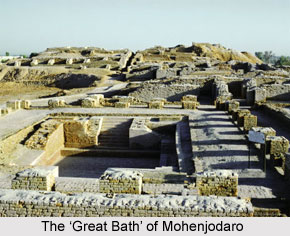
The twin cities of Mohenjodaro and Harappa were centres of all activities commercial or socio religious cult in the Indus Valley civilization. Both cities were a mile square with defensive outer walls. Cities were divided into lower dwellings and the citadel housed important buildings. Most of these buildings were built with burnt or mud bricks and stones. Till date historians are in awe witnessing the Great Granary or the Bath, both exclusive for its architectural inputs and planning.
The housing plan in Indus Valley Civilization consisted of straight lines, an efficient drainage and sewer system. Both the cities of Harappa and Mohenjodaro were divided into two main parts. The upper portion of the cities were fortified, while the remaining parts of the cities were devoid of forts and meant for the common masses. It is believed that the higher portions of the city were constructed for accommodating the ruling sections of the society. Lower parts of the cities normally extended to a square mile. The streets interested each other at right angles and the main streets ran directly from the north to the south. Their breath varied from about 9 feet to 34 feet. Every lane possessed a public well and street lamps.
 While the rich dwelled in multi-roomed and spacious houses which were situated on the streets, the poorer citizens were assigned to more modest homes which were usually located inside lanes. Several houses contained baths, wells and drains which were kept covered with stone slabs. Drains were always horizontal and sometimes vertical. The houses had wooden doors which were placed on the side walls, instead of being constructed on the front as of present-day architecture. Regularly sized burnt bricks were employed for the construction of the buildings. Their architecture favoured massive walls which surrounded the buildings, which might have protected them against military invasions or floods. The Harappans created impressive structures like dockyards, baths, warehouses, granaries, homes and brick platforms. The `Great Bath` was an impressive structure in the city of Mohenjodaro, which might have been a public bath during that time. Measuring about 180 feet by 108 feet, the Great Bath was attached to the fort of Mohenjodaro, where the upper strata of the city dwelt.
Language in Indus Valley Civilisation
It was Sir John Marshall who first suggested that the people of the Indus Civilization spoke in Dravidian language. Most scholars agreed with Marshall. On the other hand, Piero Meriggi, another historian suggested that they used Brahvi language, which is still used in Baluchistan.
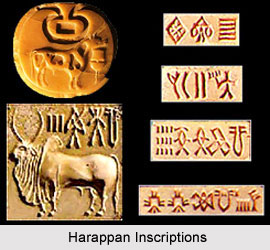
The writing style of Indus Valley civilisation appeared to be a pictographic script. The script seems to have had about 400 basic signs with several variations. The sign probably stood forwards and for syllables. The direction of the writing was generally from right to left. Most of the inscriptions were found on seals. The seals were probably used in trade and also for official and administrative works; mention of literary extravaganza is absent. A lot of the inscribed material was found at different Harappan site which opens the door of awe struck amazement before the world populace.
Religion in Indus Valley Civilization
Scholars are unable to draw a conclusion regarding the religion of the inhabitants of Indus Valley civilization. Unlike Mesopotamia or Egypt, there were no buildings discovered to conclude that there might had been a temple or the people were involved in any kind of public worship. However, some historians are of the opinion that Harappan people were Hindus. In view of the female terracotta figurines found at sites or seals of male god in tantric posture resembling Lord Shiva, a Hindu deity and also the Mother Goddess exemplifies that the Indus people believed in the mother goddesses.
Some of the seals discovered in Indus Valley Civilisation reveal the existence of `Swastikas`, which are symbols of religions of Hinduism, Buddhism and Jainism. `Shiva lingams`, which means the phallic signs of Lord Shiva have been encountered in the remains of Harrapan civilisation. Many other seals contain inscriptions of a horned figure seated in the `Lotus position`. Excavators named the god `Pasupati`, which means the lord of cattle and is a manifestation of Lord Shiva.
People belonging to the Early Harappan Phase used to bury their corpses. However, the ones who lived during the Mature Harappan age cremated their dead bodies prior to burying their ashes. It is also said that some people of this civilisation belonged to the `Bhakti cult`, which believed in worshipping a personal God.
 Society in Indus Valley Civilisation
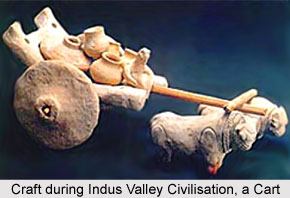
The population of the Indus Valley Civilisation comprised Australoid, Mediterranean, Mongoloid and Alpine communities. Such a cosmopolitan populace proved that Indus Valley, or Harappan civilisation was the junction of rich, cultural interchange of people belonging to manifold traditions, customs and races. Experts put the approximate figure of the population in Mohenjodaro to 35,000. In the Indus Valley Civilization, the society was stratified into 3 distinct social groups. One group ruled and administered the city; the other group included the merchants who were associated with trade and other business activities in the city. The third group was that of the labourers who worked in the city. They also included the farmers who cultivated wheat and barley as their main crops. For the transportation means of men and goods double-ox carts must have been in use. The horse was also known by the beginning of the 1st millennium BC. Terracotta cart frames and wheels with and without hubs have been found.
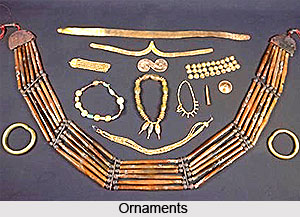
Jewellery was not only the forte of women, even men enjoyed such. The pieces of ornaments saw the lavish use of gold, copper and silver. Necklaces, armlets and rings were common jewelleries for men. On the other hand women decked themselves up with ear rings, necklaces, anklets, bangles, girdles, bracelets and others. Ivory products like combs were also popular with the people of this civilisation. Ornaments used by the womenfolk included those which were engraved with precious gems and stones like jade, agate, lapis lazuli and carnelian. Toilet jars found in Harappa show that Harappan women were fond of applying ivory powder and face paint as cosmetics. Besides these, people enjoyed playing in dice and marble. Gambling was a favourite past time of the elder members in the society. Gold jewelleries were mostly worn by the richer people. Social inequality prevailed extensively in their society.
Agriculture in Indus Valley Civilisation
Rice, wheat, barley, milk and vegetables like sesame seeds, peas and dates formed the staple diet of the citizens of Harappa and Mohenjodaro. Poultry, beef, mutton, pork and fish were also popular among the locals. Indus Valley Civilisation was majorly an agricultural economy. Cotton and wool were woven by the people. Both men and women utilized two pieces of garments. Men were mostly clad in `dhotis` and shawls which were wrapped around their left shoulders. Women used similar attire, with long hair, neatly plaited and held together with a fan shaped bow and a `hair band` made of silver or gold to ensure that the hair was kept in a specific pattern or position. Male members wore a middle parting in their hair. Small, flat-bottomed boats and bullock carts, were the major means of commutation.
Art and Craft of Indus Valley Civilisation
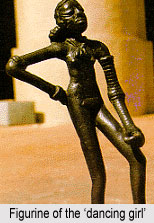
The patterns that the craft traditions in India were to take and which were to survive for years appear already mature. It firmly established the urban life of the Indus valley. The Indus valley crowd revealed expertise in craftsmanship. Dancing, painting, sculpture, and music were all part of Indus culture. Though statues are abundantly found, but only stone, bronze or terracotta ones have been excavated. Potters, masons, metal workers like silversmiths and goldsmiths were in high demand in the Harappan civilisation. Domestic objects manufactured of porcelain, earthenware and metal were frequently used. Razors, fish-hooks, combs, axes and spindles were some items which were commonly utilized. Children played with carved toys of horses and those of other animals. Jars, dishes, vessels were widely used in households, which were all composed of stone or earth. Knives, kneedles, saws and axes made of copper and bronze were also utilized. Harappan artisans decorated their rooms with comfortable chairs and tools. Indus seals excavated in Lothal also indicate the existence of a musical instrument, shaped like a harp, along with two shell objects in the Indus Valley Civilisation.
Decline of Indus Valley Civilisation
The decline of Indus valley civilization has been attributed to various reasons such as, ecological, increase in population, excessive deforestation, etc. However, the advent of the Aryans, probably from Central Asia was unanimously accepted as a major cause for the decline and complete disintegration of the civilization according to Sir Mortimer Wheeler, a British archaeologist. As many as 37 skeletons were discovered in several regions of Mohenjodaro, as per the studies by this archaeologist. Some Vedic texts also refer to certain battles and forts during this period. The name Mohenjodaro possibly derived from the sudden decline of most people of this civilisation, and it means, `the mound of the dead` in the Sindhi language.
However, many scholars are of the opinion that the decline of the Harappan civilisation was provoked by a drought which was a consequence of a halt in the trade activities with Mesopotamia and Egypt. Natural calamities like deforestation, flood, an alteration in the regular course of the river and settlement of new people are the other reasons which are the factors responsible for the downfall of the people of Indus Valley civilisation. The decline had commenced around 1800 BC and by 1700 BC, a majority of the cities were deserted.
A sudden climate change might also be the cause of the disappearance of the race of this civilisation. Researchers, scientists and archaeological experts are conducting various experiments, case studies and analytical work to ascertain the accurate cause of the ultimate extinction of the Harappan people.
New Discoveries on Indus Valley Civilisation
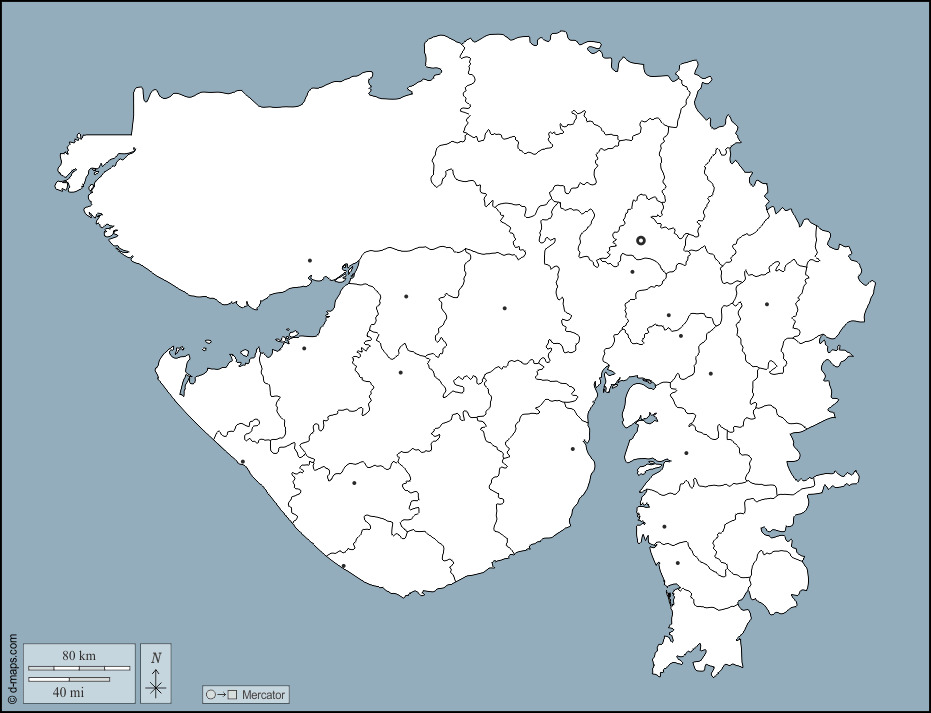
There was a discovery in the craft and trading town of this civilization being excavated since 1996 by a team of archaeologists from the Department of Archaeology and Ancient History of the Maharaja Sayajirao University of Baroda on the south eastern coast of Gulf of Kutch at Gola Dhoro in Gujarat. These excavations outlined the importance of smaller settlements that are far removed from the core area situated near specific resource areas, in the economic development of the Harappan civilization.
Gola Dhoro is situated half a kilometre northeast of a sleepy village of Bagasra (N 23 3` 30": E 70 37`10"). The settlements are measuring 1.92 hectares is about 7.50m high from the surrounding area. Archaeological excavations suggested that the settlement began as a small village. Subsequently, a massive fortification wall measuring 5.20m in width was built in three successive stages on the northern half of the site left surprisingly little space of approximately 50 x 50m, at any stage of its history, for the construction of residential houses and craft workshops. It indicated that the residents were not only lived in the mud brick houses, while on the other hand, some people also lived in the fortified areas that was situated in the lower southern half of the settlement.