
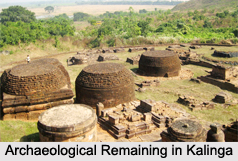
 History of Odisha from the earliest written records can be traced all the way back to 3rd century B.C. Ashoka fought the famous Kalinga war and brought it under Maurya rule. The Chedi emperor Kharvela of Kalinga came to power in second century B.C. He defeated the Mauryas and extended his empire as far as Mathura. The famous Hathigumpha inscription in Udaigiri near Bhubaneshwar describes in detail the war adventures of Kharvela as well as his administration. He was succeeded by the dynasties of Magharas (4th-5th century), Sailodbhavas (6th-8th century), Bhoumakaras and Somavamsis (8th-llth century). Later, Gangas emerged as a major power in Southern Odisha in the eleventh century. In this period remarkable development in Odisha`s economy, society and culture took place. The contribution to Oriya art especially, to the development of Odissi dance and Odissi music was disproportionately great compared to the contribution of other dynasties. Turko-Afghans conquered Odisha in 1590. According to historians the political decline started in Odisha from the time of the Muslim rule. British finally conquered Odisha in 1803.
History of Odisha
History of Odisha goes back a rather long way. Most of the history of the state is replete with the dynastic as well as tribal struggle for territorial superiority. Odisha is a place where one can find the religion, culture and history flow in away that lead to cultural amalgamation of early India.
Introduction
History of Odisha from the earliest written records can be traced all the way back to 3rd century B.C. Ashoka fought the famous Kalinga war and brought it under Maurya rule. The Chedi emperor Kharvela of Kalinga came to power in second century B.C. He defeated the Mauryas and extended his empire as far as Mathura. The famous Hathigumpha inscription in Udaigiri near Bhubaneshwar describes in detail the war adventures of Kharvela as well as his administration. He was succeeded by the dynasties of Magharas (4th-5th century), Sailodbhavas (6th-8th century), Bhoumakaras and Somavamsis (8th-llth century). Later, Gangas emerged as a major power in Southern Odisha in the eleventh century. In this period remarkable development in Odisha`s economy, society and culture took place. The contribution to Oriya art especially, to the development of Odissi dance and Odissi music was disproportionately great compared to the contribution of other dynasties. Turko-Afghans conquered Odisha in 1590. According to historians the political decline started in Odisha from the time of the Muslim rule. British finally conquered Odisha in 1803.Ancient History of Odisha
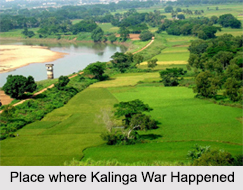 Early History of Odisha began from the pre historic time. The trace of the human civilization began from the Lower Paleolithic era. Kalinga has been mentioned in ancient texts like Mahabharata, Vayu Purana and Mahagovinda Suttanta. From early time, Odisha was named as Kalinga, Utkala, Mahakantara, Udra, Oddiyana, Kamala Mandala, South Kosala, Kongoda, Chedim, Tosali, Uranshin, Jajnagar and Odivissa.
Odisha in Purana : According to Purana, a king Bali, the Vairocana and the son of Sutapa, had no sons. So, he requested the sage, Dirghatamas, to bless him with sons. The sage is said to have begotten five sons through his wife, the queen Sudesna. The princes were named Anga, Vanga, Kalinga, Sumha and Pundra. The princes later founded kingdoms named after themselves. The prince Vanga founded Vanga kingdom, in the current day region of Bangladesh and some part of West Bengal. The prince Kalinga founded the kingdom of Kalinga, in the current day region of coastal part of Bay of Bengal- Odisha.
Mahabharata Era in Odisha : The Sabar people of Odisha have also been mentioned in the Mahabharata. It was the part of the Empire of Karna. Baudhayana mentions Kalinga as not yet being influenced by Vedic traditions, implying it followed mostly tribal traditions.
Kalinga War : Emperor Ashoka of the Mauryan dynasty conquered Kalinga in the bloody Kalinga War in 261 BC, which was the eighth year of his reign. According to his own edicts, in that war about 100,000 people was killed, 150,000 were captured and several more were affected. The resulting bloodshed and suffering of the war is said to have deeply affected Ashoka. He turned into a pacifist and converted to Buddhism.
Post Ashokan Era in Odisha : Emperor Kharavela in 150 BC who was possibly a contemporary of Demetrius I of Bactria, conquered a major part of India. He was a Jain ruler. He also built the monastery atop the Udayagiri hill. Subsequently, the region was ruled by the Jain such as Samudragupta and Shashanka. It was also a part of empire of Harshavardhana.
Somavamsi Dynasty : The kings of the Somavamsi dynasty began to unite the region of Kalinga. By the reign of Yayati II, they had integrated the region into a single kingdom. Yayati II is supposed to have built the Lingaraj temple at Bhubaneswar. They were replaced by the Eastern Ganga dynasty.
Anantavarman Chodaganga Dynasty : The notable ruler of Chodaganaga dynasty was Anantavarman Chodaganga, who began construction on the present-day Jagannath Temple in Puri 1135 AD, and Narasimhadeva I, who constructed the Konark temple in 1250 AD.
Medieval History of Odisha
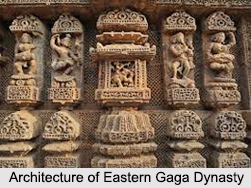 Medieval History of Odisha was introduced by Gajapati Empire. The art and architecture of Gajapati Kingdom is now the torch bearer of the cultural heritage of Odisha.
Gajapati Dynasty : The Gajapati Dynasty was a medieval Hindu dynasty from India that ruled over Kalinga (present Odisha), large parts of Andhra Pradesh and West Bengal, and the eastern and central parts of Madhya Pradesh and Jharkhand from 1434 to 1541. The Gajapati dynasty was established by Kapilendra Deva (1434-66) in 1434.
Eastern Ganga Dynasty in Odisha :
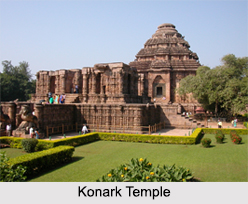 The Eastern Ganga Dynasty was followed by the Gajapati Kingdom. The region resisted integration into the Mughal empire until 1568, when it was conquered by Sultanate of Bengal. Mukunda Deva, who is considered the last independent king of Kalinga, was defeated and was killed in battle by a rebel Ramachandra Bhanja. Ramachandra Bhanja himself was killed by Bayazid Khan Karrani. In 1591, Man Singh I, then governor of Bihar, led an army to take Odisha from the Karranis of Bengal.
Odisha under the Nawab of Bengal : The territory of modern day Odisha and Bihar was ruled by the Nawabs of Bengal, including Bengal proper, Bihar and Odisha. Odisha was the first subah (imperial top-level province) added to Akbar`s fifteen by Shah Jahan. It had Cuttack as seat and bordered Bihar, Bengal and Golconda subahs as well as the remaining independent and tributary chiefs. From 1717, the Odisha and Bijar governors were reduced to deputies of the Nawab of the pseudo-autonomous Bengal Subah. In 1751, the Nawab of Bengal, Alivardi Khan ceded the region to the Maratha Empire.
Bhoi Dynasty :
 Bhoi Dynasty was founded by Govinda Vidyadhara who came to throne in a bloody coup, in 1541. The dynasty was short-lived and during this period the kingdom came under conflict with neighboring kingdoms and reeled with civil wars.
Karrani Dynasty in Bengal and Odisha : In 1568, Odisha came under the control of Sulaiman Khan Karrani of Karrani dynasty, who was the ruler of Sultanate of Bengal. In the Battle of Tukaroi, which took place in modern-day Balasore, Daud Khan Karrani was defeated and retreated deep into Odisha. The battle led to the Treaty of Katak in which Daud ceded the whole of Bengal and Bihar, retaining only Odisha. The treaty eventually failed after the death of Munim Khan (governor of Bengal and Bihar) who died at the age of 80.
Mughal Rule in Odisha : In 1590, Qutlu Khan Lohani, an officer of Daud, declared himself independent and assumed the title of "Qutlu Shah". Raja Man Singh who was the Mughal governor of Bihar, started an expedition against him. Before facing Man Singh, Qutlu Shah died. Qutlu Khan`s son Nasir Khan, after little resistance, accepted Mughal sovereignty and paid homage to Man Singh on 15th August 1590. Nasir Khan was then appointed Governor of Odisha and signed a treaty which ceded the region of Puri. Raja Ramachandra Deva, the king of Khurda, had accepted Akbar`s suzerainty. Akbar mostly followed a policy of non-interference in the local chieftains` matters. After Akbar, his son, Jahangir came to power who followed a different policy. Under him, Odisha was made into a separate Subah and a governor, titled Subahdar, ruled in the name of the Mughal emperor.
Odisha under Marathas : The Maratha Empire in medieval India started raiding Alivardi Khan`s territory starting in 1742, aided by Rustam Jung and his allies. These raids used quick hit-and-run tactics and were called bargis. Alivardi Khan unable to check the raids ceded Odisha to Raghoji Bhonsle I in 1751.During this period, the idols of Jaganatha and other deities were removed from the temple several times, and hidden to save them from iconoclasm. The river Subarnarekha served as the border between Bengal and Maratha-controlled Odisha. After the decline of Marathas, British East India Company began ruling Odisha with full pomp and power.
Modern History of Odisha
 Modern History of Odisha was framed by the colonial powers which came to India in the later Mughal period. Then it came under the Portuguese governors and later British took the powers in Odisha, Bengal and Bihar from Nawab of Bengal.
Arrival of Portuguese in Odisha : The Portuguese were the first Europeans to build factories in Odisha. They had a settlement in Pipili in Balasore district. The British had established a settlement in Hariharpur with the permission of the Mughal administrator, as early as 1633 to trade cotton goods. But it could not maintain for long because of the harsh climate, and Portuguese and Aracanese pirates.
Diwani of Bengal and Odisha : In 1765, after the 8 years of Battle of Plassey, Lord Clive acquired the "Diwani of Bengal, Bihar and Odisha from titular Mughal emperor, Shah Alam II. But, only the Midnapore district was meant by Odisha, as rest of it had passed on to the Marathas. Lord Clive had tried to negotiate the acquisition of Odisha from the Marathas. His successor, Warren Hastings, had also tried negotiating with the Marathas.
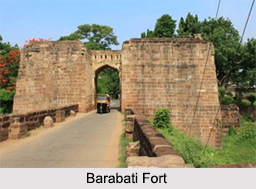
Attack of British East India Company in Odisha : A Colonel Harcourt of the British Army sailed from Northern Circars on 3rd August 1803 and landed on 25th August. He marched from Ganjam now Ganjam District of modern Odisha with 5000 men on 8th September, to flush the Marathas out of the region. On 18th September, Harcourt took control of Puri. On 21st September, a second force had landed at Balasore, now the Balasore District and after taking control of the region, it sent reinforcements to Cuttack to help with the siege of Barabati Fort. On 14th October, the fort of Barbati was stormed and captured.
Marathas and British :
 On 17th December 1803, Raghoji II Bhonsle of Nagpur signed the Treaty of Deogaon (also Deogarh) in Odisha with the British after the Battle of Laswari and gave up the province of Cuttack (which included Mughalbandi, the coastal part of Odisha, Garhjat the princely states of Western Odisha, Balasore port, parts of Midnapore district of West Bengal).
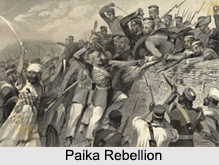
Paika Rebellion in Odisha : Jaya Krushna Rajguru Mahapatra, known to the people as Jayee Rajguru, the royal preceptor to Mukunda Dev II (who was a minor) mobilized an army of Paika warriors and raised a revolt against the British in 1804. This is the first uprising against the British rule in Odisha. The British East India Company, ultimately with the help of some treacherous natives ruthlessly suppressed the rebellion. Both Jayee Rajguru and the Raja were made prisoners. Later Jayee Rajguru was convicted and on 6th December 1806 hanged heinously by his legs tied to two different branches of Banyan tree and released to tear him to two parts at Midnapore. The Raja was released in 1807 since Jayee Rajguru had taken the entire responsibility of the uprising on him. Thus Jayee Rajguru is said to be the first martyr of the early freedom struggle against British rule in Odisha. His sacrifice, however, did not go in vain. It laid the foundation of a major revolt 13 years after his martyrdom. In 1817, the British had to suppress the Paika rebellion. The Paika were a landed militia who were exempted from taxes in lieu of their services. They were dissatisfied with the new British land laws and were led by Bakshi Jagabandhu, a commander of the king of Khurda. Surendra Sai from Sambalpur region had started a rebellion against the British in 1827. During the Indian Rebellion of 1857, the princes of Odisha did not join the wars.
Odisha Famine : In 1866, Odisha was struck with a great famine, called Na Anka Durvikhya (literally the nine number famines) locally. The death toll has been estimated to be about one million spread across different regions. During the famine, Babu Bichitrananda Das and Gouri Shankar Roy decided to publish a magazine in Odia. The first issue of Utakala Deepika appeared on 4th August 1866 from the newly Cuttack Printing Press. It dealt with issue of famine. Though Christian missionaries had established a printing press in Cuttack in 1838, this was the first independent publication in Odia.
Contribution of Newspaper in Odisha : In 1903, the Utkal Union Conference was founded. In 1911, Odisha and Bihar were separated from Bengal province to form a new single province. In 1912, Odisha Tenancy Act was introduced in the Bihar-Orissa Legislative Assembly. The previous Bengal Tenancy Act of 1885 was considered ill-suited for the conditions of the region. On 12th September 1913, the Orissa Tenancy Act was passed, securing better rights and treatment for "ryots" in the region. In 1913, Sashibhusan Rath began publishing the first Odia daily newspaper, Asha, from Berhampur. Gopabandhu Das was the editor and wrote its editorials until 1919. In 1915, Gopabandhu Das began publishing a magazine called Satyabadi, to promote Odia literature and culture. On 4th October 1919, he started his own weekly newspaper, Samaja.
Contribution of Bagha Jatin : In 1914, the revolutionary Bagha Jatin moved to a hideout in Kaptipada village in Mayurbhanj District. On 9th September 1915, Bagha Jatin and his companions were discovered by the British Government and it resulted in a 75 minutes gunfight. On 10th September 1915, Jatindranath Mukherjee (Bagha Jatin) died of bullet wounds at the Balasore hospital.
Recently updated articles in States of India
Bandare Waterfalls, Meghalaya
Bandare Waterfalls in South Garo Hills, Meghalaya, is a secluded natural attraction surrounded by dense subtropical forests and rugged mountain terrai...
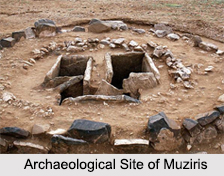
History of Thissur District
Early History of Thissur District explains flourishing of the port cities. Now these port cities are transformed into archaeological sites.
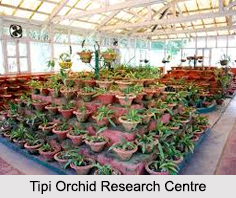
Tippi Orchid Research Centre, Arunachal Pradesh
Tippi Orchid Research Centre in Arunachal Pradesh is renowned for its rich collection of exotic and endangered orchids. Surrounded by lush rainforest...
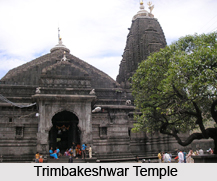
Tourism in Nashik District
Pilgrimage tourism in Nashik district involves visiting the various places of Hindu and Jain worship located here. Some of the holiest sites for Hind...
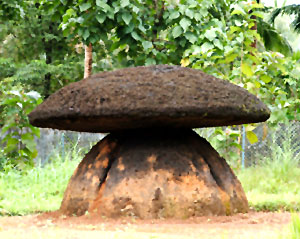
Mangadu, Kerala
Mangadu in Kerala’s Kollam district is a significant megalithic site known for its urn burials, cist burials, menhirs, and stone circles. Excavations...
Related articles in States of India
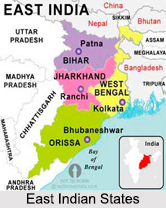
East Indian States
East Indian States comprises of Bihar, Jharkhand, West Bengal, Odisha and also the Union Territory of Andaman and Nicobar Islands. It defines the cult...
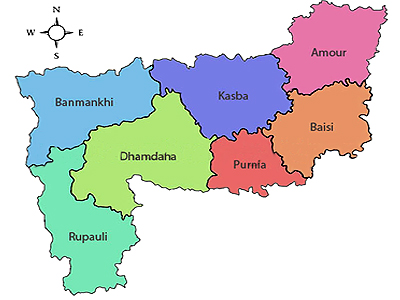
Purnia District in Bihar
Purnia District is located in Bihar and extends from River Ganga to Nepal. The district has a rich Hindu history and glorious past.
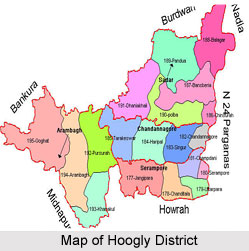
Hooghly district
Hooghly District along the bank of the river Hooghly is one of the principal trading ports of West Bengal.
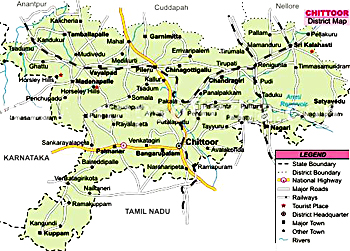
Geography Of Chittoor District
Geography of Chittoor district is spread along the topography of the land which is divided into two natural divisions; Chittoor has a dry and healthy...
Districts of West Bihar
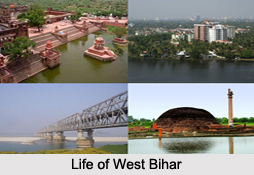
Districts of West Bihar is comprised of medieval monuments that were built by the different governors of Mughal era.