Bhubaneshwar forms a vital part of the Golden Triangle formed between the Jagannath temple of
Puri and the Sun temple of Konark. From the 8th to the 13th century, 7000 or more temples were constructed of sandstone and thus there was a development in the stone construction. Shantistupa is another historical monument which was erected by
Ashoka the Great. It is a symbol of peace and thus completes the golden triangle.
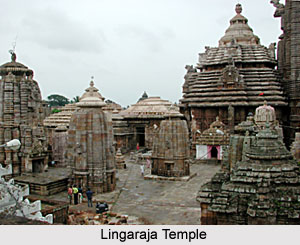
Lingaraja Temple : The largest Hindu shrine in Bhubaneswar, Lingaraja Temple, in its present form, dates back to the 11th century. The temple complex has four main sections, namely Vimana (sanctum), Jagamohana (hall of assembly), Natamandira (hall of events) and Bhoga Mandapa (hall of offerings). All these are arranged in a straight line, and each has a tower, higher than the one preceding it. The main feature of the complex is its almost 148-feet high sanctum tower, every bit of which carries ornate sculpting. Not only the tower, but the walls of Bhoga Mandapa also contain sculptures.
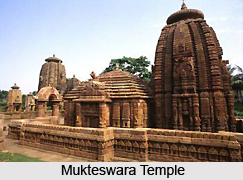
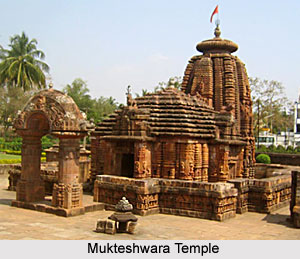
Mukteswara Temple : Another notable temple in the city of Bhubaneshwar is the Mukteswara temple. It is also called the `Gem of Odisha Architecture`. This temple belongs to the 10th century and it is dedicated to
Lord Shiva. The Mukteshwara temple is famous for its magnificent work in Kalingan style of architecture with a mixture of
Buddhist, Hindu and Jain features. The temple is also well-known since it was constructed during the phase of transition of early and late school of architecture of Kalinga. The temple presents a magnificent gateway or `torana` which is brilliantly designed with sculptures of monkeys, female figurines,
peacocks, etc. Different ascetic figures in meditative pose are also engraved on the walls of the temple.
Jagannath Temple : Jagannath Temple in Puri is one of the
Char Dhams. It is thought to have originally been a Jain shrine. The temple complex, measuring a whopping 400000 sq feet has all the elements of a regional Kalinga architectural shrine, i.e. Vimana, Jagamohana, Natamandira and Bhoga Mandapa. Every year in June-July, the temple hosts the famous Rath Yatra, wherein huge wooden chariots are pulled by devotees. The holy sight of
Lord Jagannath, accompanied by
Subhadra and Balabhadra raises loads of joy among the devotees. The structural design of the temple is in pyramid shape and consists of four entrance gates, named as Singhadwara, Ashwadwara, Hathidwara and Vyaghradwara referring to lion, horse,
elephant and
tiger.
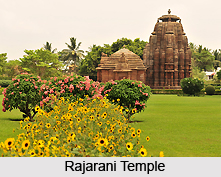
 Rajarani Temple :
 The Rajarani temple belongs to the 11th century. It is known for its stone figures and the successive tiers of projections which arise to make the 18 meter tower. The miniature replicas decorate the spire, which are similar to those in the
Khajuraho temples. The major highlight of this temple is the beautiful sculptures of dikpalas or guardians of the eight directions engraved around the shrine. Decorated in diaphanous drapery, these dikpalas stand on lotuses, having their mounts beneath. From the eastern portion, one can see
Indra with a thunderbolt in his hand and an elephant, the beared
Lord Agni, God of fire with the Ram and
Lord Yama with a noose and a staff.
There is Nirriti, the God of misery bearing a sword and a severed head,
Lord Varuna, having a noose, and his vehicle as
makara,
Vayu, with a banner and a
deer as his vehicle, and
Kubera is placed at the top of seven jars of gems, and possesses a horse. Another figure of
Isana is displayed with an upright phallus alongside an emaciated figure.
Konark Sun Temple : The Konark Sun temple is dedicated to the Hindu sun god
Surya and conceived as a giant stone
chariot with 12 wheels, it is the most famous of the few sun temples built in India. It is located about 35 km northeast of the city of Puri on the coastline in the state of Odisha. It was built in 1250 CE by King Narasimhadeva I (1238-1264 CE) of the Eastern
Ganga dynasty (8th century CE - 15th century CE). Although many portions are now in ruins, what remains of the temple complex continues to draw not only tourists but also Hindu pilgrims.
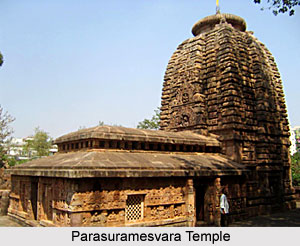
Parashurameshwar Temple : The evidence of Parashurameshwar Temple being constructed much earlier than the two above-mentioned shrines is evident in its even smaller size and rather primitive carvings. Large parts of its Jagamohana (assembly hall) are bereft of decorative elements. This is said to be the first shrine in the region to have an additional structure (assembly hall) other than the Vimana-topped sanctum.
Ananta Vasudeva Temple : While most of the temples in the city are associated with the
Shaiva sect, Ananta Vasudeva Temple is associated with the Vaishnava sect, reflecting that by the time it was constructed (13th century), Vaishnava deities had been assimilated in the otherwise dominantly Shaiva culture. Another way in which it is different from other shrines is that, it has three structures, whereas others have either two or four.
 Bhaskareshwar Temple :
 Bhaskareswar Temple looks unfinished as it has just one structure on a raised plinth. The reason for this might be, it was earlier a Buddhist site which was modified and converted into a temple. Another reason might be it is rather unadorned in terms of carvings. Its main attraction is its Shiva Linga, which is almost 9 feet high.
Chausathi Jogini Temple : Located just outside the city, Chausathi Jogini Temple stands in stark contrast to a Hindu temple. Built in a circular fashion with no roof, it is associated with the
Tantric cult, rather than mainstream Hinduism, bearing a similarity to Druid temples, such as the Stonehenge in England. Inside the temple, 56 idols of various forms of
Goddess Kali are kept in niches in the wall.
Brahmeshwar Temple : Brahmeshwar Temple is said to be built by Kolavati Devi during the reign of her son, Udyotakesari, in AD 1058-1060. Brahmeswara Temple is built according to the Panchatanaya plan, which means that there are four smaller shrines flanking the primary temple on each cardinal direction. Images of musicians and dancers appear on it for the first time, hinting at the continuous evolution in regional architecture. Reportedly, this was also among the first shrines, the construction of which included iron beams.
Baitala Deula : Baitala Deula was built in the 8th century that makes it one of the oldest Hindu shrines in Bhubaneswar. It is again a bit unusual. Its temple tower is slightly pyramidal in shape, rather than cylindrical. This and the three spires on its top take it closer to being a South Indian Dravidian temple. The four vertices of its Jagamohana house four smaller temples as well, complete with their Vimana.
Besides the temples, Bhubaneshwar also house several contemporary monuments. Thus this city in Odisha offers a homogeneous mixture of its modern day aspirations and the intriguing past.

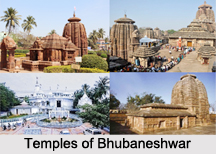
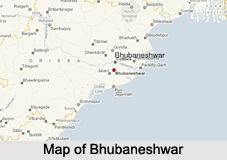 Bhubaneshwar is the modern capital of Odisha in independent India. It is known as "Temple Metropolis of India". The temples of Bhubaneshwar bear witness to the comprehensive history of the Orissan style of temple architecture. Bhubaneshwar is known for its architecture and ancient temples.
 Bhubaneshwar is located in the eastern coastal plains of Odishaon the banks of
  Bhubaneshwar, in
  The temples of Bhubaneshwar from the early days reflect the style of Hindu temples when they were emerging. Temples in the basic style of the early period were very simple with only the
  The Bhubaneshwar temple is rich in decorations and the iconographic studies are an interesting one. The main icon in the garbhagriha (sanctum sanctorum) is always a Linga but in the Bhubaneshwar Linga two religious cults meet. The Linga is always the representation of a two icon deity called Haridhara of which we shall have occasion to speak below. The outside decorations and the iconographic specimens are varied and not only are the main deities of the Hindu pantheon represented in bold relief but there are also male and female figures, epic-representations, naganaginis and profuse floral or ornamental decorations.
 Bhubaneshwar is a great religious place that house around 500 temples like the "Lingaraj Temple", "