
The Sitabenga and Jogimara Caves, also known as the
Sitabenga Cave or Jogimara Cave, are ancient cave monuments located on the
northern side of the Ramgarh Hills in Puta village, Chhattisgarh, India.
Dating from between the 3rd century BCE and the 1st century BCE, the caves are
notable for their non-religious inscriptions written in the Brahmi script and Magadhi language.
They are also renowned for preserving some of the oldest known coloured
frescoes in Asia, making them an important part of India’s ancient cultural and
artistic heritage.
Sitabenga and Jogimara Caves
Sitabenga and Jogimara Caves in Chhattisgarh are ancient rock-cut monuments dating to the early historic period. Known for their Brahmi inscriptions, poetic texts, and faded murals, the caves offer valuable insights into early Indian art and culture. Their distinctive architecture and non-religious themes make them especially significant archaeological sites.
Introduction
Legend Associated with Sitabenga and Jogimara Caves
 The caves are partly natural formations and partly sculpted
structures. According to regional tradition, they are associated with the Ramayana and are
believed to be a place where Sita,
Rama, and Lakshmana stayed at
the beginning of their exile. The oldest ruins and temple artworks found at the
site are connected with the Ramayana and are believed, based on their
iconographic features, to date from approximately the 8th to the 12th century.
The caves are partly natural formations and partly sculpted
structures. According to regional tradition, they are associated with the Ramayana and are
believed to be a place where Sita,
Rama, and Lakshmana stayed at
the beginning of their exile. The oldest ruins and temple artworks found at the
site are connected with the Ramayana and are believed, based on their
iconographic features, to date from approximately the 8th to the 12th century.
The inscription at the Jogimara Cave has been interpreted in several ways based on local beliefs and scholarly readings. One interpretation describes it as a form of love graffiti written by a young woman and a young man. Another suggests that it records the association between a female dancer and a male sculptor-painter who worked together to create the two caves for the benefit of others. The inscription is also regarded as the earliest known reference to the term “devadasi.
Location of Sitabenga and Jogimara Caves
The Jogimara and Sitabenga Caves are located in Surguja district of Chhattisgarh, approximately 45 kilometres southwest of Ambikapur, 180 kilometres northeast of Bilaspur, and 5 kilometres from Khodri. Situated between two forested hills, the caves can be reached by a short hike westward along a marked, stone-paved trail that passes a seasonal waterfall and a natural lake.
The Sitabenga Cave, also known by names such as Sitabangira,
Sitabonga, and Sitalangra, is located toward the northern side of the site.
Further south lies the Jogimara Cave, which contains inscriptions and painted
artwork and has visitor platforms and railings. The surrounding area also
features several small crescent-shaped caves and a large, elongated tunnel
known as the Hathipol.
Architecture of Sitabenga and Jogimara Caves
The Jogimara and Sitabenga Caves are distinctive among India’s ancient caves for their unique design and decoration. Unlike many other ancient cave sites, they contain no evidence of stupas, sculptural reliefs, extensive paintings, or religious images. The inscriptions found at the site are poetic in nature, while the surviving paintings are largely non-religious. However, one panel appears to depict a scene associated with a Krishna legend from Hindu tradition.
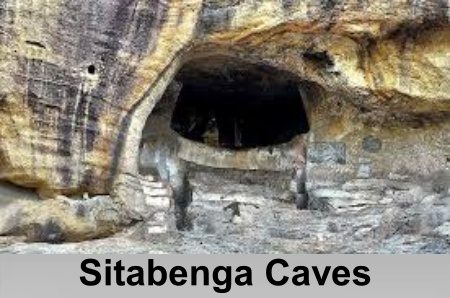
 The Sitabenga Cave resembles a partly sculpted stage,
featuring two rows of hemispherical, rock-cut stone benches at the front. These
structures may have served as steps for entering the cave, although a separate
set of proper steps had already been provided on the left side. The cave itself
is oblong in shape, measuring approximately 46 by 24 feet and ranging from 6 to
6.5 feet in height.
The Sitabenga Cave resembles a partly sculpted stage,
featuring two rows of hemispherical, rock-cut stone benches at the front. These
structures may have served as steps for entering the cave, although a separate
set of proper steps had already been provided on the left side. The cave itself
is oblong in shape, measuring approximately 46 by 24 feet and ranging from 6 to
6.5 feet in height.
Inside the cave, along its sides, are rock-cut beds measuring about 7 feet in width and 2.5 feet in height, with a slight downward slope. Near the cave’s opening are two deliberately carved holes in the stone. The front portion has also been carefully rock-cut and shaped in a stage-like form. This distinctive design appears unusual and would have been unnecessary if the cave had served merely as a retreat for monks or traders.
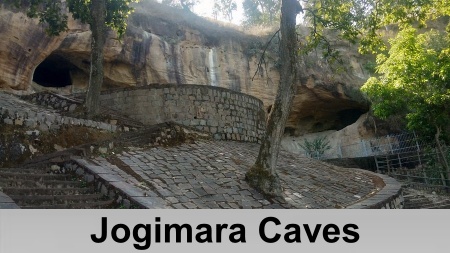
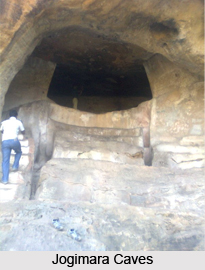
The Jogimara Cave measures approximately 15 by 12 feet and
has an interior height of just over 6 feet. Like the Sitabenga Cave, it is a
natural cave that was adapted and sculpted to facilitate access, allowing
visitors to climb in, step inside, sit, and rest comfortably. According to an
archaeological survey, no exterior benches or other significant sculpted
features were found at the cave.
Inscriptions inside Sitabenga and Jogimara Caves
Both the Sitabenga and Jogimara Caves contain ancient inscriptions. Paleographic analysis indicates that these inscriptions, written in the Magadhi language, date to approximately the 3rd century BCE. They are considered unusual among ancient Indian inscriptions because of their distinctive language and content. Another notable stylistic feature is the use of the danda as a punctuation mark, a convention that continues to be used in many Indian languages to indicate the end of a sentence or verse.
The Sitabenga Cave contains a two-line inscription written
in the Brahmi script
near the upper portion of a cut-out wall. The Jogimara Cave features a
five-line inscription, also written in Brahmi script and the Magadhi language.
It is located on the southern side of the cave, just beyond the entrance and
beneath the painted murals on the ceiling. Parts of the Jogimara inscription
have been lost, while several letters and words have been eroded over time.
Murals and Paintings inside Sitabenga and Jogimara Caves
The Jogimara Cave contains eight mural panels, most of which have faded considerably over time. The original paintings were created using three colours and a relatively simple technique, differing from the more sophisticated methods described in some of the earliest known Indian texts on painting. At some point, the original murals were repainted, apparently as an attempt to restore and enhance them. This restoration effort is believed to have taken place during the second half of the 1st millennium CE.
Unlike the murals at Ajanta and several other Indian caves, the original paintings at Jogimara did not appear to have been prepared with a conventional base coating. Instead, the murals feature a white lime surface. The artist first sketched the compositions using red outlines and then completed them with three principal colours, namely red, yellow, and black.
The mural panels have suffered significant damage, making their original number and subject matter difficult to determine with certainty. Their arrangement is particularly distinctive, as the panels appear to follow a concentric pattern. This design may have been intended to create a circular visual effect for viewers looking upward toward the cave ceiling.
Recently updated articles in Indian Monuments
Badshahpur Fort
Badshahpur Fort is a historic defensive structure reflecting the architectural traditions of its era. Built with granite and red sandstone, the fort w...
Sitabenga and Jogimara Caves
Sitabenga and Jogimara Caves in Chhattisgarh are ancient rock-cut monuments dating to the early historic period. Known for their Brahmi inscriptions,...
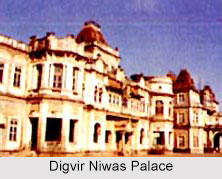
Digvir Niwas Palace
Digvir Niwas Palace in Vansda, Gujarat is one of the popular heritage buildings that reflect the majestic architecture of the early 20th century.
Historical Monuments of Satara
Among the historical monuments of Satara the fort at Satara is the most famous. Most of the constructions here belong to the Marathas.
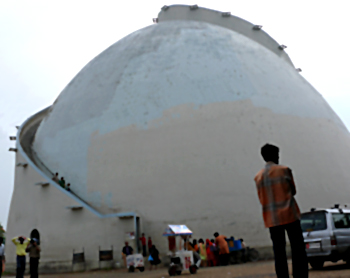
Architecture Of Bihar
Architecture of Bihar consists of Buddhist and Mughal style of architecture.
Related articles in Indian Monuments
Monuments of Lakshwadeep
Monuments of Lakshwadeep are famous for their ancient religious feel and historical value.
Monuments of West Bengal
Monuments of West Bengal, mainly from the British era, are considered as priceless heritage of the state and attracts many tourists to the state.
Monuments of Telangana
Monuments of Telangana covers the ancient, medieval and modern historical structures illustrating the architectural grandeur and attracting thousands...
Architecture Of Andhra Pradesh
Architecture of Andhra Pradesh is an illustration of diverse types of Hindu, Buddhist and Islamic architectural styles.
Architecture of Lucknow
Architecture of Lucknow is mostly Islamic in nature. It is representative of 18th and 19th century Indian architecture. The architecture is broadly di...