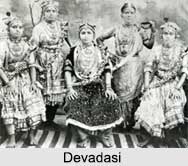
 Devdasi is a system of offering of votive girls to the deities in Brahmanic temples. In addition to taking care of the temple, they learnt and practiced Bharatnatyam and other classical Indian art tradition through which they expressed their devotion to the deity or Almighty. The Devadasis were known by various names as "Jogins", "Basavis", "Kalawants", "Paravatis" or "Mathammas".
Etymology of Devadasi
Devadasis is a Sanskrit term meaning female servant of God and a Hindu religious practice in which young girls were "married" to a deity.
Origin of Devadasi System
Devadasis have been referred in Kalidasa"s "Meghdoot" and also in the Puranas and therefore it is believed that this custom of dedicating girls to Gods started from the 6th century BC.
It was customary for the elite to invite devdasis at marriages and family functions. By the end of the 10th century the total number of Devadasis in the temples increased. During the medieval period their status was elevated and occupied a rank next only to the priests. The popularity of devadasis seemed to have reached its pinnacle around 10th and 11th century B.C.
Devadasi, A Community
Devadasis, as a community, developed distinct customs, practices and traditions that were best suited to enable them to live as artists without suppressing their physical and emotional needs. This professional community was controlled by women and was matriarchal. Following the demise of the great Hindu kingdoms the practice degenerated. Originally Devadasis were celibate all their life. Though they had a glorious past, later these girls were forced into a life of poverty, misery and in some cases were also further degraded.
In modern India, the tradition has become associated with commercial sexual exploitation as described in recent report of the National Human Rights Commission of the Government of India. However, the Government of Karnataka and Andhra Pradesh declared this practice of dedicating devadasis illegal in 1982 and 1988 respectively. It is widely prevalent even today as a profession, which has the sanction of religion and culture, seldom considering it as a violation of human rights. It is found in all parts of India, but was more prevalent in the south. In some parts of Maharashtra and Karnataka it is still prevalent and has become a source of exploitation of lower castes. Efforts are being made to abolish the "evil" system of Devadasi.