 Monuments of Telangana includes heritage structures starting from Warangal Fort to Warangal Toranas of Kakatiya times, to the Buddhist Biharas of Phanigiri of early times or the mosques built during the reign of Mughal Emperor Akbar, Jahangir, Shah Jahan, Aurangzeb and in modern times, the Nizams. Some of the ancient historical monuments in Telangana are Charminar, Macca Masjid of Hyderabad, fortification of Baradari, Ramgir Fort, Golconda Fort, Hill fort of Medak District and Shambunigudi temple.
Charminar
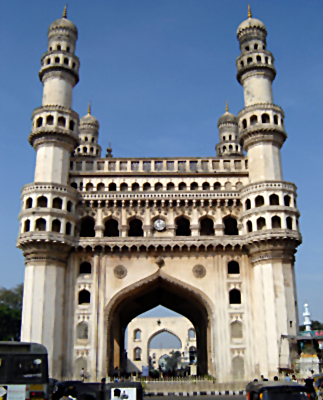
Charminar was built in 1591 which serves as the major landmark of Hyderabad. Charminar is a monument and mosque located in Hyderabad, which is the capital city of both Telangana and Andhra Pradesh. The landmark has become a global icon of Hyderabad and is listed among the most recognized structures of India. Charminar is situated on the east bank of Musi River, the tributary of Godavari River.
Mecca Masjid
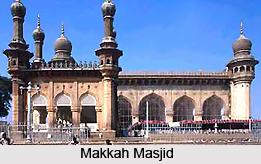
Mecca Masjid, which is also known as "Makkah Masjid" was built in the era of Muslim rule in India. It is believed that the bricks of Mecca Masjid that were inserted over the central arch were baked out of clay brought from Mecca, and also from the grand mosque at Mecca based on which it is structured. Muhammad Quli Qutb Shah, the fifth ruler of the Qutb Shahi dynasty, brought the bricks that were made from the soil brought from Mecca, the holiest site of Islamic World, and used them in the construction of the central arch of the mosque.
Badshahi Ashurkhana
Badshahi Ashurkhana is one of the most important structures of Telangana. This ancient monument shows the architectural grandeur of Mughal era. This site is now under the supervision of Archaeological Survey of India.
Warangal Fort
Warangal Fort is located in Warangal District of Telangana. This fort was formerly the pride of Andhra Pradesh. This early medieval historical monument was erected by the Kakatiya Kings of 13th century. Although precise dating of its construction and subsequent enhancements are uncertain, the historians and archaeologists generally accept that an earlier brick-walled structure was replaced with stone by Ganapatideva, who died in 1262, and that his successors - Rudramadevi and Prataparudra - added to its height and added gateways, square bastions and additional circular earthen walls prior to the death of Rudramadevi in the year 1323. The construction of Warangal Fort, happened towards the end of the Kakatiya period. There were later modifications between the 15th and 17th centuries, comprising principally the addition of barbicans to the four gates in the stone wall and the creation of gates in the outer earthen wall.
Warangal Torana
 Warangal Torana was also built by the Kakatiya Kings of Warangal of 13th Century. Now the Torana is the symbol of the Government of Telangana. The Toranas were present because, Warangal is the erstwhile capital of ancient Andhra Pradesh during 12th to 14th century. It is one of the fine examples of Kakatiya architecture and popular tourist attractions in Telangana.
Golconda Fort
Golconda fort is one of the most outstanding fortress complexes in India aged about 400 years. This majestic and imposing Golconda Fort was built by the Kakatiya dynasty in the 13th century. It is also popularly known as "Shepherd`s Hill" or "Golla Konda", in Telugu. The fortress is built on a granite hill that is 120 metres high, surrounded by massive crenulated ramparts.
Taramati Baradari
Taramati Baradari is a historical "sarai" regarded as part of Ibrahim Bagh, a Persian style garden built during the reign of Ibrahim Quli Qutub Shah, the second Sultan of Golconda. This architectural monument is now an entertainment zone in Telangana.
Kulsum Begum Mosque
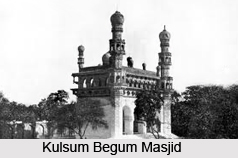
Kulsum Begum Mosque is easily distinguishable from its Qutb Shahi style of architecture, this white-coloured mosque is laying on the road from Golconda to Charminar. This mosque is located in the Karwan area, which is near the Sabzimandi or Kulsumpura, where the locals call it the `Badi Masjid`. It is even popularly referred to as Kulsumpura Majid. A princess of the Qutb Shahi lineage, Kulsum Begum, the daughter of Muhammad Qutb Shah is said to have paid the entire cost of the building.
Other monuments of this state are Ramgir Fort, Hindu Fort, Hill fort, Medak, Shambunigudi temple and many others.