Tourism in Warangal comprises of the temples, forts, toranas, waterfall and the hilly terrain. The 1000-pillar temple and the
Ramappa Temple in the district are glowing examples of the exquisite architecture patronized by the Kakatiyas. Warangal city today is part of a cluster of three towns - Warangal, Kazipet and Hanamkonda, the district headquarters. The attractions in the city are Planetarium, Musical Garden, Rock garden, Archeological Museum, Samskriti Vihar. The district is also known for its picturesque lakes, hand-woven thick cotton fibre carpets, scroll painting done on cloth in earth colours mainly at Cheriyal nearby, and sheet-metal artistry at Pembarti.
Thousand Pillar Temple
The Kakatiya King Rudra Deva, following the Chalukyan style of temple architecture, built one of the most famous monuments of Andhra Pradesh, the Thousand Pillar Temple, located in Hanamkonda, in 1163 AD. The 3 shrines are dedicated to Lord Shiva or
Mahadeva, Vishnu and Surya - with its perforated stone screens, richly carved icons, meticulously designed pillars, stands testimony to the highly evolved brilliance of Kakatiya architecture. The six feet high monolithic Nandi is another major lure of this temple, also known as `Trikutalayam`, because of the three shrines within. There are a few festivals that are celebrated in the temple complex, which are Maha Shivaratri, Ganesha Festival, Karthika Poornami, Nagula Chaviti and Kunkuma Pooja.
Ramappa Temple
This temple is also know as Ramalingeswara temple, this is situated in Palampet village, which is 70-km from Warangal. This is a magnificent monument dating back to 1213 AD depicts the glory and richness of the Kakatiya kingdom.
Kolanupaka
Kolanupaka, 80-km from
Hyderabad, is situated between Hyderabad and Warangal. This was the second capital town of Kalyani Chalukyas during the 11th century AD. During this period the village was a religious centre of Jains, and ranks among other great Jain centres in the south. It was also a great centre of Shaivism. Kolanupaka is also the birthplace of `Renukacharya` the great `Vira Saiva` saint born from the `Svayambaghu Linga` at this village and absorbed into it after preaching Vira Saivism.
Jain Mandir
The 2,000-year-old Jain temple of Mahaveer is a famous place of worship for Jains in the country. The temple is embellished with beautiful images of Thirthankaras. The 5ft high image of Mahavira is entirely carved of Jade.
Sri Veeranarayana Temple
The temple is constructed in the
Chalukyan style around 1104 AD. The appearance of the temple indicates that it was originally a Jain temple converted into a Vaishnava shrine
Someshwara Temple
Someswara III the Kalyani Chalukya emperor constructed the temple of Someswara. Rare specimens of architecture and sculpture of the Western Chalukyan period can be found in this temple.
Kolanupaka Site Museum
The State Department of Archaeology and Museums established a sculptural gallery, which exhibits artefacts from the various historical monuments in Kolanupaka.
Pakhal Lake
Pakhal Lake is a manmade lake completed in 1213 AD by the Kakatiya king, Ganapathidev, by harnessing a small tributary of the
Krishna River. It is located 50-km from Warangal and spreads over an area of 30-sq-km.
Khush Mahal
A testimony to a glorious past is the Khush Mahal, a masterpiece built by Shitabh Khan. Located close to the Warangal Fort, this magnificent edifice houses idols excavated in the surrounding areas.

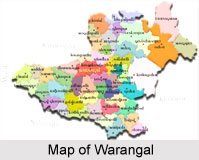 Warangal is located in Warangal District of Telangana. Warangal lies along the Chennai-Kazipet-Delhi rail route.
 History of Warangal includes the rise and fall of glorious Kakatiya rulers. Warangal, now under Warangal District of
 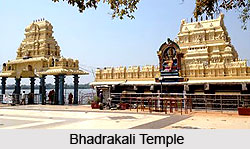 Bhadrakali Temple in Warangal also known as the Warangal Bhadrakali Temple is one of the oldest temples of
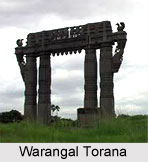
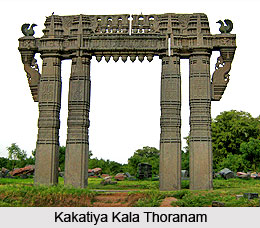
 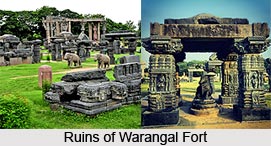 Warangal Fort is located 12 kilometres from Hanamkonda in south-east of Warangal city in Telangana. The fort is now under ruins and a popular spot among the tourists. This fort was constructed in the 13th century by the
 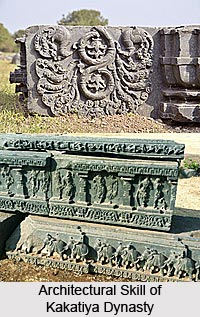 Built with Geometric workings, the fort portrayed an exquisite Thorean Architectural style. Although most of the fort is in ruins today, but still Warangal fort is among the best attractions in Telangana. The fort stands as a fine example of the architectural brilliance of the past.
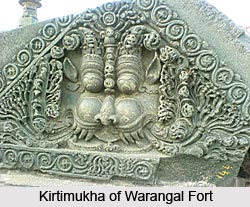 There are nearly 45 towers and pillars spread over a large area amidst which stands this temple. The fort has two fortifications, with the inner one consisting of four stone gateways made of granite.