The most stunning Indian cave paintings of the medieval period can be found in Southern India. Extraordinary amongst these are paintings of Sittanavasal Cave,
Tamil Nadu, which are of the period from 7th -
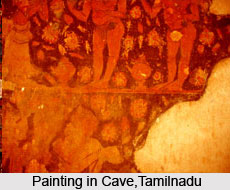
9th century AD. The artwork is spread all over the ceiling of the caves and the pillars. The murals depict a picture of Samava-Sarana, which is considered important in Jain religion. It shows a pond with lotus flowing on the water surface.
There are also paintings of gods and
Apsaras, elephants and bulls.
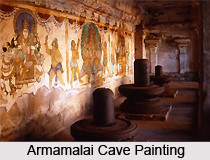
The Armamalai Cave in Tamil Nadu also portrays themes of the Jain religion, and dates back to 8th century AD. The walls and ceilings are covered with art of lotuses, flowers and humans. Thirunadhikkara Cave Temple, which was a Jain temple earlier, but was converted into a Hindu sacred ground, is highlighted with gorgeous paintings which portray stories from the
Mahabharata and
Ramayana. The Vishnu temple of Olipathivishnu Vishnugraham in Tamil Nadu, which belongs to the Malayadipatti rock-cut Hindu temples, depicts the Dashavatara, the ten incarnations of Lord Vishnu.
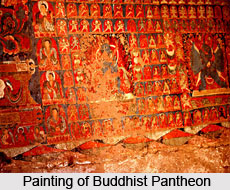
Numerous beautiful rock cut caves are scattered through out the Himalaya. Buddhist paintings of the Saspol Caves in Jammu and Kashmir, from the 13th - 15th century AD, are of special significance to the Buddhist monks. The painting is a mix of Indian and Tibetan Buddhist art and the colour Blue seems dominant in these paintings. The cave paintings of the Tabo Caves in
Himachal Pradesh are also worth mentioning. Cave paintings from the medieval era can also be tracked in the Bhimbetka Rock Shelters, amongst the ancient paintings. Indian Cave Paintings can also be found in Thiruparankundram and Murugan Temple in Tamil Nadu, Manmod and Kanheri Caves in
Maharashtra and Undavalli in
Andhra Pradesh.
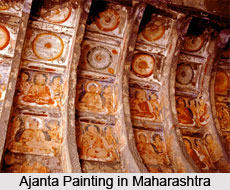 Techniques in Indian Cave Paintings
Indian cave painting were usually created in tempera and fresco techniques. The preparation of the surface that served as the canvas was also given due importance. The surface was generally plastered with lime, clay, dung and hay, after being chiselled to make the surface rough. This was normally done to achieve a smooth finish and a glossy effect was added with the use of seashells and conch dusts.
Indian cave painting has suffered adequate erosion over time as colours have faded and have been tarnished. Moreover damp and moist air also adds to the degradation process of the artwork. In the recent times, graffiti created on the painting by immoral and irresponsible citizens have also become a poignant threat. Proper steps and measures should be undertaken in order to preserve and conserve the Indian cave paintings, as these are of great value to the entire world.

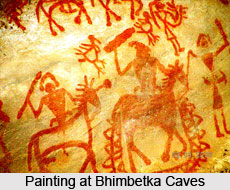 Indian cave paintings are of utmost importance due to the lack of proper documented and written records of prehistoric period. Moreover, Indian cave paintings have more durability than most other forms of paintings and are comparatively safe from general wear and tear that gravely affects paper, fabric, wooden or other form of ancient art. Indian caves provide the adequate setting for preservation of ancient paintings by means of which an idea about the ancient way of life and society can be obtained.
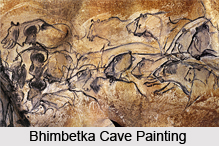 Many ancient painting in India have been preserved over time, even though painting, as an art form, is considered to be comparatively fragile and short lived. The rock cut structures and cave paintings provide the art to survive for ages. No other place on earth can compete with India in this respect. The geology of the Deccan Plateau and other region of India, offer enough domes and cliff faces suitable to rock cut caves. Since the pre-historic days India has experienced extremely flourishing and diversity of culture.
 The Pitalkhora Caves in Maharastra were decorated with beautiful paintings in 4th century AD, and the remains of these art and paintings are preserved till today. Some of the ancient and beautiful Indian cave paintings have been carefully preserved in Bagh Caves in Madhya Pradesh. This truly beautiful artwork has been created circa 4th-6th century AD. There are paintings which have been restored in the royal Badami Cave Temple in Karnataka from 6th -7th century AD. Here the ceilings contain the painting pictures of four armed Brahma on his swans. The traces of less impressive ancient paintings from 3rd - 8th century AD are found in many caves in Maharashtra- Thanale, Karsamble, Kuda Lenvadri, Tulja Lena, Shivneri, Manmod also popular for Bhaja Caves and Elephanta Caves. The traces of ancient paintings are found in Ravana Phadi- beautiful cave temple from 550 AD in ancient capital Aihole in Karnataka.
 There are many rock cut cave temple and also monasteries situated in Himalayan regions. Saspol Caves, located in Jammu and Kashmir, contains Buddhist panteon. Most of the paintings use blue colour and has an uncanny resemblance with Indian Buddhist art.
 Various mythical creatures like