Sawai Man Singh II
Sawai Man Singh II, also known as Mor Mukut Singh was the last ruling Maharaja of Jaipur belonging to Kachwaha dynasty.

Share this Article:

About Sawai Man Singh II

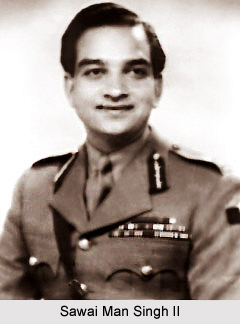
Sawai Man Singh II, Maharaja of JaipurSawai Man Singh II, popularly known as Mor Mukut Singh was the last ruling Maharaja of Jaipur belonging to Kachwaha clan of Rajputs. Born on August 21, 1911, Sawai Man Singh II ruled the princely state between 1922 and 1949 and eventually the state acceded unto the Dominion of India. Since then, Sawai Man Singh II held office as Rajpramukh of Rajasthan from 1949 to 1956. In later life, Sawai Man Singh II served as Ambassador of India to Spain. He was also known as a notable sportsman and eminent polo player.

Sawai Man Singh II is also known as "SMS" in Jaipur as the second son of Thakur Sawai Singh of Isarda and Sugan Kunwar. The father of Sawai Man Singh II was a nobleman belonging to the Kachwaha dynasty of Rajputs. Sawai Man Singh II grew up in the grimy, walled township of Isarda, a chief Thikana of the Rajawat sub-clan, which lies between the towns of Sawai Madhopur and Jaipur in present-day Rajasthan. The family of Sawai Man Singh II was associated with the ruling house of Jaipur and Kotah (where his father`s sister was married). The then ruler of Jaipur, Sawai Madho Singh II, had been born to the former Thakur of Isarda and had been adopted into the monarch family of Jaipur. After giving the child for adoption, Madho Singh`s actual father had in turn did not have his own heir. He adopted the son of a distant relative and was succeeded by that adopted son as Thakur of Isarda. That lad was Sawai Singh, father of Mor Mukut Singh. Thus, Sawai Man Singh II or Mor Mukut could be supposed to be the close relative of Maharaja Madho Singh II of Jaipur.

After being adopted to become Maharaja of Jaipur, Madho Singh II had around 65 children by various concubines, but the highly superstitious Maharaja was strictly warned by a sage against having lawful heirs and thus took great care not to impregnate his five wives. On March 24, 1921, Madho Singh II adopted Sawai Man Singh II to be his son and heir. The boy was given the name "Man Singh" after his adoption. Madho Singh II died on September 7, 1922 and was thus succeeded by Man Singh as Maharaja of Jaipur and head of the Kachwaha dynasty of Rajputs. The new Maharaja was only eleven years old.

Upon his ascension in 1922, Sawai Man Singh II started and encouraged a program of modernization and initiated the infrastructure and foundation of numerous public institutions that would later result in Jaipur being declared as the capital of Rajasthan. In 1958, Sawai Man Singh II was also among the rulers to realize the importance of tourism in Rajasthan. Very soon, Sawai Man Singh II transformed the elegant Rambagh Palace into a luxury heritage hotel. Under his rule various laws of land reform were first introduced within his own jurisdiction, like Jaipur Tenancy Act. Later in 1956, the `Jagidari` or the feudal form of political administration was abolished during the government of the Congress Party in India. In 1965, the Indian Government selected Sawai Man Singh II, Indian Ambassador to Spain.
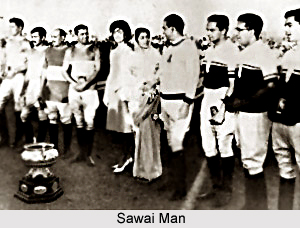
Sawai Man Singh II, Maharaja of Jaipur Utilising his endless contacts in Europe, Sawai Man Singh II spent much of his time in Europe to develop new military technology and arms-deal for the development of Indian army. He was especially noted as a fervent (10-Goal) polo player, winning the prestigious World Cup in 1933 among various other awards. During the 1950s, Sawai Man Singh II owned Saint Hill Manor in East Grinstead, West Sussex. His initial marriages were to suitable brides chosen from the royal family of Jodhpur, considering the Rajput heritage and social ranking to be equivalent. His first wife was Maharani Marudhar Kanwar was the sister of Sumer Singh, while his second wife Maharani Kishore Kanwar was the niece of his first wife and daughter of Sumer Singh. The most popular relationship in Sawai Man Singh`s life was his courtship and subsequent espousal of the legendary beauty, Gayatri Devi of Cooch Behar, daughter of Jitendra of Cooch Behar and Indira of Baroda.

In 1970, Sawai Man Singh II met with an accident while playing polo in Cirencester, England and died later the same day. He was survived by his third wife Gayatri Devi and by four sons. His eldest son, Maharaja Sawai Bhawani Singh of Jaipur, succeeded him as titular Maharaja of Jaipur and head of the Kachwaha clan. After the death of this able ruler, Indira Gandhi was finally able to suppress the power of India`s former Rulers in democratic India as they formed a large bulk of her opposition party - the Swatantra party.

The statue of Sawai Man Singh II has been installed at the Ram Niwas Bagh in Jaipur and the statue was unveiled at a grand function on 30th March 2005. Knight Grand Commander of the Order of the Star of India and Knight Grand Commander of the Order of the Indian Empire were awarded to him.

Sawai Man Singh II was given the following titles in his lifetime -
• Mor Mukut Singh of Isarda
• His Highness the Yuvaraja of Jaipur
• His Highness the Maharaja of Jaipur
• His Highness the Rajpramukh of Rajasthan, Maharaja Sawai Man Singh II of Jaipur
• Lt. General His Highness Saramad-i-Rajaha-j-Hindustan Raj Rajendra Shri Maharajadhiraj Sir Sawai Man Singh II of Jaipur

Sawai Man Singh II had several children; his younger sons married princesses from Jubbal, Tripura, and Lunawada and his daughter married the Maharaol of Baria. His eldest son, Maharaja Sawai Bhawani Singh of Jaipur, succeeded him on the throne. His second son was created Raja of Jhalai, third son, Maharaj Prithviraj, while the youngest son, Prince Jagat Singh was later called Raja of Isarda, named for the previous fief of Man Singh`s father.
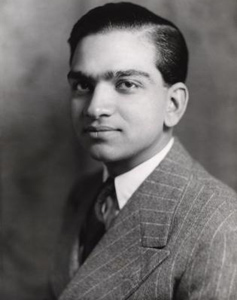

Early Life of Sawai Man Singh II

Early Life of Sawai Man Singh IISawai Man Singh II is one of the prominent rulers of Jaipur who ruled from 1922 to 1949. The state was one of the largest princely states which was annexed to the Dominion of India in 1949. Mainly known for his dynamic innovations Sawai Man Singh II brought modernisation in the state. Born in the royal family he succeeded Sawai Madho Singh II after his death when he was only eleven year old. Sawai Man Singh-II was born in the noble family of Thakur Sawai Singh of Isarda and his wife Sugan Kunwar as their second child. Both named him as Mor Mukut. His father was a nobleman of the Kachwaha of the Rajput clans. Mor Mukut grew up in a small village of Isarda which was the prime centre of the Rajawat clan which lies between the town of Sawai Madhopur and Jaipur in present day Rajasthan. His family had a royal origin which was well connected with the royal family of Jaipur and Kota where his sister was married. Sawai Madho Singh adopted Mor Mukut as his Heir apparent who shall be renamed as Sawai Man Singh II.
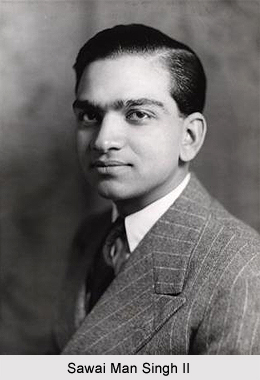
Early life of Sawai Man Singh was largely spent in training in initial customs and beliefs of the traditional Rajput family. Under the supervision of Sir James Robert customary arrangements were made for the young chief who should know the basic traditions of his own clan. After a month of Sawai Madho Singh`s death Sir James Robert insisted in educating Man Singh in Jaipur only and started a school at Rambabgh Palace which was attended by the children of notable families. His school education included study of various subjects along with English. Alongwith this special training was provided regarding horse riding. His initial training was further nurtured with the training of Mr Mayne who was appointed as the new tutor who was sent for Rajkot College. He was given the title of Deputy Guardian. Later on to avoid any intrigue in the palace against the young couple he was shifted to Mayo College where he continued his further training and education.

Mayo College was an extraordinary institution, founded by Lord Elgin in the nineteenth century for the education of the Princes and nobles of all the twenty-one princely states of Rajputana. However, due to life risk he was shifted to Bharatpur House which was a small gloomy place but good for security for the prince. The school was run very much on the lines of a British public school. Only about twenty of the two hundred boys could afford horses, but the young Maharaja lived in luxurious style. Mr Mayne, the tutor, along with plenty of servants and nine syces and an Indian tutor to coach him in Indian subjects accompanied him. In the long run Mr Mayne who was very fond of Man Singh insisted in sending him to England for further education. Sending abroad was objected by the queen. As such they insisted in staying in Jaipur. He was restricted to stay in his own palace at Rambagh which was at some distance from City palace and his family. On 10th July 1027 Man Singh finally left for England from Bombay (now Mumbai). In the meantime he underwent his marital alliance with sister of Sumer Singh which was another important aspect of his early life.


Marriages of Sawai Man SinghII

Sawai Man Singh II had three wives who were connected with the royal families of Jodhpur and Cooch Behar. He got married at a very early age. While his first wife was Maharani Marudhar Kanwar, sister of Sumer Singh, Maharaja of Jodhpur; his second wife was Maharani Kishore Kanwar, niece of his first wife and daughter of Sumer Singh. His most celebrated marriage was with Maharani Gayetri Devi who was the daughter of Jitendra of Cooch Behar and Indira of Baroda.


Sawai Man Singh II as Yuvraj of Jaipur

Sawai Man Singh II as Yuvraj of JaipurSawai Man Singh II as Yuvraj of Jaipur succeeded his father Sawai Madho Singh after his death. Sawai Man Singh as the Yuvraj spent a major time in England during which period he gained training in military knowledge at the Royal Military Academy, Woolwich. Man Singh sailed from Bombay (now Mumbai) along with his elder brother and Colonel Twiss. Besides military education Man Singh developed a keen interest in the game of Polo which was one of his favourite games. He also continued developing connections with one of his close friend the Raja of Barwaras. It was during this period that Man Singh developed the sense of differentiating between responsibilities and fun. In England Man Singh was commonly known as Jai by his close friends.

On his return to India he got alarmed with some issues of social backwardness which became his main orientation. A major issue was female child infanticide, especially in rural villages. Along with this the young Yuvraj also took some prime initiative in organising the public works. As the society was still quite backward the prince had to take some moral steps to improve the general condition of the local rural people. Among his major public works he took up the issue of water supply as a prime concern. Under his orders the irrigation dam was constructed at Ramgarh which shall provide sufficient water supply to the surrounding areas. This was supplemented with the building up of some filtration plants which would supply clear drinking water to the people. As a Yuvraj he launched some such most important ventures in the public interest which were completed after he gained complete power as the Maharaja. In 1927 the electricity work was launched officially. Various administrative steps were also taken with regular payment of taxes and regular check up of the revenue department of Jaipur. All this gave complete knowledge of the kingdom which brought the Yuvraj much closer to the people.

During this period reshaping of army as well as internal police force of Jaipur was undertaken. These were originally divided into four separate quarrelsome sections which got reorganised into single units. This enhanced the security of the state both externally and internally. Along with some sound administrative and economic reforms were also made for the well being of the people. When in Jaipur Yuvraj Man Singh was also interested in introducing innovations in sports. While Polo had been his major attractions, hunting was equally exciting for him. He used to be accompanied by his friends and other local native princes in his expedition of hunting either tiger or panthers. Among this shooting a tiger was his biggest passion.

Sawai man Singh as the Yuvraj of Jaipur also went through his second marriage. As he was some of the most attractive good looking young prince of Jaipur he was approached by Sumer Singh, Maharaja of Jodhpur for a second time. This time he wanted his daughter to be married with Yuvraj Man Singh. The marriage was celebrated wit great pomp and show. His name, fame and glory reached all the corners of India. Along with Sumer Singh, Jiterdra of Cooch Behar from West Bengal also approached him for his daughter Gayetri Devi who became the most popular third prince of Man Singh. She is commonly known for her beauty and elegance.

Thus with some major administrative and economic reforms and public works Yuvraj Man Singh marked his presence just after returning from England. He was one the most prominent Yuvraj of India.


Maharaja Sawai Man Singh II Museum

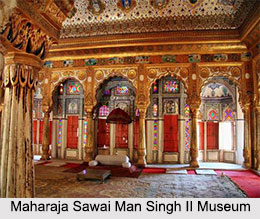
Maharaja Sawai Man Singh II Museum, Jaipur, RajasthanMaharaja Sawai Man Singh II Museum is located in the Indian state of Rajasthan. More specifically, this museum is situated in Jaipur. In the central-northeast part of the city of Jaipur is a famous palace called the City Palace. This palace is a complex of several other palaces, pavilions, gardens and temples and the residence of the Royal Family of Jaipur. The museum is a part of this complex. More specifically, an inbuilt public hall of the palace called the Diwan-I-Aam is the home to the Maharaja Sawai Mansingh II Museum. Thus, this museum is also known as the City Palace Museum.
Exhibits of Maharaja Sawai Man Singh II Museum : Maharaja Sawai Man Singh II Museum houses some of the rare Hindu scriptures of the primitive period of India. These scriptures were mostly written with hands. Most significant are the minute copies of the Bhagwat Gita, which were prepared to protect them from Mughal king Aurangzeb`s onslaught on holy religious scriptures.

Other treasures of the Maharaja Sawai Man Singh II Museum include a handful of miniature paintings. They are quite frail thereby depicting several themes of the Ramayana and also other primeval Hindu mythological scriptures. They belong to several schools of Indian art and architecture like Rajasthan, Mughal and Persian. Also the ceilings are painted colorfully and are quite attractive. The ceiling possesses huge chandeliers. These are usually sheltered from dust covers. They are displayed only on special occasions. The elephant saddles, better known as the haudas is worth mentioning. City Palace Museum houses sterling silver items of 2 mammoth silver vessels. It is the world`s largest one. As per the opinion of the experts Maharaja Sawai Madho Singh II possessed these vessels. He used to take them to River Ganga and fill them for the purpose of drinking. There is Diwan-I-Khas, or hall of the public audience of the City Palace Museum, lying between the art gallery and the armory museum. It is lined up in beautiful marbles.

Till today imperial family members reside in a portion of this City Palace museum. However the visitors are permitted to visit this portion where numerous things are being displayed. In the outside courtyard superb peacock deserves to be mentioning. In other words this city palace museum is well preserved which retains ancient legacies with immense concern.

Visiting Information : Travelling to Jaipur by air is considered to be the most convenient. The Jaipur airport is located at Sanganer, which is about 12 kilometers from the heart of the city. This airport has both international and domestic terminals. A number of airlines that operate on a regular basis connect Jaipur to most of the cities not only across India, but also across the globe. Jaipur is reachable by trains such as Shatabdi Express which is air-conditioned, very comfortable and connects Jaipur to many important Indian cities like Delhi, Mumbai, Ahmedabad, Jodhpur, Udaipur, Jammu, Jaisalmer, Kolkata, Ludhiana, Pathankot, Haridwar, Bhopal, Lucknow, Patna, Bangalore, Chennai, Hyderabad and Goa. Some other popular trains are Ajmer Shatabdi, Pune Jaipur Express, Jaipur Express and Adi SJ Rajdhani. The Rajasthan State Road Transport Corporation (RSRTC) runs regular, Volvo (air-conditioned and non-air-conditioned) and deluxe buses between Jaipur and other cities within the state.


Share this Article:

Related Articles

More Articles in States of India


East Indian States
East Indian States comprises of Bihar, Jharkhand, West Bengal, Odisha and also the Union Territory of Andaman and Nicobar Islands. It defines the cultural heritage, rich historical background and the linguistic unity.
Erode District
Erode District is one of the districts in the state of Tamil Nadu. The district of Erode is having a land-locked area with no sea coast.
Purnia District in Bihar
Purnia District is located in Bihar and extends from River Ganga to Nepal. The district has a rich Hindu history and glorious past.
South Delhi District
South Delhi District is the third largest district of Delhi as far as its area is concerned. South Delhi District is known for its economic, historical, cultural and social significance.
North Indian States
North Indian States formed the cultural and religious unity in spite of having many foreign invasion and the political disturbances from the early era till the British gained supremacy in Indian sub continent.
Kendujhar District
Kendujhar District, spread over an area of 8,240 sq kms, is as varied as the whole of Orissa with waterfalls roaring gorges, mountains and minerals. The manifold expressions of nature in Kendujhar District are considered as unique.
Hooghly district
Hooghly District along the bank of the river Hooghly is one of the principal trading ports of West Bengal.
Districts of South Tamil Nadu
Districts of South Tamil Nadu consist of many tourism destinations like archaeological sites and the history of Pandyas and Cholas. Considering their proximity to the sea, many districts also boast of serene beaches and coastal beauty.
Flora of Arunachal Pradesh
Flora of Arunachal Pradesh includes infinite species and is a subject of great interests for the botanists.
Districts of South Gujarat
Districts of South Gujarat are the epicenter of Jain pilgrimages and the early Hindu kingdoms.
North West States of India
North West States of India consist of three states, which are Rajasthan, Punjab and Haryana. All of them are culturally and traditionally diverse and they have been ruled by different dynasties in historical time.
Geography Of Chittoor District
Geography of Chittoor district is spread along the topography of the land which is divided into two natural divisions; Chittoor has a dry and healthy climate.
Districts of North Rajasthan
District of Northern part of Rajasthan is dotted with ancient forts and medieval villages.
Districts of North Odisha
District of North Odisha has Bengal boundary and shares the same culture. These are reachable if one pays a weekend visit to Digha.
Districts of West Bihar
Districts of West Bihar is comprised of medieval monuments that were built by the different governors of Mughal era.
Districts of South Haryana
Districts of South Haryana consists of many cities of industrial excellence. These districts are dotted with popular tourism destinations.
Medieval History of Assam
Medieval history of Assam narrates the advent and rule of a number of kingdoms in the region. The prominent dynasties of the kingdom left an everlasting imprint on the socio cultural heritage of India.
Geography of Meghalaya
The suitable climate, highland plateaus, rivers and the flora and fauna together forms the geography of Meghalaya.
Districts of Rayalaseema
Districts of Rayalaseema in Andhra Pradesh state has urban population and rural settlements as well.
Districts of South Punjab
Districts of Southern part of Punjab depict medieval history of Punjab and the rise of Sikhs.