Kota
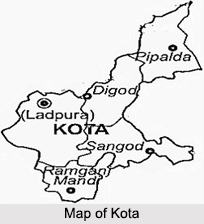
Kota is a city in Kota District of Rajasthan. This city is popular for the presence of many tourism destinations.

Share this Article:

Introduction

Kota, Kota District, RajasthanKota is a metropolitan city in Kota District of Rajasthan. This city was previously under Princely State of Bundi. Kota is an amazing blend of antiquity and the contemporary.

Kota is a place of hydro electricity and Nuclear power plants and the palaces of Rajputana era. Kota is well known for its opulent forts and temples, which are worth checking out. It is also one of those places that offer a fertile landscape to the people of Rajasthan.


Location of Kota

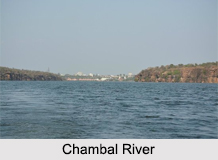
Kota is located in the south Rajasthan. Kota is fed by Rajasthan`s largest river, the Chambal River.


History of Kota

The history of Kota generally revolves around the city of Kota. The kingdom of Kota was ruled by the Hadas and was thus known as the land of the Hadaoli. They were known to be the descendants of Chauhan clan of the Agnikula Rajputs. Initially they had settled in the hilly terrain of Mewar near Bijolianat Bambaoda in the 12th century A.D. they slowly extended their empire and conquered Bundi in 1241 A.D. however it was not before 1624 that Kota became a separate identity. It was separated from Bundi in 1579 to create an individual kingdom. The kingdom was ruled by Rao Madho Singh quite efficiently.

Rao Madho Singh at the age of fourteen was popular for his ability as a fighter. It was one of the reasons why a separate kingdom was carved out for him. He fought for the ageing Mughal emperor, Shah Jahan, against his usurper son, Aurangzeb. The history of Kota is dotted with tales of courage and sacrifice. Five of Rao Madho Singh`s six sons died on the battlefield. While Bundi was hidden away from the invasions amidst the hills Kota was not that fortunate. It was threatened by Mughal rulers, the Maharajas of Jaipur and Mewar, the Maratha warlords, and sometimes their own cousins in Bundi. It was through diplomacy that the rulers of Kota would often safeguard their kingdom. One such move was an alliance with the Marathas through a treaty in the 18th century to keep the Kachhawas rulers of Jaipur away from Kota.

One of the most interesting characters of modern Rajput history is Zalim Singh, a statesman and diplomat. He was often known as the "Talleyrand of North India" and the "Machiavelli of Rajwarra." Beginning as a general of the Kota armies he went onto become the Regent of the kingdom when the ruler died. He left an infant son on the throne. At this time Zalim Singh reorganized the kingdom and he was the first one who signed a treaty with the British. By doing this he ensured that Kota would be divided into his sons equally. This treaty was signed in the year 1817. Under the guidance of Zalim Singh Kota prospered. Due to this treaty a new state of Jhalawar was formed in 1838. his diplomatic decisions and smart moves gave Kota recognition amongst the Rajputana states.

In the Indian history too Kota was of great importance as it was one of those kingdom`s that took part in the Revolt of 1857.


Geography of Kota

The geographical extension of Kota is about 193.58 square kilometers. The place is also easily accessible from the main cities of Rajasthan as there are sufficient transports around. Kota covers an area of 527 square kilometers. It has an average elevation of 271 metres. Kota is surrounded on the north and North West by Sawai Madhopur District, Tonk District and Bundi district. The latitudinal and longitudinal limit of Kota is 25.18 degree north to 75.83 degree east.


Economy of Kota

Kota, Kota District, RajasthanKota is dependent on agriculture because of its fertile soils. The city is the centre of trade for cotton, millet, wheat, coriander and oilseeds. Kota is enriched for its Kota sarees. Kota saris are the most traditional piece of work from medieval era.


University of Kota

University of Kota, RajasthanUniversity of Kota was recognized by the UGC in 2003 under the state act. It offers both undergraduate and postgraduate courses. It has 129 affiliated colleges and autonomous departments. The university has education programs in six areas: Arts, Commerce & Management, Education, Law, Science and Social Science.

Departments of University of Kota : 
Department of Commerce & Management
Department of Computer Science & Informatics
Department of Pure & Applied Chemistry
Department of Pure & Applied Physics
Department of Social Sciences

Courses of University of Kota
Post Graduate courses:
M.C.A.
M.Sc.(IT)
M.Sc.(CS)
M.Sc.(Biotech)
M.Sc.(Microbio)
M.Sc.(Bioinfo)
M.Sc.(Ele. &Comm.)

Under Graduate courses:
B.C.A.
B.B.A.
B.Sc (IT)
B.Sc.(CS)
B.Sc.(Biotech)
B.Sc.(Ele. & Comm.)

Academic courses:
B.Sc.(Maths)
B.Sc.(Bio)
B.A.
B.Com.
M.Sc.(Phy.)
M.Sc.(Chem.)
M.Sc.(Maths)
M.Com
M.Com
M.Com
M.A


Tourism in Kota District

Tourism in Kota District, RajasthanTourism in Kota district, surprisingly unexplored, has some splendid treasures for the tourist to take home memories of. Its impregnable fortresses, sprawling and exquisitely wrought palaces and lovely waterways act as a magnificent foil to its exotic wildlife and delicate fresco paintings. Kota lies along the eastern bank of the Chambal River, an amazing juxtaposition of the majestic medieval age and modern industrialisation. Its untouched wealth of impressive forts, opulent palaces and splendid temples dating back over several centuries retain the past glory. The present day edifices and heavy industries have made it the industrial heartland of Rajasthan.

The various places of tourism in Kota district are discussed below.
The commanding Kota fort stands overlooking the modern Chambal Valley Project with its many dams- Kota Barrage, Gandhi Sagar, Rana Pratap Sagar and Jawahar Sagar. An old palace, dating back to the time when Kota was under the control of Hada chieftaincy faces the Kota Barrage. The Durbar Hall is ornate with beautiful mirror work and has ebony and ivory doors. Exquisite miniatures of the Kota school are housed within the Hall. Other noteworthy edifices of the bygone era are the Brij Raj Bhawan Palace, Jag Mandir and island Palace, a splendid haveli (mansion) with beautiful frescoes and the royal cenotaphs.

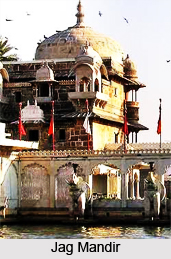
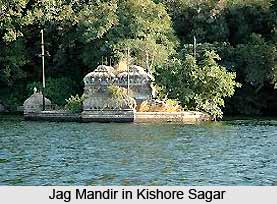
Jag Mandir L Amid the picturesque artificial lake of Kishore Sagar constructed in 1346 AD by Prince Dher Deh of Bundi, stands the enchanting little palace of Jag Mandir. The azure waters around the red-sandstone monument enhance its beauty. Boat-rides can be enjoyed in the lake. The Keshar Bagh famous for its royal cenotaphs lies in the vicinity.

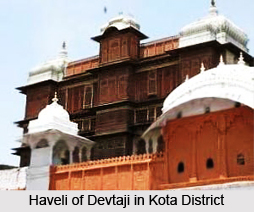
Haveli of Devtaji : The beautiful Haveli of Devta Shridharji is located in the middle of the busy market. The haveli is noted for its splendid frescoes and ornate rooms with lovely wall paintings.

Tourism in Kota District, RajasthanChambal Garden : The Chambal garden is a beautifully landscaped garden at the Amar Niwas. Its lush surroundings make it a popular picnic spot offering enjoyable boat rides.

Kota Barrage : A part of the irrigation canal system on the Chambal River, this beautiful setting is ideal for outings and evening strolls.

Maharao Madho Singh Museum : Situated in the old palace, the museum has a superb collection of Rajput miniature paintings of the Kota school, exquisite sculptures, frescoes and armoury. The museum also houses a rich repository of artistic items used by the Kota rulers.

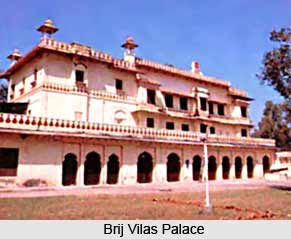
The Government Museum : This museum is housed in the Brijvilas Palace near the Kishore Sagar. The museum displays a rich collection of rare coins, manuscripts and a representative selection of Hadoti sculpture. Especially noteworthy is an exquisitely sculptured statue brought here from Baroli.

Other places worth visiting in the district of Kota are the Kansua temple with a four faced Shiva Lingam, Bhitria Kund, Adhar Shila, Budh Singh Bafna haveli, Yatayat Park, Haryali Water Park and the Godavari Dham Mandir.


Visiting Information

Kota is easily reachable by roadways, railways and airways. Kota is well connected by bus with the other cities in Rajasthan and across the state border to Bhopal and Indore (Madhya Pradesh).

Accommodation in Kota
Accommodation in Kota, RajasthanTo accommodate the swarm of tourists several accommodation units have mushroomed in the Kota district. Amongst the Rajputana states it was always famous for its handicrafts. Today its has evolved as one of the popular tourist places in Rajasthan. Even today it is a leading name in the handicrafts industry. However apart from its artwork Kota is also known for.

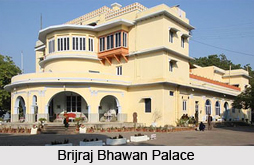
Brijraj Bhawan Palace: It is a heritage hotel with 7 well-furnished rooms to offer to the travelers. All the usual facilities like dining, terrace garden, travel assistance, personalized services and recreational amenities are offered to the guests. Both traditional Indian and International cuisine are served on the platter to the tourists. What sets it apart is that provides an opportunity to the guests to experience the opulence and luxury of the Rajput royals.

Sukhdham kothi: There are 15 rooms in this hotel. Homemade Rajasthan cuisine, bar, conference and other services are available for the guests.

Umed Bhawan Palace: This too is a part of heritage stay. With 32 air-conditioned rooms it also has restaurant, bar, banquet, conference, recreation services and Internet.

Palkiya Haveli: This was the house of Rathores of Palkiya, built by Thakur Deo Singh in the traditional Rajput style. Whether it is the carved balconies, well-maintained gardens, open courtyards or outstanding services-everything about this hotel is impressive. Some of the other services here are dining, room services and cars on hire.

Hotel Menaal Residency: With fully air-conditioned, swimming pool, restaurant, coffee shop, conference, lawn and car rental this too is popular with travelers.

Hotel Surya Royal: The travelers can also stay at this hotel as it offers comfortable rooms. For business travelers there is the conference facility. Restaurants, travel desk and others are also available.

Hotel Phul plaza: 20 well furnished rooms are at the tourists` disposition at this hotel. There are Direct Dial telephones in the rooms. Besides these there are services, such as, CCTV, conference, restaurant, elevator, ticketing, taxi, laundry and others.

RTDC Hotel Chambal: Here cozy rooms are teamed up with excellent services to cater to the needs of the guests. There are 12 rooms with room service, attach bath and H/C water. There are laundry services too.

Hotel Navrang: 25 rooms are there at this hotel for accommodating the travelers. Restaurant, room service, CCTV, H/C water are offered.

Hotel Raj Kesar: An intelligent blend of good accommodation units and traveler friendly services can make the stay at this hotel quite convenient and comfortable. Lawn, laundry, dining hall, transport, car parking and others are available for the guests.

Hotel Everest: 20 rooms, CCTV, refrigerator, travel desk, laundry and several other services are at the disposal of the guests.


Monuments of Kota

Monuments Of Kota, Monuments Of Rajasthan Kota, also known as the industrial capital of north Rajasthan, is the capital of the Kota district. The monuments of Kota, resplendent palaces and forts, exist side by side with modern factories in this quaint little place. Kota lies on the east bank of the Chambal River, below a deep gorge straddling one of the main lateral trade routes from the plains of Delhi to the fertile lowlands of Gujarat. The history of Kota alternated between periods of expansion and contraction, depending on the political environment. In the early 19th century, under the enlightened tutelage of Zalim Singh, Kota weathered the worst political storms and emerged a prosperous and flourishing state. On his death this stability was lost. It was not recovered until 1894, when British intervention reunited the territory.
Monuments Of Kota, Monuments Of Rajasthan The monuments of Kota comprise a number of resplendent palaces and forts. The City Palace and fort beside the Kota barrage is one of the largest fort complexes in Rajasthan. Built from 1625 onwards, it reflects the turbulent history of the state in that it evolved over a long period, growing in times of stability and stagnating in adversity. There is no large ordered plan found in the construction of the palace. Located here are a Durbar Hall and the Bhim Mahal from the early 18th century. These are covered with Rajput miniatures depicting the history and legends of Kota. The exterior of the palace is a mixture of robust fortification and delicate ornamental stonework. There is some fine ivory and ebony inlay work and a profusion of surface ornament. The entrance to the palace is the Hathi Pol or the Elephant gate. It is flanked by later murals showing a royal wedding procession and bracketed elephants, whose trunks form a triumphal gesture over the central arch.

The Kota fort is one of the largest fort complexes in Rajasthan. It was built in 1264 and expanded over the years. The rampart of the fort is one of the highest in Rajasthan, with massive bastions, 6 double gates and 25 towers. A number of palaces are found situated inside the fort- Madhao Singh Mahal, Bada Mahal, Raj Mahal, Jhala Haveli and Chhatra Mahal. The main entrance to the fort is via the Naya Darwaza.
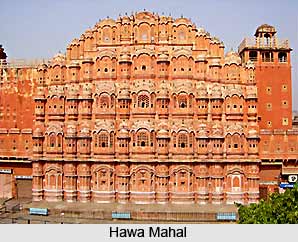
Monuments Of Kota, Monuments Of Rajasthan The Akhade Ka Mahal was added to the west of the inner court between 1723 and 1756, and was later enlarged and recast between 1888 and 1940. The prominent Hawa Mahal, added next to the entrance to the fort in 1864, is based loosely on the famous facade at Jaipur. The cenotaphs of the ruling family lie nearby.

The Maharao Madhao Singh Museum is situated within the old palace. It houses a fabulous collection of Rajput miniature paintings of the Kota School. Apart from this found herein are exquisite sculptures, frescoes, armoury, antique garments, toys, and a rich collection of items used by the Kings of Kota. To the right is the Raj Mahal. This palace is exquisitely painted and has excellent mirror work.
Monuments Of Kota, Monuments Of Rajasthan The Umaid Bhawan Palace was built for Umed Singh II in 1904. The construction of the palace was commissioned to Sir Swinton Jacob, a distinguished officer of the British army. It is faced in buff-coloured stone with stucco dressings and incorporates a great deal of scholarly Rajput detail, but the overall composition and much of the interior is European and Edwardian in conception. It might be said that the palace evidences a harmonious blend of Rajput and Victorian architectural styles. There is a fine drawing-room and banqueting hall, picturesque ceiling, marble corridors and a beautiful garden, renowned for its spectacular herbaceous borders. The Palace currently functions as a Luxury hotel.

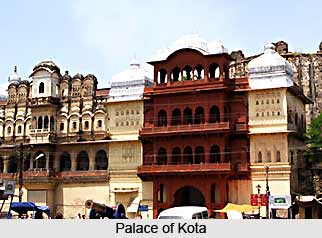
The Jagmandir Palace is another popular monument of Kota. It rises picturesquely out of a small island on the artificially constructed Kishore Sagar Lake. The Palace was built in the year 1740 by a Queen of Kota. It is a beautiful red sandstone palace.
Monuments Of Kota, Monuments Of Rajasthan On the North side of the Kishor Sagar Lake is the Brij Vilas Palace Museum. It exhibits an interesting collection of weapons, statues and paintings. A rare collection of coins and Sanskrit manuscripts are found here.

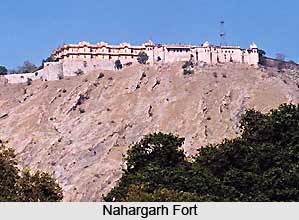
Featuring among the other impressive monuments in Kota is the Haveli of Devtaji. The Haveli is famous for its beautiful paintings and frescoes. Other ancient monuments which can be visited from Kota are the Nahargarh fort and the temple complex of Badoli. The latter is situated 56 kms to the South West of Kota. The temples contained here are some of the oldest in Rajasthan, dating as far back as the ninth century.

The Bhanddeora temple is situated at a distance of 110 km from Kota. Also known as the "Khajuraho of Rajasthan", this temple is an important religious site of Kota. The temple is believed to have been built sometime between 11th and 12th century.

There are also some other buildings of note in Kota. These include General Hospital, Hospital for Women, the Crosthwaite Institute, the Curzon Wyllic Memorial, the Herbert High School and the Girls` School.

Kota is now a fast growing industrial station, complete with an atomic power station and a river barrage. However, the ancient monuments of Kota existing side-by-side with modern technology still lend it on old world charm.

Share this Article:

Related Articles

More Articles in Cities of India


Ancient North Indian Cities
Ancient North Indian Cities were developed in the early era that is from the time of Mahabharata, and after the decline of Hindu kings in Northern parts. Some have become desolated and some became the archaeological ruins.
Ancient South Indian Cities
Ancient South Indian Cities witness the rise and fall of many empires from the early era.
Ancient Cities of North West India
Ancient Cities of North West India show the Rajput culture from the early phase, but in medieval era it showed the prominence after having a good relation with Mughals.
Ancient West Indian Cities
Ancient West Indian Cities are now completely in ruins, because of the heavy earthquake in some of the regions.
Holy Cities of North West India
Holy Cities of North West India are grown up in the midst of dry and thorny desert lands with Rajputana art and architecture.
Holy Cities of North India
Holy Cities of North India are having the rich history of Hinduism and the entire civilization was grown up with the hands of beliefs, rituals and the evolution of religion.
Holy Cities of South India
Holy Cities of South India gives the detailed cultural formation of Dravidians from the early era, which later developed to the world by the Pallavas and the Cholas.
Holy Cities of Central India
Holy Cities of Central India have the excellence of art and architecture in temples in the early era.
Holy Cities of East India
Holy Cities of East India refer the places of religious importance. Hinduism, Islam, Christianity and Buddhism are widely spread.
Holy Cities of West India
Holy Cities in West India were established by the rulers of Rajputs and the Satvahana Dynasty and the medieval rulers of Junagadh.
Cities of West Uttar Pradesh
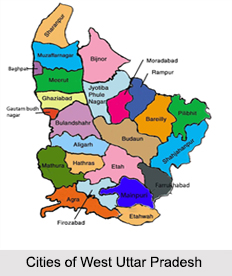
Cities of West Uttar Pradesh include Meerut, Bulandshahr, Ghaziabad, Saharanpur, Muzaffarnagar, Bijnor, Bareilly, Rampur, Agra, Aligarh, Mathura and many others. It comprises the western parts of Uttar Pradesh.
Architecture of Ladakh
Architecture of Ladakh is very typically Buddhist due to the strong influence of the religion here. The architecture is in keeping with the geography and climate of the region.
Architecture Of Madurai
Architecture of Madurai reflects the Hindu architectural pattern as is seen in the lakes, temples and palaces.
Port Cities of South India
Port Cities of South India are developed from the early phase of colonial era when the Portuguese and the French traders came to India
Vaishali Ancient City
Vaishali was an ancient prosperous metropolis, which was probably the first republic of the world.
Kudra City
Kudra, the city in Kaimaur District where agriculture is the prime occupation and in this city there is present Asia’s largest seed cold storage.
Thuraiyur in Tamilnadu
Thuraiyur is a municipality town where the inhabitants are mostly dependent on agriculture and handloom industries.
Dharapuram - Tiruppur
Dharapuram is a town located in Tiruppur district in Tamil Nadu. It is said that the Pandavas resided here in the town.
River Ghats in Haridwar
There are several river ghats in Haridwar, which are considered as popular spots among tourists.
Mataundh - Banda District
Mataundh is a prominent `panchayat town` situated in Banda district of Uttar Pradesh.