
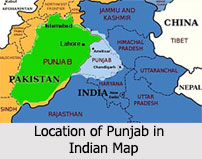
 The word Punjab was first time used in the book Tarikh-e-Sher by Sher Shah Suri (1580), who mentioned the construction of a fort "Sher Khan of Punjab". However, the history of Punjab dates back to the Sanskrit equivalent of `Punjab` in the great epic, the Mahabharata (pancha-nada `country of five rivers`). The name Punjab is mentioned again in Ain-e-Akbari, written by Abul Fazal, who also mentions that the territory of Punjab was divided into two provinces, Lahore and Multan.
History of Punjab
History of Punjab dates back to the 16th century; however its formation is traced in the great epic Mahabharata.
Introduction
The word Punjab was first time used in the book Tarikh-e-Sher by Sher Shah Suri (1580), who mentioned the construction of a fort "Sher Khan of Punjab". However, the history of Punjab dates back to the Sanskrit equivalent of `Punjab` in the great epic, the Mahabharata (pancha-nada `country of five rivers`). The name Punjab is mentioned again in Ain-e-Akbari, written by Abul Fazal, who also mentions that the territory of Punjab was divided into two provinces, Lahore and Multan.Etymology of Punjab
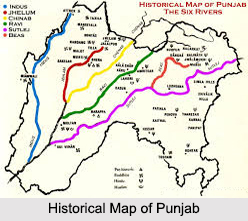
Punjab in Persian literally means "Panj" (five) "Ab" (River), i.e. the Land of Five Rivers, thus referring to the five rivers, which go through it. It was because of this that it was made the granary of British India. Today, two rivers flow in Indian Punjab, two rivers lie in Pakistani Punjab, and one river is the general border between them.
Early History of Punjab
 Early History of Punjab is characterized by Indo-Aryan culture. It is associated with the texts of Vedas, sacred to Hindus, which were orally composed in Vedic Sanskrit language.
Veda Era in Punjab
The Rig Vedic era in Punjab began with the "Battle of Ten Kings". They were fought on the banks of the Parusni River between king Sudas of the Trtsu lineage of the Bharata clan on one hand and a confederation of ten tribes on the other.
Indus Valley Civilization in Punjab
The archaeologists have discovered the evidence of life in the Punjab region as early as 7000 B.C. By around 3000 BC, the human settlements grew in and around the Indus Valley Civilization. There was the evolution of historic cities like Harappa (near Sahiwal in West Punjab) and Mohenjo Daro (near Sindh). After 19th century BC, there was the sudden decline in these civilizations.
Invasion of Punjab in Early Era
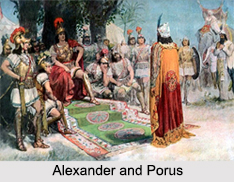
Punjab was continuously attacked by the Persian Emperors and European Emperors in early era. Punjab region was lying just at the outskirt of the Persian Empire. The Persian king King Gustasp conquered the region in 516 BC. Consequently, Punjab became the wealthiest province of the Persian kingdom. The Greeks, the strong competitors of the Persians, also had a lure for Punjab territory. In 321 BC, the Greek King Alexander invaded Punjab, breaking the authority of the Persian kings. He invited all the chieftains of the Persian Satrapy to come and surrender to him.
Foreign Rule in Punjab
After a stretch of time, the Greek empire in the east was disrupted by the ascendancy of the Bacterians. In the second century BC, Bacterian king Demetrius I added Punjab to his kingdom. During the same period, the Northern Sakas successfully wrestled the power of the area from the Indo-Greeks. The white Huns established their rule over the state in the later 3rd century AD. Then Punjab fell in the hands of Kushana Empire, Indo-Parthian Kingdom, Gondopharid dynasty, Empire of Harsha, Mauryas, Rai dynasty and Guptas of eastern India. Rai Dynasty is the last dynasty that ruled Punjab region till 557 AD. Following the birth of Islam in Arab, the Muslim Arabs rose to power and gradually came towards South Asia in the mid-7th century. In 711-713 AD, the Arab armies from the Umayyad caliphate of Damascus conquered Sindh and advanced into the present-day southern Punjab, occupying Multan, which was later to become a centre of the Ismaili sect of Islam.
Medieval History of Punjab
 Medieval History of Punjab began with the downfall of Hephthalites after they were defeated by Sassanid and Gokturk. The Hephthalites were defeated by a Sassanid and Gokturk alliance in 557 AD, and the Hephthalite remnants formed smaller Kushano-Hephthalite or Turki Shahi kingdoms that were dominated by Persia. Taank and Kapisa both dominated Gandhara.
Invasion of Arabs
The Muslim Arabs rose to power and gradually came towards South Asia in the mid 7th century. In 711-713 AD, Arab armies from the Umayyad caliphate of Damascus conquered Sindh and advanced into the present-day southern Punjab, occupying Multan, which was later to become a centre of the Ismaili sect of Islam. The conquest of Sindh and southern Punjab was the first and last great achievement of the Arabs in India. The Arabs tried to invade India but were defeated by Vikramaditya II of the Chalukya dynasty and south Indian general Dantidurga of the Rashtrakuta dynasty in Gujarat and by Nagabhata of the Pratihara Dynasty in Malwa in the early 8th century. They failed to end their dominance beyond Sindh and southern Punjab.
Role of Pratiharas
The Pratiharas who played a major role in confining the Arabs within Sindh ruled over a large empire with its capital at Kannauj, during the 9th and 10th centuries.
Rule of Hindu Shahis
The Hindu Shahis were ruling from Kabul in modern Afghanistan captured some parts of Punjab. The Brahmana dynasty ruled in Punjab, between the rivers Satluj and Sindh. Bachan Pala, Ram Singh, Bir Singh and Prithvi Pala of his family ruled in Punjab. The kingdoms of Kannauj, Punjab, Kabul and Samarqand all prospered mainly due to international trade caravans passing through their respective dominions.
Invasion of Turks in Punjab
In the later era, The Mahmud of Ghazni and Sabuktagin ascended its throne in 977. He first added Muslim ruled Bust, Dawar, Qusdar, Tukhristan and Gaur to his kingdom and started nibbling at the border territories of the Shahi king at Waihind. Muhammad of Ghazni invaded Punjab many times and captured.
Rule of Ghaznavids
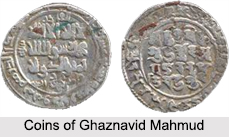
 The Mahmud`s successors, known as the Ghaznavids, ruled for 157 years. Their kingdom gradually shrank in size following his death, and was racked by bitter succession struggles. The Hindu Rajput kingdoms of modern Rajasthan and Gujarat conquered the eastern Punjab, and by the 1160s, the line of demarcation between the Ghaznavid state and the Hindu kingdoms approximated to the present-day boundary between India and Pakistan. The Ghorids of central Afghanistan occupied Ghazni around 1150, and the Ghaznavid capital was shifted to Lahore. Muhammad Ghori conquered the Ghaznavid kingdom, occupying Lahore in 1186-1187, and later extending his kingdom past Delhi into the Ganges-Yamuna Doab.
Rule of Delhi Sultanate in Punjab
Delhi Sultanates ruled from Delhi between 1206 and 1526, when the last was replaced by the Mughal dynasty. In 1160, Muhammad Ghori, a Turkic ruler, conquered Ghazni from the Ghaznavids and became its governor in 1173. He for the first time named Sindh Tambade Gatar roughly translated as the red passage. He marched eastwards into the remaining Ghaznavid territory and Gujarat in the 1180s, but was rebuffed by Gujarat`s Hindu Solanki rulers. In 1186-87, he conquered Punjab, bringing the last of Ghaznevid territory under his control and ending the Ghaznavid Empire. Muhammad Ghori`s successors established the Delhi Sultanate.
Rule of Mughals in Punjab
Punjab was later added to Mughal Map after the decline of Delhi Sultanates. The Lahore Fort is one of the most famous landmarks left behind from the empire. In 1526, Babur swept across the Khyber Pass and founded the Mughal Empire. However, his son Humayun was defeated by the Afghan warrior Sher Shah Suri in the year 1540, and Humayun was forced to retreat to Kabul. After Sher Shah died, his son Islam Shah Suri became the ruler of North India from 1540-53, on whose death his prime minister, Hemu who had won 22 battles continuously against Afghans and Mughals during 1553-56, from Punjab to Bengal ascended the throne and ruled North India from Delhi. He was defeated by Emperor Akbar`s forces in the Second Battle of Panipat on 6th November 1556.
Rule of Durranis and Marathas
After the death of Aurangazeb, Marathas and Durrani rule some parts of Punjab for a short period of time. In 1747, the Durrani kingdom was established by a Pakhtun general, Ahmad Shah Abdali.
Rise of Sikhs
In 1757, the Sikhs were persistently ambushing guards to loot trains. They conquered total Punjab and ruled here till the British came into power.
Punjab in Indus Valley Civilization
Archaeological discoveries at Mehrgarh in today`s Baluchistan show evidences of inhabited villages in the region as early as 7000 BCE. By about 3000 BCE the small communities started to grow up and around the Indus River basin they expanded giving rise to the Indus valley civilization, one of the earliest in human history. At its height, it boasted large cities like Harrapa (near Sahiwal in West Punjab) and Mohenjo Daro (near Sindh). The civilization declined rapidly after the 19th century BCE, for reasons unexplained.
Reference of Punjab in Indian Epics
The Rig-Veda, one of the older texts in Indian history, is generally thought to have been poised in the Greater Punjab. It embodies a literary record of the socio-cultural development of ancient Punjab, known as Sapta Sindhu. The Bhagavatagita of Mahabharata comprehensively expounds a philosophy of heroism in the erstwhile Punjab. Punjabis, represented by ethnic groups such as the Gandharas, the Kambojas, the Trigartas, the Madras, the Malavas, the Pauravas, the Bahlikas and the Yaudheyas were declared to have sided with the Kauravas and displayed exemplary courage in the Kurukshetra War. The great epic provides abundant evidences of the fact that contingents of Gandharas, Kambojas, Sauviras, Madras and Trigartas occupied major positions in the Kaurava rows throughout the epic war.
Different Conquerors of Punjab
 Chandragupta Maurya conquered the portions of Punjab that had been captured under Alexander. The founder of the Mauryan Empire included the rich provinces of Punjab into his empire and fought Alexander`s successor in the east, Seleucus, when the latter invaded. Punjab prospered under Mauryan rule for the next century. It became a Bactrian Greek (Indo-Greek) territory in 180 BCE following the collapse of Mauryan authority. Alexander established two cities in Punjab to settle his people from multi-national armies, that existed even after his departure
After Muhammad`s death in 1206, his general Qutb-ud-din Aybak took control of Muhummad`s Indian empire, including areas of Afghanistan, Punjab and northern India. Qutb-ud-din moved his capital of the empire from Ghazni to Lahore, and the empire he founded was called the Sultanate of Delhi. His successors were the Mamluk or Slave dynasty who ruled from his death in 1210 to 1290. The Mongols, who had occupied Muhammad Ghori`s former possessions in Central Asia, continued to encroach on the Sultanate`s northwest frontier in the 13th century. Lahore was sacked in 1241, and the Mongols and Sultans challenged for control of Punjab for much of the 13th century.
The Mughal Empire persisted for several centuries until it was brutally damaged in the 18th century by the Marathas and the 1739 sack of Delhi by the Persian Nadir Shah. Afghan rulers took control of the empire`s northwestern provinces, including Punjab and Sind. The 18th century also saw the rise of the Sikhs in Punjab.
Afghan"s Recapture of Punjab
Again in 1798 Shah Zaman attacked Punjab to avenge the defeat of 1797. The Sikh people took refuge in the hills. A Sarbat Khalsa was again called and Sada Kaur persuaded the Sikhs to fight once again to the last man. This time even Muslims were not spared by Shah Zaman`s forces and he won Gujarat easily. Sada Kaur roused the Sikhs sense of national honour. If they were to again leave Amritsar, she would command the forces against the Afghans. Then Ranjit Singh collected his men and faced Shah`s forces about 8km from Amritsar. They were well-matched and the Afghans were, at last, forced to retire. Humiliated, they fled towards Lahore. By this time the people of the country had become aware of the rising strength of Ranjit Singh.
Ranjit Singh"s Kingdom in Punjab
Muslims joined Hindu and Sikh people of Lahore in making an appeal to Singh to free them from the tyrannical rule. A petition was addressed to Ranjit singh, requesting him to free them from the Bhangi sardars. Ranjit Singh ultimately acquired a kingdom in Punjab, which stretched from the Sutlej River in the east to Peshawar in the west, and from the junction of the Sutlej and the Indus in the south to Ladakh in the north. Ranjit died in 1839, and a succession struggle ensued. Two of his successor maharajas were assassinated by 1843.
British Raj in Punjab
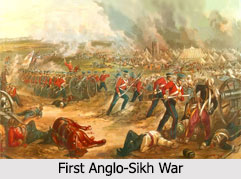
By 1845 the British had moved 32,000 troops to the Sutlej boundary, to secure their northernmost possessions against the succession struggles in Punjab. In late 1845, British and Sikh troops engaged near Ferozepur, then started the First Anglo-Sikh War. The war ended the next year, and the territory between the Sutlej and the Beas was surrendered to Great Britain, along with Kashmir, which was sold to Gulab Singh of Jammu, who ruled Kashmir as a British vassal.
Within a few months, the unrest had spread throughout Punjab, and British troops once again invaded. The British prevailed in the Second Anglo-Sikh War, and the Treaty of Lahore was signed in 1849. Punjab became a province of British India, although a number of small states, most particularly Patiala, preserved local rulers who followed the British sovereignty.
Within a few months, the unrest had spread throughout Punjab, and British troops once again invaded. The British prevailed in the Second Anglo-Sikh War, and the Treaty of Lahore was signed in 1849. Punjab became a province of British India, although a number of small states, most particularly Patiala, preserved local rulers who followed the British sovereignty.
Jallianwala Bagh Incident
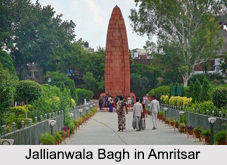
Jallianwala Bagh Massacre of 1919 occurred in Amritsar. In 1930, the Indian National Congress declared independence from Lahore. The 1940 Lahore Resolution of the Muslim Leagues to work for Pakistan made Punjab the center stage of a different Indian history. In 1946, massive communal tensions and violence erupted between the majority Muslims of Punjab, and the Hindu and Sikh minorities. Both Congress and League leaders agreed towards the separation of Punjab.
Reformation of Punjab as Sikh Majority State
Sikhs eventually demanded a Punjabi speaking East Punjab with autonomous control. Led by Master Tara Singh, Sikhs wanted to obtain a political voice in their state. In 1965, a fierce war broke out between India and Pakistan over the disputed region of Kashmir. In 1966, owing to the incredible bravery shown by innumerable of Sikh officers and soldiers in the Indian Army, and the growing Sikh unrest, the Government separated Punjab into a Sikh-majority state of the same name, and Hindu-majority Haryana and Himachal Pradesh.
Sikh Empire in Punjab
Punjab presented a picture of chaos and uncertainty when Ranjit Singh took the control of Sukerchakias occurrence. Both Punjab and Sind were controlled by the Afghan rule since 1757 when Ahmed Shah Abdali was granted suzerainty over these provinces. Taimur Khan, a local Governor, was able to drive away the Sikhs from Amritsar and raze the fort of Ram Rauni. His control was short-lived. The Sikhs joined to defeat Taimur Shah and his Chief Minister Jalal Khan. The Afghans were forced to retreat and the Sikhs occupied Lahore in 1758. Jassa Singh Ahluwalia proclaimed the Sikh`s sovereignty and assumed leadership, striking coins to honor his victory.
Shah Zaman marched on the territory of Ranjit Singh. Singh was alert and raised an army of 5000 horsemen but were inadequately armed with only spears and muskets. The Afghans were equipped with heavy artillery. Ranjit Singh foresaw a strong, united fight against the invaders as he came to Amritsar. A congregation of Sarbat Khlasa was called and many Sikh sardars answered the call. There was general agreement that Shah Zaman`s army should be allowed to enter Punjab and that Sikhs should retire to the hills. Forces were reorganized under the command of Ranjit Singh and they marched towards Lahore. They gave the Afghans a crushing defeat in several villages and surrounded the city of Lahore.
Shah Zaman marched on the territory of Ranjit Singh. Singh was alert and raised an army of 5000 horsemen but were inadequately armed with only spears and muskets. The Afghans were equipped with heavy artillery. Ranjit Singh foresaw a strong, united fight against the invaders as he came to Amritsar. A congregation of Sarbat Khlasa was called and many Sikh sardars answered the call. There was general agreement that Shah Zaman`s army should be allowed to enter Punjab and that Sikhs should retire to the hills. Forces were reorganized under the command of Ranjit Singh and they marched towards Lahore. They gave the Afghans a crushing defeat in several villages and surrounded the city of Lahore.
Modern History of Punjab
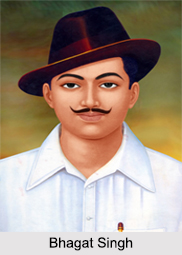 Modern History of Punjab shaped the modern state. This state was ruled by British East India Company till 1857 Sepoy Mutiny. Then the British Government in India ruled for 197 years till India got independence in 1947.
Advent of British East India Company
After the age old clashes between Sihks, Durrani, Marathas and British, finally the colonial power rose into prominence of political hemisphere. The entire Punjab was occupied by the British East India Company. By 1845 the British had moved 32,000 troops to the Sutlej River frontier, to secure their northernmost possessions against the succession struggles in the Punjab.
Anglo Sikh Wars
The first resistance against the British was Anglo Sikh War. In late 1845, British and Sikh troops engaged near Ferozepur, beginning the First Anglo-Sikh War. The war ended the following year, and the territory between the Sutlej and the Beas was ceded to Great Britain, along with Jammu and Kashmir, which was sold to Gulab Singh of Jammu, who ruled Kashmir as a British administrator.
Punjab after Sepy Mutiny
 Punjab became the hot seat of India"s Independence Movement after Sepoy Mutiny in 1857. In every way, Punjab was one of Great Britain`s most important assets in colonial India. Its political and geographic predominance gave Britain a base from which to project its power over more than 500 princely states that made up India. Lahore was a centre of learning and culture under British rule, and Rawalpindi in modern Pakistan became an important army camp for British India.
Jallianwala Bagh Massacre
The Jallianwala Bagh Massacre of 1919 occurred in Amritsar. In 1930, the Indian National Congress proclaimed independence from Lahore in modern Pakistan. The 1940 Lahore Resolution of the Muslim League to work for Pakistan, made Punjab the centre-stage of a different, bloodier struggle.
Communal Riot in Punjab
In 1946, there was a massive communal tensions and violence which was erupted between the majority Muslims of Punjab, and the Hindu and Sikh minorities. The Muslim League attacked the government of Unionist Punjabi Muslims, Sikh Akalis and the Congress, and led to its downfall. Unwilling to be cowed down, Sikhs and Hindus counter-attacked and the resulting bloodshed left the province in great disorder. Both Congress and League leaders agreed to partition Punjab upon religious lines, a precursor to the wider partition of the country. The British Punjab province, which includes present-day Punjab province of Pakistan, and the Indian states of Punjab, was partitioned in 1947 prior to the independence of Pakistan and subsequently, India. In India, the Punjab province was further partitioned into and forming Haryana, and Himachal Pradesh.
Recently updated articles in States of India
Bandare Waterfalls, Meghalaya
Bandare Waterfalls in South Garo Hills, Meghalaya, is a secluded natural attraction surrounded by dense subtropical forests and rugged mountain terrai...
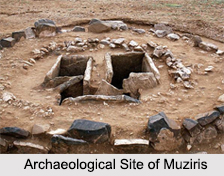
History of Thissur District
Early History of Thissur District explains flourishing of the port cities. Now these port cities are transformed into archaeological sites.
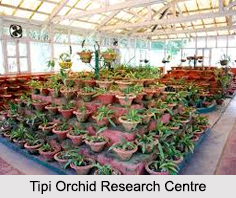
Tippi Orchid Research Centre, Arunachal Pradesh
Tippi Orchid Research Centre in Arunachal Pradesh is renowned for its rich collection of exotic and endangered orchids. Surrounded by lush rainforest...
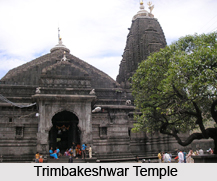
Tourism in Nashik District
Pilgrimage tourism in Nashik district involves visiting the various places of Hindu and Jain worship located here. Some of the holiest sites for Hind...
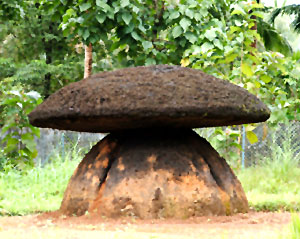
Mangadu, Kerala
Mangadu in Kerala’s Kollam district is a significant megalithic site known for its urn burials, cist burials, menhirs, and stone circles. Excavations...
Related articles in States of India
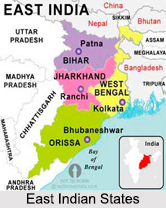
East Indian States
East Indian States comprises of Bihar, Jharkhand, West Bengal, Odisha and also the Union Territory of Andaman and Nicobar Islands. It defines the cult...
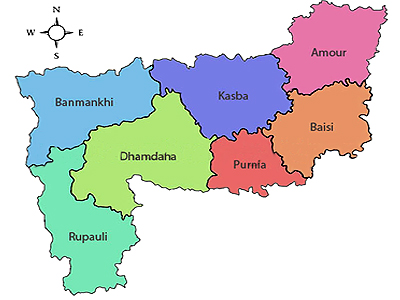
Purnia District in Bihar
Purnia District is located in Bihar and extends from River Ganga to Nepal. The district has a rich Hindu history and glorious past.
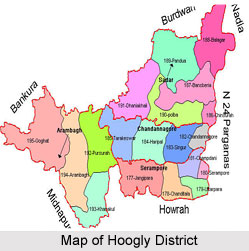
Hooghly district
Hooghly District along the bank of the river Hooghly is one of the principal trading ports of West Bengal.
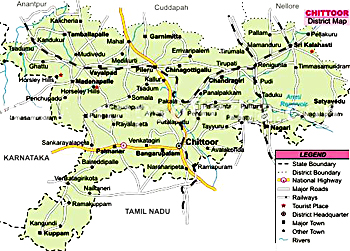
Geography Of Chittoor District
Geography of Chittoor district is spread along the topography of the land which is divided into two natural divisions; Chittoor has a dry and healthy...
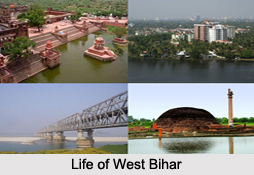
Districts of West Bihar
Districts of West Bihar is comprised of medieval monuments that were built by the different governors of Mughal era.