
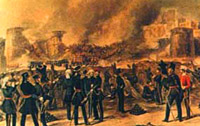
 Anglo-Sikh Wars was a unique military experience for the British rulers in the Indian subcontinent. The British rulers had already become accustomed to take into account certain factors such as terrain or climate rather than the military skill of their opponents. The regular troops of the Sikh kingdom of Lahore were fully trained and armed along the European lines. They were also to present the British with a determined and resourceful enemy. The cause of the outbreak of the Anglo-Sikh Wars has been attributed to the Sikh army making their way across River Sutlej on 12th September 1845. There have been two Anglo-Singh Wars.
Anglo-Sikh Wars
Anglo-Sikh Wars was a unique military experience for the British rulers in the Indian subcontinent.
Introduction
Anglo-Sikh Wars was a unique military experience for the British rulers in the Indian subcontinent. The British rulers had already become accustomed to take into account certain factors such as terrain or climate rather than the military skill of their opponents. The regular troops of the Sikh kingdom of Lahore were fully trained and armed along the European lines. They were also to present the British with a determined and resourceful enemy. The cause of the outbreak of the Anglo-Sikh Wars has been attributed to the Sikh army making their way across River Sutlej on 12th September 1845. There have been two Anglo-Singh Wars.Causes of the Anglo-Sikh Wars
• After the death of Maharaja Ranjit Singh, the anarchy in the kingdom of Lahore resulted in a powerful struggle for domination between the Lahore court and the ever-powerful vocal army.
• Suspicions arising in the Sikh army due to the recent British military campaigns which also included the annexation of Gwalior and Sind in the year 1841 and also the campaign of Afghanistan.
• The increase in the number of British troops that were posted near the border with the Lahore kingdom.
The other factor that was important in the Anglo-Sikh Wars. The British had allowed a number of Indian rulers to remain in power provided they backed the British. Many of the bigger rulers especially that of Mysore, Hyderabad and Maratha have spared no expense to rearm like the British and the Mutiny displayed the danger of this policy. The final factor was the discontent among the `warrior` caste of the Indian society. There were also several ambitious Indian who could not rise far enough to suit them and this was a major factor in the mutiny. The short term consequences of the Anglo-Sikh Wars was that the British worked hard to integrate India, limit the powers of the princes and keep a stronger army in India.
• Suspicions arising in the Sikh army due to the recent British military campaigns which also included the annexation of Gwalior and Sind in the year 1841 and also the campaign of Afghanistan.
• The increase in the number of British troops that were posted near the border with the Lahore kingdom.
The other factor that was important in the Anglo-Sikh Wars. The British had allowed a number of Indian rulers to remain in power provided they backed the British. Many of the bigger rulers especially that of Mysore, Hyderabad and Maratha have spared no expense to rearm like the British and the Mutiny displayed the danger of this policy. The final factor was the discontent among the `warrior` caste of the Indian society. There were also several ambitious Indian who could not rise far enough to suit them and this was a major factor in the mutiny. The short term consequences of the Anglo-Sikh Wars was that the British worked hard to integrate India, limit the powers of the princes and keep a stronger army in India.
First Anglo Sikh War
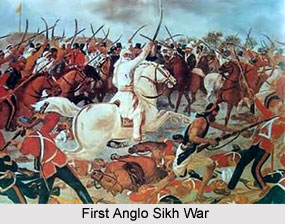 The first Anglo Sikh War was held between the Sikh kingdom of Punjab and British East India Company in the year 1845 to 1846, which resulted in partial conquest of Sikh Kingdom by British.
There was a historical background of first Anglo-Sikh War. During the early years of nineteenth century the Sikh kingdom was expanded and amalgamated under the leadership of Ranjit Singh. At the same time the British was expanding their territory and reached up to the border of Punjab. Ranjit Singh was intelligent enough to take a dual policy. He maintained a friendship with British while on the other hand he established military army to prevent the aggression both by British and by the Afghans under Dost Mohammed Khan. He hired European and American mercenary soldiers to coach his artillery and also incorporated a large number of Hindu and Muslim armies into his force.
Ranjit Singh passed away in 1947 and almost immediate after his death his kingdom fell in a huge perturbation. His adopted son Kharak Singh was unpopular among the subjects and was expelled from power within a few months and later died in prison. His successor Nau Nihal Singh was able but he also died in a very suspicious circumstance as he was crushed by falling archway at Lahore fort while he was returning from his father`s cremation. The hollow Sikh throne caused a reason for First Anglo Sikh War. Then two major factions of power Sindhanwalias and the Dogras fought over to achieve the power of Punjab. The Dogras represented an illegitimate son of Ranjit Singh named Sher Singh and put him in the throne in January of 1841. The defeated Sindhanwalas took shelter in British territory but had many followers in the Punjab army.
The Army of Punjab was expanding rapidly after Ranjit Singh`s death as all the landlords and their retainers adopted arms in their hands. The army now claimed itself as `Khalsa` or embodiment of the Sikh nation. Khalsa was the main Sikh power that took part in First Anglo Sikh War. The regimental Panchayats or committees formed a parallel source of power within the Sikh kingdom. They declared Guru Gobind Singh`s ideal of Sikh commonwealth has resurrected with the Sarbatt Khalsa or the whole Sikh community attaining all executive, military and civil authority of the kingdom. The British reprobated it as `dangerous military democracy`. British visitors and representatives reported that Khalsa army observed strict discipline and remain in a state of mutiny or rebellion against the central `Darbar`. In a notorious instant the Khalsa force came up with riot, killing the Persians by their swords.
Sher Singh was unable to meet the demands made by Khalsa force although he maintained funds of a degenerated court. In September of 1843 a Khalsa officer named Ajit Singh Sindhanwalia assassinated Sher Singh. The Dogras took revenge and Sher Singh`s widow Jind Kaur became regent of her infant son Duleep Singh. After that the officer Hira Singh was killed while attempting to attack the capital with troops under Sham Singh Attariwala. Thereby Jind Kaur`s brother Jawahir Singh got the post of the Vizier in December 1844. Jawahir Singh bribed the Khalsa and promised them much wealth out of terror, which could not be made. At an army parade in September 1845 Jawahir singh was murdered in front of his sister Jind Kaur and nephew Duleep Singh.
However, the Khalsa did not take the charge of kingdom at this time. Jind Kaur publicly vowed against her brother`s killer but she did nothing in action. Lal Singh became the new vizier and Tej Singh became the commander of the army. Both of them came from high class Hindu family and converted to Sikhism in 1818 as the majority of the Sikhs of Punjab at that time.
On the other hand British East India Company army also started to achieve strength after the death of Ranjit Singh and their place of action was mainly the border area of Punjab. The actions and attitudes of British were disputed under the leadership of Lord Ellenborough and later under sir Henry Hardinge. Khalsa army though had not any strong leadership became a threat to British army along the border area. Major George Broadfoot then reported about the disorder in Punjab. The main motto of East India Company was to annex the Sikh kingdom. They also were affected by the increasing tension of Punjab and Khalsa, as a result of which First Anglo-Sikh War broke out.
After the mutual demands of British East India Company were not fulfilled by the Sikh Darbar , the diplomatic relations between Sikhs and British broke. Thus first Anglo Sikh War was initiated. An English army marched towards Ferozepur, that was led by Sir Hugh Gough and accompanied by Sir Henry Hardinge, the British Governor General of Bengal. Most of the soldiers and infantry of British army came from Bengal. In response to the British Army, the Sikh army also aggressed and crossed the Sutlej River on December 11,1845. Although the commanders and many soldiers of the army were Sikhs, there were also Punjabi, Pakhtun and Kashmiri infantry units. The artillery was strongly built with heavy guns and canons.
The Sikhs claimed that they were only moving in the Sikh territory, specifically near the village of Moran on the eastern side of the river but British demanded that Sikhs had intruded in their area. So the first Anglo Sikh War was declared. The Sikh army showed no interest to surround or attack exposed English division. On December 18, Lal Singh`s army clashed with British army in the Battle of Mudki and British won in a very clumsy situation. The British attacked the Sikh army on December 21. The Sikhs tried to cut off the supply line for British. Sir Harry smith was sent to face them and he won in Battle of Aliwal on January 28, 1846. Gough`s main army now attacked the Sikhs at Sobrao on February 10 in the year 1846. The Sikh army was eventually trapped. This victory in the First Anglo Sikh War broke the Sikh Army.
As a result of First Anglo Sikh War the treaty was signed between British and the Sikhs, in which Sikhs had to sacrifice Kashmir and accepted a British resident at Lahore. The East India Company also had control over the Sikh Government. The Treaty also made Sikhs to give Koh-I-Noor diamond to queen Victoria.
Second Sikh War
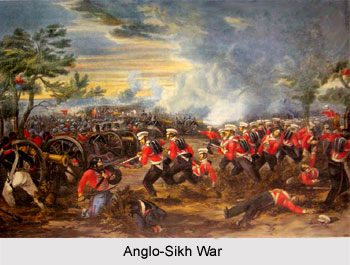 Second Anglo-Sikh War fell out between the Sikh Empire and the British Empire. The war led to the subjugation of the Sikh kingdom and the annexation of Punjab and what subsequently became the North-West Frontier Province by the British East India Company. Second Anglo-Sikh War was fought in 1848 and 1849 and this historic battle resulted in the conquest of the Sikh Empire. Further, it also led to the annexation of Punjab.
The presence of the English contingent at Lahore and their officers at all the outlying districts was not liked by the people. The feeling, however, remained hidden for a short while and came out soon after in the form of a large scale revolt. On 19th of April 1848, at the reception of a new Sikh governor replacing the Hindu Mulraj in Multan, the local Sikhs had wrecked havoc on the oppressors by severe attack. They gravely injured English lives and in consequence, Multan passed into a state of rebellion under the leadership of the Mulraj of Multan. Inadvertently, Mulraj, the diwan of Multan, caused the rise of this popular uprising. Events moved at a fast pace.
During the transfer of power the Muslim sepoys of Mulraj attacked and injured these officers. The officers then left the fort and camped outside the town. The next day the Sikhs attacked the English officers. The whole escort of the Khalsa army also went over to Mulraj. Meanwhile local commanders took matters in their hands. Lieutenant Edwardes advanced towards Multan with a small force. On the way he crossed the Indus River and Chenab River and fought a number of engagements until he reached Multan by the end of July 1848. Mulraj was now confined to the fort. A force under Genera] Whisk then marched on Multan. While this was in progress there was further defection in the English camp. Raja Sher Singh with his whole force of 3,500 Sikhs went over to Mulraj on September 14. This reverse caused the English to lift the siege until December 27th when further reinforcements had arrived.
Standards of revolt had been raised by the Sikh army at a number of other places also including Peshawar, Bannu and even Lahore. As the uprising had assumed serious proportions immediate measures were taken by the English to form an Army of Punjab and it was decided to occupy the province with the Company`s troops. This army when formed consisted of seven infantry brigades, 4,000 cavalry and a large park of artillery. Sher Singh came out of Multan and collected in all about 30,000 men and 28 guns. He faced the English at Ramnagar on the Chenab River. They numbered 12,500 infantry and 3,500 cavalry led by Lord Gough, the Commander-in- Chief himself. An engagement was fought on November 22. This was primarily a cavalry action. The Sikhs did not gain much except that they managed to cross the river, with negligible losses, on to the right bank. Sher Singh won the day and inflicted heavy losses on the English. On the other hand Lord Gough had also obtained an advantage over his adversary by forcing them across the Chenab and so unable to influence the siege of Multan or the move of reinforcements from Lahore or further north.
Leaving behind sufficient forces to keep Lord Gough engaged Raja Sher Singh moved up and surprised General Thackwell. This was, however, a half hearted measure. An artillery duel was fought at Sadulapur on December 3, with no gain to either side. Having failed in his attempts to turn the English flanks Raja Sher Singh retreated with his whole force towards the Jhelum River and on to Chilianwala. On 3rd December, at Sadulapur, the British engaged in hostilities with the Sikh forces of Shere Singh. Lieutenant-General Sir Joseph Thackwell with a force of 7000 repulsed the Sikhs, but declined their pursuit. Within 10th to 12th December, the Bombay Column arrived at Multan with three Native Cavalry regiments, six infantry regiments and several siege guns. On 27th of December, the British attacked and cleared the outer works held by the Sikhs at Multan. This success led to a tactical change of attacking the city first and then the fort. The Second Sikh War had already advanced to a sufficient stage, where the British acquired upper hand over the Sikhs in Multan.
With the extensive period of 1848 to 1856, Lord Dalhousie annexed the following Indian states to the administration of the East India Company - Satara (1848), Nagpur (1853), Jhansi (1854) and Oudh (1856). In retrospect, these annexations and particularly that of Oudh weighed heavily as a cause of the Indian Sepoy Mutiny of 1857. The defeat of the Sikh Army in the Second Anglo Sikh War resulted from various reasons including administrative reasons.
Recently updated articles in History of India
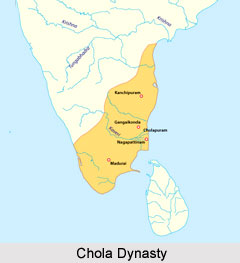
Chola Dynasty
Chola Dynasty is a Tamil dynasty and had longest duration of ruling in parts of South India. Chola dynasty had ruled South India successfully for a ex...
Suhungmung
Suhungmung was the fourteenth ruler of the Ahom dynasty who ruled from the period 1497 to 1539 AD. His reign was significant in terms of expansion of...
Princely State of Dadhalia
Princely State of Dadhalia was located in the present state of Gujarat. The state covered a total area of 28 sq miles and comprised of 15 villages. Th...
Princely State of Rupal
Princely State of Rupal was a part of the Baroda Agency, a sub division of Western India States Agency. It was under the administrative control of the...
Archaeological Sites of West Bengal
Archaeological sites of West Bengal reveal several aspects of ancient India. Excavations by the Archaeological Survey of India have furnished artefact...
Related articles in History of India

Mughal Architecture during Babur
Mughal architecture during Babur marked the foundation of a new architectural era in India, blending Timurid, Persian, and local influences. His reign...

Architecture during Sayyid and Lodi Dynasty
Architectures during the Sayyid and Lodi dynasty were mainly the tombs and monuments for the dead rulers. It were carefully designed and meticulously...

Brahmanical Sources of Ancient History
Brahmanical Sources of ancient history are contained in the Vedas and they constitute one of the most important literary sources of information about...

Coins of Chola Empire
Coins of Chola Empire were issued in gold, silver and copper and carried the Chola emblem.

Coins of Khilji Dynasty
Coins of Khilji Dynasty had an influential feature that was followed by the other dynasties.