 Brahmanical sources of ancient history play a very important part in delineating the route of development of the ancient history of India. This literary source of ancient Indian history is a vast composition which is mostly religious in disposition. Although most of these books are spiritual, yet they render very fitting historical statements and references.
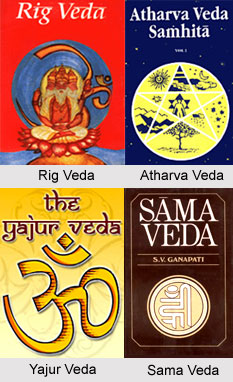
The earliest of the Brahmanical literary books comprise 4 Vedas- Rig Veda, Yajur Veda, Atharva Veda and Sama Veda. It is incorrect to assume that since these Vedas have a spiritual content their descriptions hold no importance in historical reconstruction of society. They furnish a lot of information about the social and religious life of the Aryans, which is very important for restructuring the history of Aryans in India. Rig Veda is the oldest of all Vedas and furnishes priceless information about the history and political systems of the Aryans. The Vedas also sheds light upon the economic life of the Aryans. Through the Vedas, it is also knows exactly who were the original inhabitants of India, how they had spread into different parts of India, how they fought the Dasus and so on.
The Brahmanas are the commentaries and explanations attached to the Vedas. They mostly deal with the ritualistic aspects of religion and explain the intricacies of sacrificial procedures. Usually, the works of the Brahmana are arranged in two principal categories- these are the Vidhi and Arthavada. Vidhi means "rule, precept," and Arthavada" explanation of meaning." For the Brahmanas first give rules for the performance of the single ceremonies, and to these the interpretations and explanations of the purpose and meaning of the sacrificial acts and prayers are afterwards attached. Thus, for example, the Satapatha Brahmana begins with the precepts upon the vow of abstinence, which the sacrificer has to make on the day before the new-moon and full-moon sacrifice. To this explanation there is attached the discussions of the views of various teachers upon some question of ritual.
Etymologies are exceedingly frequent in the Brahmanas. Moreover, it is regarded as a special advantage if an etymology is not quite accurate, for "the gods love that which is hidden." Thus, for instance, the name of the god Indra is derived from Indh, "to kindle," and it is said: he is, therefore, actually named Indha, and he is called "Indra" only because the gods love what is concealed. Or the word "ulukhala," which means "mortar," is derived from uvu kaat, meaning it shall make wide, and ulukhala is declared to be a mystical designation for urukara.
Like the etymologizing, identifying and symbolizing play an even greater part in the Brahmanas than in the Yajur Veda Samhitas. The most dissimilar things being put together and associated with one another comprise a frequent feature of such Brahmanical literature. On every page of the Brahmanas we find explanations like the following:
"He now strews sacrificial grass all round (the fires), and fetches the utensils, taking two at a time, viz. the winnowing basket and the Agnihotra ladle, the wooden sword and the potsherds, the wedge and the black antelope skin, the mortar and the pestle, the large and the small mill-stones. These are ten in number; for of ten syllables consists the Viraj (metre), and radiant (viraj) also is the sacrifice; so that he thereby makes the sacrifice resemble the Viraj. The reason why he takes two at a time is, because a pair means strength; for when two undertake anything, there is strength in it. Moreover, a pair represents a productive copulation, so that a productive copulation (of those respective objects) is thereby effected."
Thus discussed is a brief description of the Brahmanical sources of ancient history. These sources comprise the chief literary source of information about ancient India.