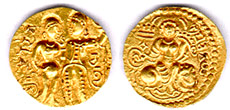
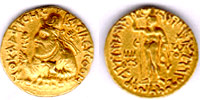
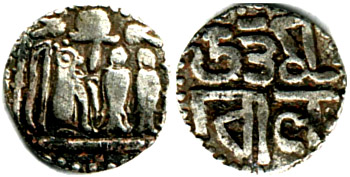
 Coins of Chola Empire have their origins in Indian mythology. This is an ancient dynasty of southern India and they ruled this part of India for centuries. It has been found from the historical excavations that the Chola kings used to issue coins during their reigning period and some of them represent the socio cultural scenario of the then society.
Archeological excavation at Kaveripattanam throws ample light on the Chola coins, their shapes, denominations and symbolic representations. The Chola coins were found in square and some other shapes. The coins bore the emblem of the Cholas, which is defined by a standing tiger with its tail upraised on one side and an elephant on the other side. Most of the symbols on the reverse were those that were seen on the early die struck coins of the North. No inscription was done on the coins during this time. Some coins of this era stand evidence for the fact that the coins also were designed with a horse on one side and a zig zag line which might be the representation of river on the other side of the coin. Some circular lead coins, may be dated to `circa` second century A.D. had been excavated that prove the influence of Satavahana influence. The coins bore an `anushka` like symbol and the legend `Atinan etiran Chandan` meaning Atinan, the son or the successor of Chanda on one side of the coin. The other side bore the emblem of the Cholas. With the Cholas the coins of southern Indian dynasties ushered a new genre in the coinage system.
The Chola ruler, Raja raja Chola struck coins both in Sri Lanka and India. These coins differed in fabric, style and in the gold purity. The coins of Chola Empire were issued in gold, silver and copper. Though the coinage was mainly destined for general currency, very few commemoratives could be observed. The Chola ruler, Uttama Chola struck silver with the royal emblem of "Tiger facing two fishes" on the obverse side of the coin. The coins also contained the Nagari legend "Uttama Chola". During his reigning period, Raja Raja struck gold fanams that bore the legend Yuddha Malla on the obverse and the usual insignia on the reverse side of the coins. Apart from these coins, silver and gold `kahavanus` were also struck by the king. This type of coins bore the standing king on the obverse and the seated king on the reverse side of the coin.
Moreover, Rajendra Chola, another king of this dynasty also struck coins including the legend "Sri Rajendrah" beneath the usual insignia on both side of the coin. The succeeding generations struck coins with identical standard bearing "Standing King on the obverse" and "Seated King on the reverse". The coins sometime bore the legend "Raja Raja" and sometime the legend "Ku" appears on the coinage that surrounds the image.
With the ceasing period of the Cholas, these coins can be seen abundantly as the same type, but the type was a bit modification on the coins. The coins of southern Indian dynasties developed its coinage system after the Cholas with the introduction of other dynasties.