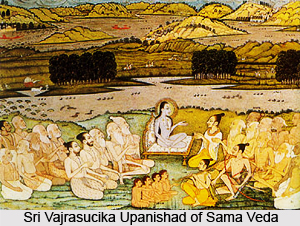
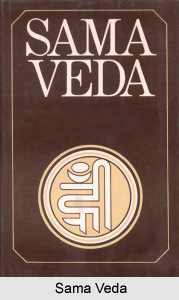
Sama Veda
Sama Veda ranks the third in the usual order of the Vedas, ancient Hindu scriptures. Sama Veda is known for hymns and it is believed that the Sama Veda has provided the foundation of Indian music.

Share this Article:

Introduction

Sama VedaSama Veda, also known as the Veda of Holy Songs, is one of the four canonical Vedic texts of India. In Sanskrit language, Sama Veda refers to the knowledge that is rendered through melody. In terms of sanctity and liturgical importance Sama Veda ranks just after the Rig Veda. It contains the hymns which are recited while performing a Yajna. The date of compilation of Sama Veda is not specifically known. The exact date of the compilation of Sama Veda cannot be specified but it can be said that Sama Veda had been compiled much later and that is one of the reasons why certain hymns are incomplete and are portions of hymns part of the Rig Veda. It is however said that probably these hymns date back to 1000 BC. The Sama Veda has exactly 1875 verses and each of the verses has a specific metre. In fact it can be said that Sama Veda has been the first attempt to give melody to any chanted verse.

Sama Veda has a very close association with Rig Veda. The purpose behind creating the Sama Veda was the Samagan. According to the Indian musical canon the lyrics for the hymns are provided by the Rig Veda but it is the Sama Veda that has provided the notes. The metrical portion of Samhita usually consists of hymns which are to be chanted by the Udgatar priests during the times of those sacrifices in which the juice of the Soma is offered to the various deities.


Composition of Sama Veda

Of the many Samhitas of the Sama Veda which are said to have existed once -the Indian Puranas even speak of a thousand Samhitas- only three have come down to us. The three recensions of Sama Veda are Kouthomiya, Rahayaniya and Jaiminiya. Kouthomiya and Rahayaniya are identical in contents. They differ only in the arrangements of the hymns in various adhyayas. The Jaiminiya recension has fewer hymns as compared to the other two recensions. The best known of these, the Sama Veda Samhita of the Kauthumas, consists of two parts, the Archika or the "verse-collection" and the Utttararchika, the "second verse-collection." Both parts consist of verses, which nearly all recur in the Rig Veda. Of the 1810, or, if one subtracts the repetitions, 1549, verses, which are contained in the two parts together, all but 75 are also found in the Rig Veda Samhita and, mostly in Books VIII and IX of the latter.

The first part of the Sama Veda Samhita, the Archika, consists of five hundred and eighty-five single stanzas to which the various melodies (Saman) belong, which are used at the sacrifice. The Uttararchika, the second part of the Sama Veda Samhita consists of four hundred chants, mostly of three stanzas each out of which the Stotras which are sung at the chief sacrifices are formed. While in the Archika the stanzas are arranged partly according to the metre, partly according to the gods to which they are addressed (in the sequence - Lord Agni, Indra, Soma), the chants in the Uttararchika are arranged according to the order of the principal sacrifices. A Stotra then, consists of several, usually three stanzas, which are all sung to the same tune, namely to one of the tunes which the Archika teaches.

It is usually assumed that the Uttararchika is of later origin than the Archika. In favour of this assumption is the fact that the Arcika contains many melodies, which do not occur at all in the chants of the Uttararchika, and that the Uttararchika also contains some songs for which the Archika teaches no melody. On the other hand, however, the Uttararchika is an essential completion of the Arcika- the latter is as it were, the first, the former the second course in the instruction of the Udgatar.

There are, attached to the Archika, a Gramageyajana (book of songs to be sung in the village) and an Aranyagana (book of forest songs). In the latter those melodies were collected, which were considered as dangerous and a taboo, and therefore, had to be learnt in the forest, not in the village. There are also two other books of songs, the Uhagana and the Uhyagana. These were composed for the purpose of giving the Samans in the order in which they were employed at the ritual, the Uhagana being connected with the Gramageyagana, the Uhyagana with the Aranyagana.

There is a ritual-book belonging to the Sama Veda, called Samavidhana Brahmana, the second part of which is a regular handbook of magic, in which the employment of various Samans for magic purposes is taught.

The seventy-five verses which do not occur in the Rig Veda, are partly found in other Samhitas, partly in various works on ritual; some may be taken from a recension unknown, but some are only pieced together out of sundry verses of the Rig Veda without any proper meaning. Both parts of the Samhita give us only the texts as they are spoken.


Metre of Hymns of Sama Veda

Most of these verses are composed in Gayatri metre or in Pragatha stanzas which are made up of Gayatri and Jagati lines, and doubtless the stanzas and songs composed in these metres were from the beginning intended for singing. Among the three types of verses that are generally found in the Vedas, Sama Veda generally consists of Sama verses.


Brahmana of Sama Veda

Brahmana of Sama VedaBrahmana of Sama Veda comprises various verses that are used for religious rites.

Panchavimsa Brahmana of Sama Veda : Panchavimsa Brahmana derives its name from the detail that it has 25 chapters. They are called Prapathakas which are subdivided into 347 sections called `khandas`. It is even known as the `Tandya Mahabrahmana`. It is the major Brahmana text of the Kauthuma and the Ranayaniya schools. It deals with the use of various verses in various Vedic rituals. The Soma sacrifices are also discussed in detail. It deals with Collection of Yajus, Vistutis, Various rites, Somaprayaschittas, Dvadashaha rite, One day rites, Ahina rites and the Sattras.

Shadavimsa Brahmana of Sama Veda : Shadavimsa Brahmana is an appendix to the Panchavimsa Brahmana. It deals with the Subrahmanya speeches and with one-day rites. It is a small text that consists of five sections.

Samavidhana Brahmana of Sama Veda : Samavidhana Brahmana consists of 3 prapathakas that deals with the recitation of verses in order to obtain specific results.

Arsheya Brahmana of Sama Veda : Arsheya Brahmana is a kind of an Arshanukramani that is connected with the Gramageya and Aranya Samans. It is possible that a particular verse might have more than one Sage associated with it.


Rites of Sama Veda

Rites of Sama Veda, Agni PuranaRites of  Sama Veda are mainly `samans` or chants, which were derived from some of the texts of the `Rig Veda`. Sama Veda is a rich collection of innumerable hymns which possess a musical harmony commonly found in musical notes. The rituals of Sama Veda were actually intended for priests who used to perform `soma` ceremonies. Gradually, with the passage of time, the several rites of Sama Veda became more complicated. This encouraged the systematic compilation of the chants, hymns and the `Mantras` into a book, which enabled priests to obtain a source of reference for the rituals and rites.

Myth behind Sama Veda : Pushkara in Agni Purana has  discussed the rites which have been involved in the Sama Veda. He has narrated to Lord Rama that a man, by repeating the Sanhita known as the `Vaishnabi`, is sure to witness the realisation of all his wished for objects.

Types of Rites in Sama Veda : The aim of the Sama Veda was a practical one that is to act as a book of songs for `singer priests`. The rituals of Sama Veda were accompanied by hymns sung by a priest. This singing priest was known as `udgai`, obtained from a Sanskrit term meaning `to sing`. These hymns used to be sung in certain pre-determined melodies. Agni Purana states that a man in prison would be liberated by repeating the Mantra running as Agni Stigma, etc. A man having committed the sin of selling improper articles should repeat the Mantra running as `Ghritavati` etc. A repetition of the Mantra running as `Ayano Deva Savitri`, etc., tends to neutralise the effects of a bad dream. Similarly a man, by constantly reciting the `Sarpa Saman`, becomes safe from snake bites.

`Going of the cows ceremony`, `soma` ceremonies and the numerous other rituals of the Sama Veda, performed by the `Brahmanas` lasted for about one to 12 days. There were also certain rituals which were conduct to compensate the errors occurring during some sacrifices. Majority of the rites of Sama Veda are agricultural rites.

Incantations or Mantras of Sama Veda : It has been said that a man by repeating the `Chhandasi Sanhita`, is sure to win the good graces of the god `Shankara`, while by repeating those respectively known as the `Paitri` and the `Skandi`, a man is sure to enjoy the greatest self-complacence. A repetition of the Mantras running as `Indram Bhajamahe` destroys the evil effects of dreadful incantations practised against a man.

Agni Purana states that a man seeking the love of a particular woman, should recite into her ears the Samans running as `Paripriya`, `Hi Yah Karih`, etc. whereby he would surely win her affections. A man, by daily repeating the eight verses known as the `Vairupyas`, is sure to become the master of bounded wealth, whereas by repeating the `SapSashtakas` a man is enabled to witness the realisation of his heartfelt desires. A man, having subjugated his senses, should worship the cows, each morning, with the verses beginning as `Gavyashuna`, etc. whereby he would have numerous heads of cattle in his house.

Mantras or chants of Sama Veda are quite musical, which make them favourable to spiritual growth. They are chanted for praising the glory of the gods. The sings of Sama Veda are considered to be the foundation of the various `swaras` or notes which form the mail pillars of Indian music.

Homas : Similarly the Purana states that by performing a Homa ceremony with the Mantra known as the `Dirgha Tamasorka`, a man is sure to have plenty of boiled rice every day. If a man chants `Svamadhyanti`repeatedly, it is believed that he will never die of thirst. Similarly, by repeating the Mantra running as `Tvamima Oushadhi`, etc. never he fails sick. A man by practising the `Prati Deva Vrata` is sure to get rid of all fears.

It has been said that a man by casting oblations of vessels full (Drotias) of barley, soaked in clarified butter, into the fire, and by repeating the Mantras as `Vata Avatu`, etc., is enabled to cast off all charms and incantations. A man by performing a Homa ceremony with oblations of sesame and by repeating the Mantras known as `Pradeva Dasa` followed by `Voushats`, becomes an expert in all trades. Pushkara in the Purana has also narrated that A thousand libations cast into the sacrificial fire with the Mantras, running as `Vaskedhama`, etc. grants a victory in war.

Effigies of pasted rice should be made of horses, elephants, car-warriors and principal leaders belonging to the enemy`s forces, and should be cut with a razor by repeating the Mantras running as `Abhi Tva Shurananumo`, etc. after which the Brahmana engaged to practise the charm, should offer them, in anger, as oblations on the sacrificial fire, mixed with boiling oil. A performance of the rite described above, is sure to grant an easy victory in war. The Mantras known as the `Garuda`, the `Rathantara` the `Varnadevya` and the `Vrihadratha` should be deemed as undoubtedly the best of sin-expiating Mantras.

Melody of Sama Veda

The melodies themselves, in any case in the earliest times, were taught by oral, and probably also instrumental rendering. Of later origin are the so-called Ganas or "song-books", which designate the melodies by means of musical notes, and in which the texts are drawn up in the form which they take in singing. i.e. with all the extensions of syllables, repetitions and interpolations of syllables and even of whole words- the so-called "stobhas," as hoyi, huva, hoi, and so on. The oldest notation is probably that by means of syllables, as ta, co, na, etc. More frequent, however, is the designation of the seven notes by means of the figures 1, 2, 3, 4, 6 and 7. When singing, the priests emphasize these various notes by means of movements of the hands and the fingers.

The number of known melodies must have been a very large one, and already at a very early period every melody had a special name. Not only are they often mentioned by these names in the ritual-books, but various symbolical meanings are also ascribed to them, and they play no insignificant part in the symbolism and mysticism of the Brahmanas, Aranyakas and Upanishads, especially a few of them, such as the two melodies " Brhat" and " Rathantara," which already appear in the Rig Veda. The priests and theologians certainly did not invent all these melodies themselves. The oldest of them were presumably popular melodies, to which very early times semi-religious songs were sung at solstice celebrations and other national festivals, and yet others date back as far as that music with which pre-Brahmanical wizard-priests accompanied their wild songs and rites. Traces of this popular origin of the Saman melodies are seen already in the above-mentioned Stobhas or shouts of joy, and especially in the fact that the melodies of the Sama Veda were looked upon as possessing magic power even as late as in Brahmanical times.

According to Mahabharata Sama Veda is best among the four Vedas. The hymns of Sama Veda not only contain the deep meaning of the Rig Vedic Mantra but also add the musical dimension to it. In fact it can be said that Sama Veda is the foundation of music in the Indian land.


Sama Veda Samhita

Sama Veda SamhitaThe verses of Sama Veda Samhita are meant to be sung by the Udgatri, who is the Sama Vedic priest as far as sacrifices are concerned. These verses are melodies and they are called the Samans. The Sama veda Samhita are divided into Purvarchika and the Uttararchika.
Purvarchika is based on the Gramageya and the Aranyaka samans. The Uttararchika is based on the Uha and the Uhya chants. The verses of Gramageya and Aranyageya form the basic collection known as the Prakritigana. There is major difference between the melodies of Purvarchika and Uttararchika. It is that the Purvarchika is constituted on a single verse basis and the Uttararchika is based on units of three verses.

Uttaragana is classified into Uha and the Uhya. Uha is adapted to the Gramageya while Uhya is adapted to Aranyageya. Uha and Uhya ganas of Uttararchika are classified into seven parts and they are Dasharatra, Samvatsara, Ekaha, Ahina, Sattra, Kshudra and Prayaschitta. These categories indicate the manner in which indicate the manner they are executed.

Ranayaniya Samhita appears to be similar to the Kauthuma Sahmita. However its verses differ. Jaiminiya Archika Samhita runs parellel to the Kauthuma Samhita of Samaveda. It has around 1650 mantras and it`s different from the main Kauthuma tradition.


Share this Article:

Related Articles

More Articles in Indian Literature


Mythological Themes in Indian Literature
Mythological themes in Indian literature have been integral to every ancient and contemporary writer and their path to f
Literature under Delhi Sultanate
Literature during the period of Delhi Sultanate was produced not only in Persian and Sanskrit but also in other regional languages.
Epics in Tamil Literature
Epics in Tamil Literature refer to the Five Great Epics namely Cilappatikaram, Manimekalai, Valayapathi, Civaka Cintamani and Kundalakesi. There are also the Five Lesser Epics in Tamil Literature.
Literature During Gupta Age
It is during the Gupta Age literature in the form of poetry, epos and drama gained a colossal importance.
Post-Sangam Age in Tamil literature
Post-Sangam age in Tamil literature basically saw the tremendous rise of Hindu saintly literary treatises in two sects.
Epics in Sanskrit Literature
Epics in Sanskrit Literature are the store house of historical knowledge and the providers of knowledge about Indian philosophies and thought.
Literature of Aravidu Dynasty
Sanskrit and Telugu were the popular literary medium of communication during Aravidu dynasty.
Indian Literature in archaic Indian Language
Indian Literature, accredited as one of the antique literature of the world is the confluence of different beiefs .
Renaissance in Bengali Literature
Renaissance in Bengali literature was the first structured gestation of the modern trends in Bengali literature.
Renaissance in Indian Literature
Renaissance in Indian Literature has brought and culminated towards several significant changes in the overall writing styles and patterns. With the renaissance in Indian literature, readership has enlarged with a literary and education explosion.
Renaissance in Hindi Literature
The renaissance in Hindi literature crafted a whole fresh diction to the Hindi literary works with its poise and rhythm.
Indian Literature in Modern Age
Indian Literature in Modern Age is the literary insurgency that is marked by several idealistic revolutions and the effect of globalization, and socio-economic as well as cultural changes.
Playwrights in Tamil Literature
Playwrights in Tamil Literature such as Cankaratas Cuvamikal, Ilatcumana Pillai and Pammal Campanta Mudaliar have written several works for the development Tamil plays and drama.
Rabindranath Tagore
Rabindranath Tagore, a renowned poet, was honoured the Nobel Prize for Literature for the famous ‘Gitanjali’ and wrote the national anthem.
Munshi Premchand
Munshi Premchand was a legendary Indian writer notable for his modern Hindustani literature. A writer of a very high caliber, Premchand`s writings have a very long lasting impression on the reader’s minds.
Sanskrit Poets
The names of some of the Sanskrit Poets are Bharavi, Devarshi Ramanath Shastri, Jayadeva and Srinivas Rath.
Ashapurna Devi
Ashapurna Devi was a Bengali novelist who through her works portrayed the struggles of the lives of the women in the 20th century.
Bengali Literature
The Bengali script has been derived from the Brahmi alphabet of the Ashokan inscriptions. Bengali or Bangla, is essentially a member of the Indo-European family of languages.
History of Tamil Literature
History of Tamil Literature has a rich literary tradition spanning more than 2000 years. It encompasses ancient Sangam literature, which includes classic works like Silappatikaram and Manimekalai, and later periods marked by religious and philosophical texts. Tamil literature has evolved through various genres, reflecting the cultural, social, and linguistic heritage of the Tamil people.
Indian English Literature
Indian English Literature includes the works of Indian writers writing in English. Indian English Literature developed during a time when the country was looking forward in creating its own identity in English writing.