
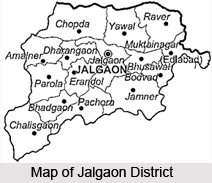
 Jalgaon district is located in the state of Maharashtra. It hosts a population of about 4 million in an area of about 11,700 sq km. It is abounded by many religious places and cultural establishments. The major tourist attractions are Pal hill station at Raver, Patnadevi temple at the confluence of Tapi and Purna River and hot water springs at Unapdev in Chopda Taluka. The world famous heritage site of the Ajanta Caves is near to Jalgaon (50 kms) making it one of the major international tourist hubs. The district has excellent rail and road connectivity and is a central destination to reach out to major places in India. It is a major business centre for tea, gold, pulses, cotton and bananas. Banana and cotton are Jalgaon`s main crops. Jalgaon district is known for its advances in horticulture. Its production of bananas and cotton, especially by resorting to drip irrigation, has created a role model for cultivators in other parts of India. Bananas grown in the district are exported outside the state and to other countries. Jalgaon is the largest banana growing district in India. Jalgaon is also growing up as a premier educational place with many colleges in the field of engineering and computer science. Modern Jalgaon now boasts of a vast industrial area, educational institutes and good hospitals.
Jalgaon District
Jalgaon district is situated in the state of Maharashtra along its northern side. It has made remarkable advances in horticulture, and is the largest banana growing district in India.
Introduction
Jalgaon district is located in the state of Maharashtra. It hosts a population of about 4 million in an area of about 11,700 sq km. It is abounded by many religious places and cultural establishments. The major tourist attractions are Pal hill station at Raver, Patnadevi temple at the confluence of Tapi and Purna River and hot water springs at Unapdev in Chopda Taluka. The world famous heritage site of the Ajanta Caves is near to Jalgaon (50 kms) making it one of the major international tourist hubs. The district has excellent rail and road connectivity and is a central destination to reach out to major places in India. It is a major business centre for tea, gold, pulses, cotton and bananas. Banana and cotton are Jalgaon`s main crops. Jalgaon district is known for its advances in horticulture. Its production of bananas and cotton, especially by resorting to drip irrigation, has created a role model for cultivators in other parts of India. Bananas grown in the district are exported outside the state and to other countries. Jalgaon is the largest banana growing district in India. Jalgaon is also growing up as a premier educational place with many colleges in the field of engineering and computer science. Modern Jalgaon now boasts of a vast industrial area, educational institutes and good hospitals.Location of Jalgaon District
 Jalgaon district is located in the north-west region of the state of Maharashtra. It lies between 20 degrees and 21 degrees north latitudes and east longitudes of 74 degrees 55 minutes and 76 degrees 28 minutes. It is bounded in the North by the Satpura mountain range, Aurangabad district and Nashik district in the south, Madhya Pradesh and Buldhana in the east and Dhule in the west. The Ajanta mountain ranges lie in the south.
History of Jalgaon District
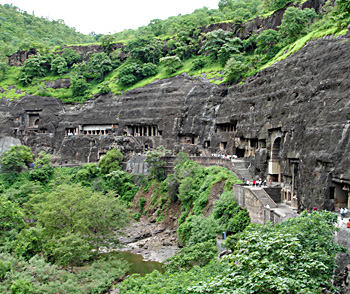 History of Jalgaon district in its early part is rather obscure. It is believed to have been part of a region known as Rasika in the ancient times. Following this, the region came under the rule of the Farqui kings and was henceforth known as Khandesh. The district continued to be known as East Khandesh prior to 21st October, 1960. According to Abul Fazl, the famous historian of the Mughal court, the name Khandesh is derived from the "Khan" title given by Ahmad-I of Gujarat (1411-1443) to Malik Nasir, the second of the Faruki kings. According to some sources, the name comes from the Khandava forest of the Mahabharata. The Mahabharata mentions Yuvanshava, the ruler of Toranmal (Nandurbar district) as fighting with the Pandavas. The rock temples and caves at Nashik and the Ajanta caves show that during the first three centuries AD, Khandesh was under rulers who patronised Buddhism. Thereafter, it was ruled by the Satavahana Kings, Andhrabhrityas, Virsen (Ahir King), Yawan dynasty, Chalukya dynasty, Yadavas and then Ala-ud-din Khilji, Mohammad bin Tughluq, Malik Raja Malik Nazir, the Nizams of Hyderabad, and subsequently the Marathas came to rule the region.
In the 18th century, Khandesh was captured by British troops from the Holkar regime with Dhule as the headquarters. Robert Gill was the first officer of the British East India Company in the Khandesh district with headquarters at Dhule. In 1906 when Khandesh was divided, east Khandesh became present-day Jalgaon. In 1956 with the reorganisation of states, it was included in Bombay state, and with the formation of Maharashtra in 1960, Jalgaon became a district of the state.
The historical legacy of Jalgaon district continues to this day. In the Parola Tahsil, there are remains of a fort believed to have belonged to the father of the great Rani of Jhansi. All India Congress Session of 1936 was held at Faizpur in Yawal Tehsil here in the district of Jalgaon. In present times, the legendary poetess Bahinabai Chaudhari of Jalgaon spread the fame of the Ahirani dialect across the seven seas. Sane Guruji awakened the labour class while Balkavi Thomre`s poetry enriched the socio-cultural life of the district.
Geography of Jalgaon District
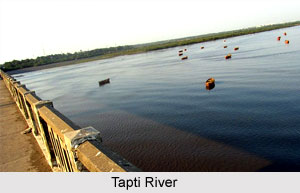
Jalgaon has got a pretty diverse climate. It is exceptionally hot and dry during summer with temperatures reaching as high as 45 degrees Celsius. Jalgaon receives about 700 mm rainfall during monsoons, which is followed by pleasant temperature in winter. The principal natural feature of the district is the Tapti River. Unlike the rest of the Deccan, whose rivers rise in the Western Ghats mountain range and flow eastward to the Bay of Bengal, the Tapti flows westward from headwaters in eastern Maharashtra to empty into the Arabian Sea. The Tapti receives thirteen principal tributaries in its course through Kandesh. None of the rivers is navigable, and the Tapti flows in a deep bed which historically made it difficult to use for irrigation. Most of Kandesh lies south of the Tapti, and is drained by its tributaries the Girna river, Bori river and Panjhra. The alluvial plain north of the Tapti contains some of the richest tracts in Kandesh, and the land rises towards the Satpura hills. In the centre and east the country is level, save for some low ranges of barren hills. To the north and west, the plain rises into rugged hills, thickly wooded, and inhabited by the people of the Bhil tribe.
Culture of Jalgaon District
The Marathi language is the language of the locals. People speak the Hindi language in the areas bordering Madhya Pradesh. The staple food of the people is millets, wheat and rice. Four main fairs are held in the district which attracts a number of devotees not only from within the district but also from the rest of the state. These are: the Shri Rama Rathotsava fair at Jalgaon town, held during the Hindu month of Kartik; the Navaratri-Mahalaxmi fair at Jalgaon town during Navaratri (October-November); Changdeo fair at the Changdeo temple located about 6 kms northwest of Edlabad, and the Mukatabai fair held again in Magha at Kothali, in Edlabad tehsil.
Temples of Jalgaon
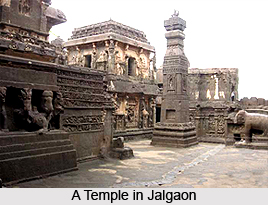
Jalgaon District is located in the northwest region of Maharashtra. It is bounded by the Satpuda mountain ranges in the north, Ajanta mountain ranges in the south. Jalgaon is rich in volcanic soil, which is well suited for cotton production. It is a major business center for tea, gold, pulses, cotton and bananas. Languages spoken are Marathi, Ahirani, Hindi and English. Jalgaon has a very diverse climatic situation. It is exceptionally hot and dry during the summer with temperatures rising as high as 45 degree Celsius, while the winters are quite pleasant. The principal river is the Tapti River. It has a population of about 4 million in an area of 11,700 sq. km. Major tourist attractions and religious establishments surround it.
Omkareshwar Mandir: Omkareshewar temple is on of the leading and stunning temples in Jalgaon city, dedicated to Lord Shiva, at Jai Nagar. Shivratri, Shravni Somvar, Ramnavami and Gokulashtami are the biggest festivals celebrated in this temple.
Ecchapurti Ganesh Temple: Ecchapurti Ganesh temple is located at Navi Peth, near Balaji Sweet Mart, in Jalgaon. The presiding deity here is Lord Ganesh. People believe that the deity of this particular Ganesh fulfills everyone`s desires and secret wishes, hence the name of ecchapurti ganesh (wish fulfillment).
Tourism in Jalgaon District
 Tourism in Jalgaon district offers a number of beautiful sights to the tourist. There are many places for the visitors to choose from, ranging from forts, places of natural beauty and even a number of temples for the pilgrims. While one can visit Pal in the Yawal Taluka for picnics and some relaxation, those interested in historical antiquities can visit the Parola Fort or the Swinging Towers of Farkande. There are also a number of places of pilgrimage tourism located here which are mainly in the form of the various temples found here. These include the Sri Padmalaya temple, Saint Muktabai temple and the Changdeo Temple among others. The various places of tourism in Jalgaon district are discussed below.
Pilgrimage Tourism in Jalgaon District
Sri Padmalaya temple : Among the two and a half Shree Ganapati Peeths in India, this is regarded as the half Peeth. It is called the Padmalaya Kshetra. This temple is located at the top of a hill. There are small temples on all sides of the main temple. The padukas of Shree Govind Maharaj are located in front of the temple. There is a huge bell next to the padukas. There are two self existent (Swayambhu) idols of Lord Ganesha in the sanctum. One idol has its trunk curving to the right and the other to the left. Padmalaya was also known, as "Prabhakshetra". It is a religious place located in Erandol Taluka about 4.8-km from Erandol. It is famous for the temples of Lord Ganapati and Lord Hanuman.
Saint Muktabai temple : Saint Muktabai temple is the region`s ancient temple with Goddess Muktabai being honoured as the deity of region. There are two temples of this deity namely Mehun temple and new Muktabai Temple located in Muktai Nagar city.
Changdeo Temple :
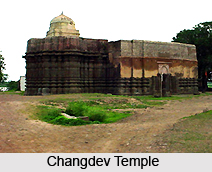
 Changdeo Temple is located at a beautiful natural location in the backwater area of Hatnur dam. The location also sees the confluence of the Tapi and Purna River. With its rich design and ancient artwork, the temple has been given the status of a Protected Monument by the Archaeological Survey of India.
Shree Manudevi Temple
Shree Manudevi Temple is located in the beautiful natural surroundings near Adgaon village in Yawal Taluka. Manudevi is the kuldevi of the maximum households in the district. There is a beautiful waterfall located here which offers a breathtaking view. The way to the temple is a very good trek with the path going through a small river. The temple is surrounded by forested hills. A fair is also held here annually.
Omkareshwar Mandir : Omkareshwar Mandir is one of the most famous and beautiful temples in Jalgaon city, dedicated to Lord Shiva. It are situated at Jai Nagar. Shivaratri, Shravni Somvar, Ramnavmi and Gokulashtami are the biggest festivals celebrated in this temple.
Patnadevi : Patnadevi is a religious place. It is also the birthplace of the great Scientist Bhaskaracharya.
Leisure Tourism in Jalgaon District
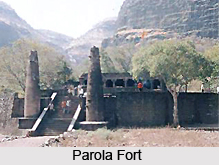
Parola Fort : Parola fort was built in 1727 and the size of the fort is 160 to 130-sq-meters. It is believed that the fort belongs to the father of the Great Rani of Jhansi, Laxmibai. Hence, Parola is believed to be the native place of Rani Laxmibai.
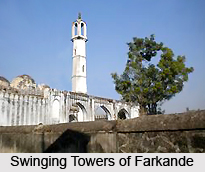
Swinging Towers of Farkande : Swinging Towers, located 16-km from Erandol on the bank of the Utawadi River, are a great example of old construction techniques. Both the towers are 15m long and when one of them is waved the other tower also starts waving automatically. It is believed that the construction is 250 years old.
Nature Tourism in Jalgaon District
Pal : Pal, located in Yawal Taluka, is very famous for its cool temperature and the natural peace with dense forests. The small river and forests make an ideal picnic spot. There is a guesthouse also if you want to stay overnight.
Unapdeo : Hot-water springs are situated in the Satpura mountain range at Unapdeo in Chopda tehsil. Like Unapdev, Sunapdev, Nijhardev are two other hot water breezes generated in the Satpura hill range. All these three places have special mention in the ancient holy `Ramayana` and are believed to have the auspicious touch of Lord Rama during his fourteen years expulsion from Ayodhya.
These are the various places of attraction offered by the district of Jalgaon to its various visitors and tourists.
Recently updated articles in States of India
Bandare Waterfalls, Meghalaya
Bandare Waterfalls in South Garo Hills, Meghalaya, is a secluded natural attraction surrounded by dense subtropical forests and rugged mountain terrai...
History of Thissur District
Early History of Thissur District explains flourishing of the port cities. Now these port cities are transformed into archaeological sites.
Tippi Orchid Research Centre, Arunachal Pradesh
Tippi Orchid Research Centre in Arunachal Pradesh is renowned for its rich collection of exotic and endangered orchids. Surrounded by lush rainforest...
Tourism in Nashik District
Pilgrimage tourism in Nashik district involves visiting the various places of Hindu and Jain worship located here. Some of the holiest sites for Hind...
Mangadu, Kerala
Mangadu in Kerala’s Kollam district is a significant megalithic site known for its urn burials, cist burials, menhirs, and stone circles. Excavations...
Related articles in States of India
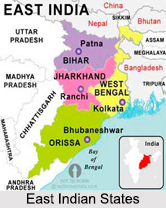
East Indian States
East Indian States comprises of Bihar, Jharkhand, West Bengal, Odisha and also the Union Territory of Andaman and Nicobar Islands. It defines the cult...
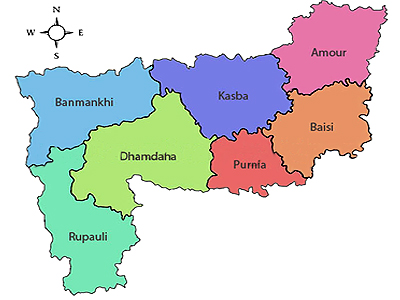
Purnia District in Bihar
Purnia District is located in Bihar and extends from River Ganga to Nepal. The district has a rich Hindu history and glorious past.
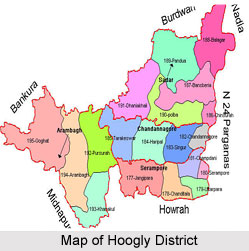
Hooghly district
Hooghly District along the bank of the river Hooghly is one of the principal trading ports of West Bengal.
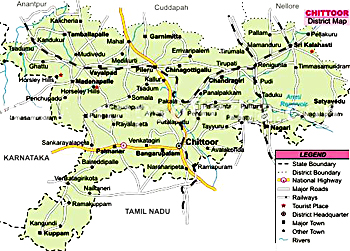
Geography Of Chittoor District
Geography of Chittoor district is spread along the topography of the land which is divided into two natural divisions; Chittoor has a dry and healthy...
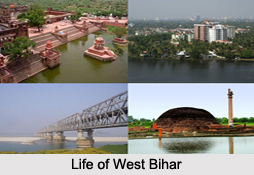
Districts of West Bihar
Districts of West Bihar is comprised of medieval monuments that were built by the different governors of Mughal era.