Introduction
Shimla District is an administrative district of Himachal Pradesh and Shimla city is the district headquarters. Shimla was the summer capital of India under British rule. Shimla has seen many important historical events such as the famous Shimla Agreement between India and Pakistan which was signed here.
Shimla District is also famous for its natural beauty, architectural buildings, wooden crafts and apples. The district derives its name from the administrative headquarters. Average altitude of the district is 2202 metres above the sea level. Main language spoken in this district is Himachali or Pahari language.
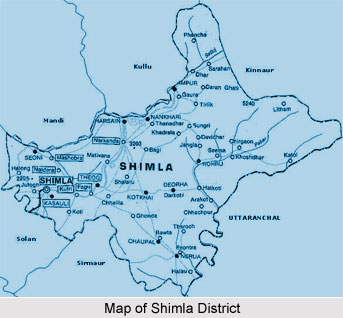
Shimla District is located between 77 degree and 78 degree 19 minutes east longitude and 30 degree 45 minutes and 31 degree 44 minutes north latitude. This administrative district of Himachal Pradesh is bounded in the north by Mandi and Kullu, in the east by Kinnaur, in the south by Uttarakhand and in the west by Sirmaur. The town of Shimla is built over several hills and connecting ridges. The important hills are Jakhu (8050 feet), Prospect Hill (7140 feet), Observatory Hill (7050 feet), Elysium Hill (7400 feet), and Summer Hill (6900 feet).
History of Shimla District
History of Shimla district can be traced back to the early nineteenth century, during the period of Anglo-Gurkha war. In the year 1804, the Gurkhas started damaging the hills and other regions of Shimla as a revenge of the battle of Kangra in which they were gravely defeated by the Sikhs. In the battle of Kangra, a number of Gurkhas were killed which greatly agitated this community.
Numerous forts were built by the Gurkhas around Shimla among which the Jagatgarh fortress served as the origin of a famous military cantonment, the modern Jutogh. Initially, the Gurkha invaders succeeded in capturing all of their target locations between the Jamuna and Sutlej in 1808. Arki served as their capital and from there they began ruling over the neighbouring regions in a ruthless manner. Their ruthlessness finally forced the people to appeal to the British government for help. Thereafter, a small British army was employed under the commandership of Major General "Sir David Ochterlony" to save the Gurkha hostages.
Almost all of the hill chiefs joined the British army to accomplish the same which led to a ferocious battle at Ramgarh fort situated in Nalagarh at an altitude of 3750 feet. The fort at Malaon was the witness of the final decisive battle where the Gurkhas were overpowered by the superior arms and ammunitions of the British. This battle took place on 15th May 1815 and put an end to the urge of Gurkhas to rule over the state. An official declaration followed this battle according to which all the Chieftains who joined hands with the British army against the Gurkhas were given back their lands with British protection. The maharaja of Patiala had major contributions in this battle and thus he was rewarded with a stretch of land in the adjoining region which is presently a part of Shimla. On the other hand, the Gurkhas signed the "Treaty of Sanjauli" after losing the battle and the forts of Kotgarh, Sandoch, Sabathu and Ramgarh were seized by the British.
Shimla district presently includes 19 former hill states namely Sangri, Ratesh, Rawingarh, Keothal, Jubbal, Dhami, Khaneti and Delath, Kumharsain, Tharoch and Dhadi, Darkoti, Bhaji and Koti, Bushahr and Balson. After Kashmir, Bushahr had the fame of being the most ancient hill states of in the Western Himalayas. Legends say that the son of Lord Krishna, Pradhuman, was the founder of the Bushahr dynasty. Pradhuman arrived in this region to marry the daughter the local chief of Shonitpur, Banasura. Pradhuman got involved in a battle with Banasura in which the later died and consequently, in the absence of any son of Banasura, Pradhuman installed himself as the chief of Bushar and Kinnaur regions. However, C. F. Kennedy stated that Danbar Singh who was a Rajput immigrant from Deccan founded Bushar in 1412 A.D. In 1914 Padam Singh was recognised by the British as the legitimate heir of the kingdom and was coronated as Raja of Rampur Bushahr. Rampur Bushahr was finally included as a part of province of Himachal Pradesh in March, 1948.
Another hill state, Jubbal, was initially a part of Sirmaur but later, after the Gurkha war, emerged as independent region. The state was founded by Raja Karam Chand. Post independence, Jubbal was merged with the Indian Union and it got became a part of the state of Himachal Pradesh in on 15th April, 1948. Dig Vijay Singh was the ruler of the state at the time of this merger.
The present form of Shimla district came in to being on 1st September 1972 after the reorganization of the districts of the state. This was following by the merger of a major portion of erstwhile Mahasu district with Shimla. The district however got its name from the town of Shimla which was the district headquarters and presently the capital of Himachal Pradesh.
Geography of Shimla District
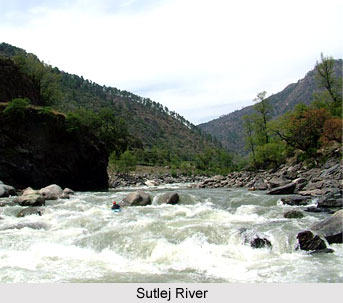
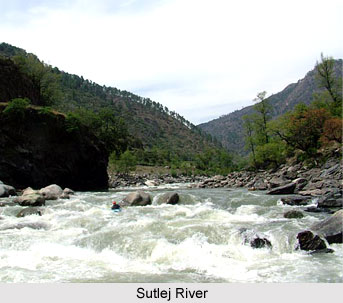
Shimla District has been blessed with all the natural bounties. This hilly district is surrounded by green pastures and snow-capped peaks. Shimla is situated in the Shivalik range of Himalayas with combination of low lying hills to gigantic mountains. Shimla district is full of thickly populated pine trees and small rivulets, rivers in deep gorges and placid mountains lakes, mountain sides draped in snow, and green alpine meadows, all form a part of this immense spectrum. Winters are generally cold and chilly winds from the upper Himalayas makes the place really cold. Around the last week of December, this district receives heavy snowfall. Temperature varies from 15 degree Celsius to 27 degree Celsius in summers and in winters it ranges from zero to 17 degree Celsius. Major rivers flowing through the district are Sutlej River, Pabbar and Giri rivers.
Demography of Shimla District
According to the Population Census in the year 2011, Shimla District had population of 813,384 of which male and female were 424,486 and 388,898 respectively. The population of Shimla District constituted 11.86 percent of total population of Himachal Pradesh. The average literacy rate of Shimla in 2011 was 84.55 compared to 79.12 of 2001. If things are looked out at gender wise, male and female literacy were 90.73 and 77.80 respectively. The total literate in Shimla District were 619,427 of which male and female were 347,013 and 272,414 respectively. In 2001, Shimla District had 504,330 in its district.
Fairs in Shimla District
Fairs in Shimla District form an integral part of the culture of the region. Several fairs are organised in Shimla District. The fairs in Shimla District are the complete picturisation of the Culture of Shimla District.
These fairs provide a glimpse of the diverse culture and indigenous traditions of the local people. Some of these fairs also have commercial significance. Fairs in Shimla District draw the attention of the devotees from various places. Details of some of the main fairs of this district of Himachal Pradesh are given below -
Bharara Fair: This fair is held in village Bharara near Kumarsain and people of all castes and creed participate in this fair. The fair is held on the 1st of Jyestha (May). The fair is cultural and recreational and `Natti` dances are performed. People also enjoy `Hindola` ride.
Bhoj Fair: This fair is held in village Guman in Rohru tehsil in the month of November for three days in honour of Devta Bansor, Parasurama and Kilbaru. Devta Bansor is the presiding deity. Besides paying homage to the deities `Natti` dances are performed by the people. The fair attracts a huge crowd.
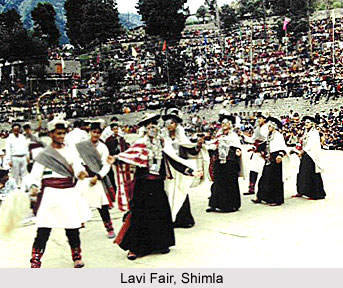
Lavi Fair: Lavi fair of Rampur is the most important fair of the district and state. It is a commercial fair held on the 25th of Kartika (November). It is said that the fair was related to the signing of trade treaty between the erstwhile Bushahr state and Tibet. It is a very old fair and entirely related to the sale and purchase of goods. `Natti` dances and cultural shows are the main attractions of this fair of Shimla District.
Mahasu Jatra: This fair is celebrated at a place about 6 kms from Shimla-Kotkhai road near Mahasu village on the 3rd Tuesday in the month of Baisakh (around May) for two days. The fair is very and is held in front of the Durga Devi temple by a large gathering from the neighbouring areas. `Natti` dances and folk songs are performed. Archery game is the main attraction of entertainment.
Pathar-Ka-Khel-Halog Fair: This fair is held in village Halog of tehsil Shimla. Halog was the capital of erstwhile Dhami state. The fair is held on the second day of Diwali in the month of Kartika (November). Stone throwing fight between two parties is the main attraction of the fair and whatever blood oozes out from the wounds caused by injuries on the bodies of the participants is collected and offered to Goddess Kali. Apart from the stone throwing game `hindola` ride is also enjoyed.
Sipi Fair: This fair is held every year in Mashobra on 1st of Jyestha. It is a very old fair and the Rana of Koti used to be the chief visitor. Thousands of people of the surrounding areas participate in the fair. Archery game is played besides several cultural programmes and shows like `Karyala`. Performance of the jugglers, magicians and acrobats provide additional entertainment to the spectators.
Rohru Fair: This fair is held in Rohru on the 9th and 10th of Baisakh (April) on the banks of river Pabbar in honour of Devta Shikru. People of nearby villages also attend this fair. It is a very old fair and is held to commemorate the supremacy of the deity. This fair also has commercial significance. Performance of `Natti` dances and other cultural activities are the main attractions of this fair.
These are some of the main fairs of Shimla District that are attended by huge number of people from distant places.
Festivals of Shimla District
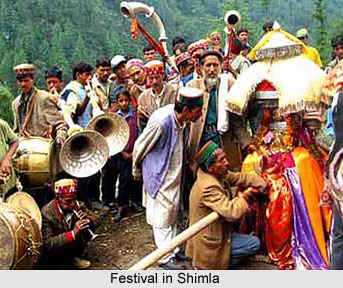
Festivals of Shimla district are celebrated with great vigour and gaiety. A number of festivals are celebrated in the district which enriches the cultural heritage of the country immensely. The chilly winters and snowfall makes the place ideal for the celebration of some unique festivals attracting a plethora of tourists from distant places. Spirit of the festivals can also be prominently witnessed among the residents of the district. The splendid decorations, vibrant cultural programs and grandeur of festivals of Shimla district are worth experiencing.
Summer Festival
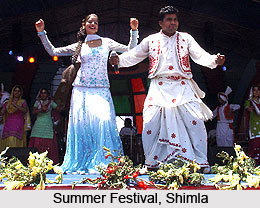
Summer festival is organized in the district of Shimla in the month of May, every year. The famous ridge ground serves as the venue for this festival. It is characterized by vibrant cultural functions including performances of local people and school children. Several famous personalities also become a part of this festival and its cultural functions.
Ice Skating Carnival
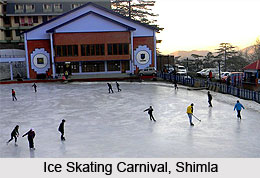
Ice skating forms one of the major attractions of Shimla which allures a plethora of sports lovers. Shimla also owns the credit of hosting the only natural ice skating rink in the whole of Asia. It forms an exquisite pass time for the players as well as viewers. The activity of ice skating begins in the month of December and continues up to February. Chilling cold and clear blue skies form the ideal atmosphere for this sport in Shimla. During this festival, two sessions are organized every day, one in the morning and the other in the evening. However the sessions greatly depend on the condition of frozen ice on the ground. In the municipal building, situated near the Scandal Point, has a hanging balloon which serves as a signal as to whether the game would be organized for the day or not. Visitors can receive membership for the whole season, for shorter terms or even for a single session. At the rink, skates are provided to the participators. Other added attractions of the festival include gymkhanas ice hockey, fancy dress carnivals and beautiful dance performances.
Rhyali Festival
Rhyali festival is celebrated in Shimla in the rainy season and is one of the most significant festivals of the district. Rain plays and important role in Shimla as the livelihood is mainly dependent on agriculture. The festival is celebrated with the purpose of making the Rain God happy so that their agricultural production flourishes greatly.
Baisakhi
One of the most significant festivals of Shimla is Baisakhi which is celebrated on the first day of the Baisakh month. In Shimla this festival is known as Bisha or Bissu. The festival marks the beginning of harvest season.
Christmas
The winters give a magnificent white visage to the district and the celebration of Christmas marks grandeur. The place also houses some beautiful churches which are beautifully decorated during Christmas. The heavy snowfall in Shimla further augments the spirit of the festival.
Diwali
Shimla celebrates Diwali with great joy and fervour. Apart from Hindus, people belonging to other religion also celebrate it with utmost vigour. The illuminated district during Diwali looks majestic.
Navaratri
Navaratri is another important festival of Shimla and Dussehra marks the end of this grand festival. Huge idols of Ravana are burnt in Dussehra which signifies the victory of good over evil.
Culture of Shimla District
Culture of Shimla District is diverse and colourful. Several fairs and festivals are organised here and people actively participate in those fairs. Summer festival and winter sports festival of Shimla District also attract travellers from adjoining areas. Summer festival is held every year in the month of May at Shimla. It is very popular and includes cultural function with performance of local folks and school children and also by some famous personalities. Ice-skating in Shimla is a big attraction for the sports-lovers during winter. Shimla is the only place in Asia which has the privilege of having a natural Ice-skating rink of the kind and offers a popular pastime to the participants and on lookers alike. Ice-skating normally begins in early December.
Tourism in Shimla District
Tourism in Shimla District includes several exploring sites like ancient temples, museums, botanical gardens and much more. The spectacular cool hills of Shimla accompanied by the structures made during the colonial era create an aura, which is very different from other hill stations. Bulging at its seams with unprecedented expansion, Shimla retains its colonial heritage, with grand old buildings, among them are the stately Viceregal Lodge, Charming iron lamp posts and Anglo-Saxon names. The Mall, packed with shops and eateries, is the centre of attraction of the town, and Scandal Point, associated with the former Maharaja of Patiala`s escapades, offers a view of distant snow clad peaks. Some of the major tourist attractions of Shimla District are as follows -
Pilgrimage Tourism in Shimla District
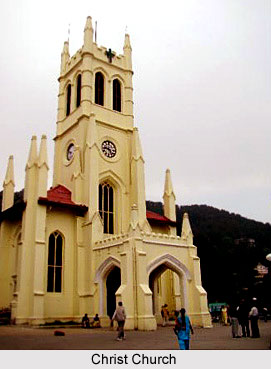
Christ Church and St. Michael`s Cathedral: Built in 1846-1857, Christ Church is the second oldest church of Northern India. The Church overlooks the ridge and is one of the landmarks of Shimla. The clocks on Christ Church were added later. The Church`s exquisite beauty comes with the stained glasses that are fitted on its windows. The town`s other important churches are St. Michael`s Cathedral and Roman Catholic Cathedral.
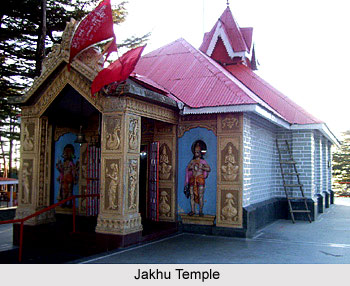
Jakhu Temple: Dedicated to Lord Hanuman, this temple is at an altitude of 8048 feet above sea level near the highest point of Shimla ridge. It offers a panoramic view over the surrounding valleys, out to the snowcapped peaks, and over the town itself.
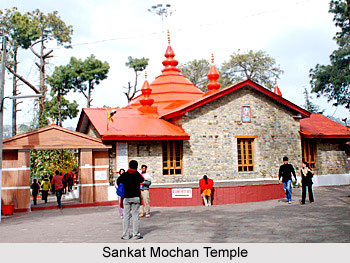
Sankat Mochan Temple: On Shimla-Kalka road at a distance of around 5 kms is the famous Lord Hanuman temple. Situated at an altitude of 1,975 metres, it commands an excellent view of Shimla town. Temple has beautiful campus and Langar is held every Sunday.
Tara Devi Temple: Situated on top of a hill that faces Shimla, the temple offers panoramic views of Shimla town and surrounding hills. A thick forest of oak and rhododendron surrounds it. It is a famous picnic spot of Shimla.
Kali Bari: The temple is dedicated to Shyamala Devi (Shimla is named after this goddess), an incarnation of Goddess Kali. Temple faces heavy rush during the festivals of Diwali and Durga Puja.
Leisure Tourism in Shimla District
Himachal State Museum and Library: The museum is located at around 2.5 kms west of the scandal point and opens daily except on Mondays for the visitors. It has got a good collection of ancient historical sculptures, paintings, coins, photos and other items from all over the state as well as outside the state. There is also a library, which houses many historical books and manuscripts.
Viceregal Lodge: On the Observatory Hills is located Viceregal Lodge, which is also known as `Rashtrapati Niwas`. This magnificent building was the residence of the British Viceroy Lord Dufferin. This lodge was completed in 1888 and it is said that every brick for the building was carried by mules. This building is surrounded by well-maintained gardens and lawns. The lodge has now been converted into Institute of Advanced Study. It is one of the heritages of Shimla.
Nature Tourism in Shimla District
The Ridge: The large open space in the heart of town presents excellent view of the mountain ranges. Shimla`s landmarks - the Neo-Gothic structure of Christ Church and the new - Tudor Library building is worth seeing.
The Mall: Most of Shimla`s landmarks are located here. The Mall further joins the Ridge at the `Scandal Point` of Kipling`s Shimla, where a statue of the nationalist leader Lala Lajpat Rai has been erected. This is the main shopping centre of Shimla with restaurants. The Gaiety Theatre, which is a reproduction of an old British Theatre, is a centre of cultural activities.
Prospect Hill: The hill at an altitude of 2,155 metres offers a spectacular view of the area. It is crowned by Kamna Devi Temple.
Summer Hill: At an altitude of 1,283 metres, 1 km from Boileauganj. Summer Hill is a picturesque spot on Shimla-Kalka Railway line offering shady walks in quiet surroundings.
Potter Hill: Situated at a distance of 1 km from Summer Hill, it is a very beautiful picnic spot with all the natural beauty. Ecological Park is situated here.
Annandale: It is another popular picnic spot. It is covered with deodar forests and was once the playgrounds of Shimla, where racing, polo and cricket entertained the British rulers. Surrounded by deodar trees, this glade has an ancient temple on the edge.
All these tourist spots are worth visiting. Shimla can be visited throughout the year, as each season has its charm. The snowfalls during the winters attract many tourists. In the summers one can escape from the scorching heats of the plains and can enjoy the cool breeze at Shimla and in its vicinity.
In the summer season, Shimla has the attraction of excellent walks and treks against the backdrop of the scenic beauty of wooded ravines, flowers and pines. In winters, it is home to winter-sports and an ice-skating carnival.
Shimla is a stark example of the diversity that India offers to tourists. In the tourist season various entertainment programmes are organised such as Summer Festival in June, Ice skating in December and January and Winter Carnival. Most of the time one or the other exhibition or craft fair is held around the mall area. Further, possibilities for a wide range of adventure activities are enormous in Shimla District. Trekking, fishing, skiing, golf and ice skating are other attraction for those tourists who are adventure lovers.

Tourist Places around Shimla
There are several tourist places around Shimla. Cities around Shimla are worth exploring as they offer visits to several religious and historical sites. One of the most interesting features about the tourist places around Shimla is their amazing scenic beauty. Some of the prominent tourist sites around Shimla are as follows.
Rampur: It is located 80 kms from Shimla on the Hindustan Tibet Road. It was once the capital of the Princely State of Bushahr, the town is situated on the banks of Sutlej River. The whole area is a maze of lanes, shops and temples. One of the main attractions of Rampur is its Lavi Fair that is usually organised in the month of November. Dumgir Buddhist Temple, Padam Palace, Raghunath Temple, Ayodhya temple and Narsingh Temple, are worth visiting.
Wild Flower Hall: On the Mahasu range, at Charabra, 13 km from Shimla, is the Wild Flower Hall situated at an altitude of 2,498 metres. Nestled among picturesque surroundings, the Wild Flower Hall commands a breathtaking view of the snows.
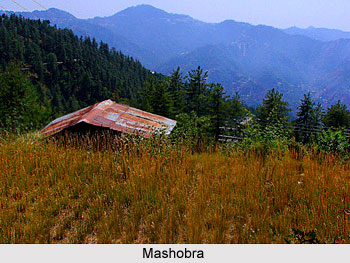
Mashobra: This place is situated at around 10 kms from Shimla on Shimla-Naldehra road at a height of 2149 metres. A place of unique beauty, Mashobra is an ideal interlude beneath the oaks and the pines. Featuring beautiful gardens spattered with the daffodils, hyacinths, asphodels and celandines, it is a popular weekend resort, dotted with delightful villas and innumerable picnic spots. Here, Goddess Durga temple is worth seeing.
Kufri: Kufri, at distance of 16 km from Shimla and at an altitude of 2510 metres above sea level, is a site offering some famous hikes and wonderful snow for skiing in winters. An enjoyable walk leads up to the Mahasu Peak. The Himalayan Nature Park here has a good collection of animals and birds found in the region.
Narkanda: This attractive tourist site is at around 64 kms from Shimla. Narkanda offers wonderful slopes for skiing. At an elevation of 2708 metres, it has dense pine forests. Hatu peak, 8 kms from Narkanda, provides a striking panorama of the plains below. Narkanda offers spectacular views of snow ranges. Ancient temple of Hatu Mata is alive with skiers.
Fagu: Fagu is situated on Hindustan-Tibet Road 22 kms from Shimla, at a height of 2,450 metres. Fagu is gifted with some enchanting views.
Chail: It is located at around 43 kms from Shimla. Chail has a lush green setting and was the former capital of Patiala state. It has the world`s highest cricket ground at a height of 2250 metres, built in 1893. It is also a hiker`s paradise and there is a wildlife sanctuary at a distance of 3 km from here.
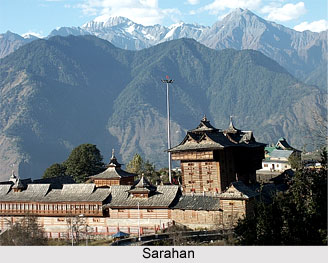
Sarahan: On Hindustan Tibet Road beyond Rampur is a small village worth visiting. It provides a spectacular view of Shrikhand Mahadev (5227 metres) and hiking opportunities to the nearby villages such as Ranwin and Bashal Peak. The Bhimakali temple, dedicated to Goddess Durga, is the finest example of Indo-Tibetan architecture. As per legend, this is where Shakti destroyed the mythical demon king, Bhasmasura. It is a highly revered place of pilgrimage. Sarahan is the gateway to Kinnaur. A Pheasant Breeding Centre and stadium are worth visiting. The area is a rich bowl of quality apples and other varieties of delicious fruits.
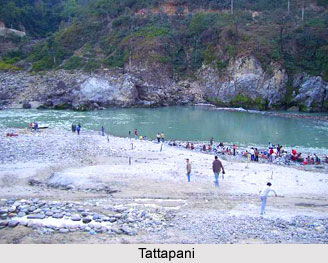
Tattapani: Tattapani, 51 km from Shimla, is a spot well known for hot sulphurous springs. Shiv Goofa at Saraur is also worth visiting. One can enjoy fishing here.
Naldehra: Naldehra, at an altitude of 2050 metres and 23 km from Shimla on Shimla- Tattapani road, houses the oldest and the highest golf course in India. In the middle of the course is a temple, Mahunag Mandir.
Kotgarh: Kotgarh lies at around 82 kms from Shimla and is the apple heartland of Himachal. Today Kotgarh continues to be one of the most intensive apple growing areas in the country with acres of orchards lining the slopes of this untouched dreamland. The view of the Sutlej River during the day and the enchanting lights of this beautiful valley at night are a photographer`s delight.
All these sites around Shimla attract travellers from distant places.