
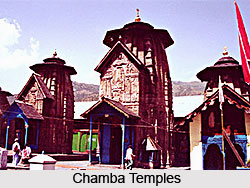
 The town of
Chamba in Himachal Pradesh is renowned for its scenic beauty
and magnificent temples. Some of these places of worship date back more than a
thousand years, while others were built a few centuries ago. Despite their
varying periods of origin, all the temples are celebrated for their
architectural excellence and aesthetic appeal. Chamba is particularly known for
its medieval temples, which showcase remarkable craftsmanship in stone, wood
and slate.
Ancient Temples in Chamba, Himachal Pradesh
The temples in Chamba, Himachal Pradesh, are renowned for their historical significance, architectural brilliance and religious importance. Dating from the 10th century onwards, these ancient sacred structures showcase Nagara, Shikhara and traditional hill-style architecture. Dedicated to various Hindu deities, they reflect the region’s rich cultural heritage, artistic craftsmanship and spiritual traditions.
Introduction
Architecture of Temples in Chamba
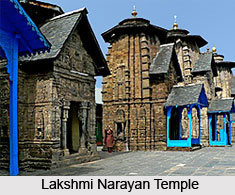
The temples of Chamba are distinctive for their architectural styles, which predominantly follow the plains type of temple architecture, known as Shikhara or spired architecture. These temples are generally constructed of stone and feature a conical spire above the sanctum sanctorum, or Garbhagriha. Another notable feature is the strong influence of Kashmiri architecture evident in many of these structures. The Lakshmi Narayan Temple in Chamba is a prominent example of this architectural style. In contrast, the Chamunda Temple, situated on a spur of Shah Madar Hill, follows the typical hill style of temple architecture.
Ancient Temples of Chamba
Laxmi
Narayan Temple: The
Lakshmi Narayan Temple, built in the 10th century by Raja Sahil Varman, is the
principal shrine in Chamba and is renowned for its historical significance and
architectural excellence. The temple complex features a Bimana or Shikhara, a
Garbhagriha (sanctum sanctorum), a small Antarala (vestibule), and a Mandapa
(pillared hall). Its architecture incorporates wooden chhatris and a
shell-shaped roof to protect the structure from heavy snowfall. A distinctive
wheel-shaped roof also helps shield the temple from the cold climatic conditions
of the region. The temple houses a metallic image of Garuda, the mythical mount
of Lord Vishnu, while a metal statue of Garuda stands guard over the main entrance. The
latter was installed by Raja Balabhadra Verma.
The temple complex comprises six temples arranged in a row from north to south, dedicated to Lord Shiva and Lord Vishnu. Lakshmi Narayan Temple complex includes several other significant shrines. These include the Radha Krishna Temple, built in 1825 by Rani Sarda, the wife of Raja Jit Singh; the Shiva Temple of Chandragupta, attributed to Sahil Varman; and the Gauri Shankar Temple, constructed by Yugkar Varman, the son of Sahil Varman.
According to historical accounts, Emperor Aurangzeb ordered the temple's demolition. However, Raja Chhatra Singh responded by adding gilded embellishments to the temple in 1678, further enhancing its architectural splendour.
Champavati Temple: The Champavati Temple is an ancient shrine built by Raja Sahil Varman in the 10th century AD in memory of his daughter, Champavati. Located near the treasury building in the heart of Chamba, the temple holds considerable religious and historical significance. The presiding deity of the temple is Mahishasura Mardini, a form of Goddess Durga. The temple is distinguished by its Shikhara-style architecture and ornate stone carvings, which set it apart from other temples in the region. Its walls are adorned with beautifully carved motifs, while a large wheel on the rooftop serves as a distinctive architectural feature, making the temple unique among the temples of North India. The Champavati Temple attracts numerous pilgrims who visit to offer prayers and pay their respects at the shrines of Vasuki Naga and Wazir.
 Hari Rai
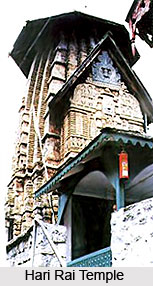
Temple: The Hari
Rai Temple is an ancient stone shrine built in the Shikhara style of
architecture. It is believed to have been constructed by Raja Salabahana in the
second half of the 11th century AD. The presiding deity of the temple is Lord
Vishnu in his Vaikuntha form. The principal idol, made of Ashtadhatu (an alloy
of eight metals), depicts a human body with three faces representing a man, a
boar and a lion. The bronze idol of Lord Vishnu is admired for its exquisite
craftsmanship and intricate detailing. Every aspect of the sculpture, from the
deity’s coiled hair to the finely carved garments and ornaments, reflects
remarkable artistic skill. The four-armed idol holds a fully blossomed lotus in
one hand and a conch shell in another.
The temple also features representations of several other deities in different niches. At the entrance, sculptures of Goddess Ganga and Goddess Yamuna can be seen. Inside the temple, Lord Shiva is depicted seated on Nandi, the bull, with Goddess Parvati by his left side. Their respective vahanas (divine mounts) are positioned in front of them. Another notable representation is that of Surya Dev, the Sun God, seated on a chariot drawn by seven horses, with Aruna, his charioteer, also depicted. The temple’s exterior walls are adorned with beautiful carvings, further enhancing its architectural and artistic significance.
Bansi
Gopal Temple: The
Bansi Gopal Temple is a historic 16th-century Hindu shrine located near the Akhand Chandi Palace in
Chaugan Mohalla in Chamba. Constructed of stone, the temple follows the
Shikhara style of architecture and features a classic Nagara-style curvilinear spire built on a square
plan. Dedicated to Lord Krishna, the temple depicts the deity in
his Bansi Gopal form, playing the flute, with his consort Radha
standing beside him. The deities are seen in the form of an sculpture made by
black marble statues.
The temple's sanctum sanctorum is square in shape and is connected to an Antarala (vestibule) and a Mandapa (pillared hall). The entrance is adorned with images of Goddess Ganga and Goddess Yamuna, adding to the temple's religious and artistic significance. In addition to the principal deities, the temple houses representations of several other Hindu Gods and Goddesses, including Lord Hanuman, Surya Dev, Hari-Hara, Anantashayi Vishnu and Mahishasura Mardini.
 Vajreshwari
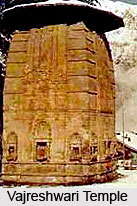
Temple: The
Vajreshwari Temple is an ancient stone shrine believed to have been built in
the 11th century AD. Located at the end of Jansali Bazaar in Chamba, the temple
is renowned for its delicate stonework and intricate carvings. Its pillars are
particularly noteworthy, as they are adorned with elaborate carvings depicting
various deities. The recesses along the temple’s periphery feature beautiful
representations of Goddess Durga and Lord Vishnu, further enhancing its
artistic appeal. The sculptures of two Dwarpalas (guardian figures) standing at
the entrance are also remarkable for their craftsmanship. In addition to its
architectural features, the temple holds historical significance due to the
inscriptions found on its structure. The outer wall bears eighteen single-line
inscriptions, while a pillar situated in front of the doorway contains another
inscription comprising three lines.
Chamunda Devi Temple: The Chamunda Devi Temple, dedicated to Devi Chamunda, a fierce form of Goddess Kali, was constructed by Raja Umed Singh in 1762. Situated on a prominent spur of Shah Madar Hill, the temple offers a panoramic view of the town of Chamba. Unlike most other temples in the town, it follows the traditional hill style of architecture and is constructed primarily of wood, featuring a distinctive gabled roof.
The temple
is also renowned for its artistic craftsmanship. The ceiling, pillars and
brackets of the Mandapa (pillared hall) are intricately decorated with carved
figures depicting various Hindu deities and mythological scenes. One of the
carvings portrays Lord Shiva clad in tiger skin and holding a trident, a
damaru (small drum) and a cup. Another depicts Yashoda, the foster mother of Lord Krishna,
churning butter while the infant Krishna attempts to steal it. Other finely
carved figures represent deities such as Lord Vishnu, Lord Ganesha and Goddess Durga, further enhancing the
temple's artistic and religious significance. At the centre of the Mandapa lies
an Agni Kund, or sacrificial fire pit, indicating the tradition of conducting
havan (ritual fire ceremonies) at the temple.
Sui Mata Temple: The Sui Mata Temple is an integral part of Chamba’s cultural and historical heritage. Located on Shah Madar Hill, the temple consists of a simple memorial and a pindi smeared with vermilion. It is dedicated to Rani Sunayana, the queen of Raja Sahil Varman, who is remembered for her legendary sacrifice for the welfare of the people of Chamba. According to local legend, Chamba was founded by Raja Sahil Varman in the 10th century AD. During his reign, an aqueduct was constructed to bring drinking water from a nearby stream to the town. However, for reasons unknown, water failed to flow through the channel, causing considerable hardship for the inhabitants.
Legend has it that one night, both the king and the queen had a strange dream in which a goddess declared that water would reach the town only if a member of the royal family was sacrificed. Concerned about the welfare of his subjects, the king offered to sacrifice his own life. However, the queen persuaded him against doing so, explaining that his survival was essential for the well-being of the kingdom. The couple also considered the consequences of sacrificing their son, as it would leave the royal family without an heir. Eventually, Rani Sunayana decided to sacrifice her own life for the welfare of her people.
According to the legend, the queen was taken to the designated sacrificial ground and buried alive in accordance with the goddess’s command. As soon as the spot was covered with earth, water began flowing through the aqueduct, providing the people of Chamba with an abundant supply of drinking water. The temple is believed to have been built at the very spot where the queen paused to take one last look at her beloved Chamba before her sacrifice. To commemorate Rani Sunayana’s sacrifice, a three-day fair is held at the Sui Mata Temple every year. During the celebrations, young girls dressed in traditional attire sing an elegy known as Sukraat in the local dialect, preserving the memory of the queen’s sacrifice.
Sita Ram Temple: The Sita Ram Temple is a stone shrine built in the Nagara style of architecture and dedicated to Lord Rama and his consort, Sita. It was constructed by Batlu Dai, the wet nurse of Raja Prithvi Singh, sometime during his reign from 1641 to 1664. Situated at the crossroads of Mohalla Bangotu, the temple stands on a raised platform and faces south. Beside the main shrine is a smaller temple dedicated to Lord Hanuman, adding to the religious significance of the complex.
Narsingh
Temple: Bharmour’s
Chaurasi Temple Complex resembles a sacred village nestled within a courtyard,
where the worship of Lord Shiva forms the central element of its religious
landscape. Within this predominantly Shaivite setting stands the Narsingh
Temple, dedicated to Lord Narasimha, the fierce man-lion incarnation of
Lord Vishnu. Built in the Shikhara style of architecture, the magnificent piece
was constructed by Tribhuvanarekha Devi, queen of Raja Yugakarvarman halfway
during 10th century. The presence of this shrine highlights the diverse
religious traditions of the Himalayan region, where sacred spaces transcend rigid
religious classifications. These temple complexes bring together diverse
deities, legends, dynastic histories, beliefs, protective traditions and local
memories, allowing them to coexist.
Recently updated articles in Temples of India
Virupaksha Temple
Virupaksha Temple, located in Hampi, Karnataka, is a historic Hindu temple dedicated to Lord Shiva. Dating back to the 7th century CE, it flourished u...
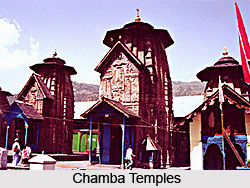
Ancient Temples in Chamba, Himachal Pradesh
The temples in Chamba, Himachal Pradesh, are renowned for their historical significance, architectural brilliance and religious importance. Dating fro...
Vijaya Vittala Temple, An Architectural Masterpiece of Hampi
The Vittala Temple, located in Hampi, Karnataka, is a magnificent example of Vijayanagara architecture. Dedicated to Lord Vittala, a form of Lord Vish...
Rathnapureeswarar Temple
Rathnapureeswarar Temple in Tiruvarur district, Tamil Nadu, is a revered Shaivite shrine among the Paadal Petra Sthalams. Dedicated to Lord Shiva, it...
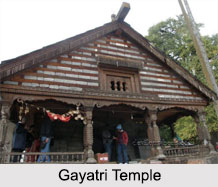
Gayatri Temple, Sirmaur
Gayatri Temple is located in Sirmaur district, Himachal Pradesh. Gayatri Temple is a sacred shrine that belongs to the medieval age.
Related articles in Temples of India
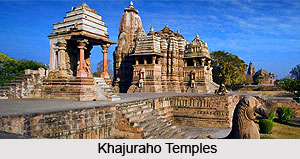
Khajuraho Temples
Khajuraho Temples are known the world over for their beauty and architectural construction. This group of temples is situated in the central Indian st...
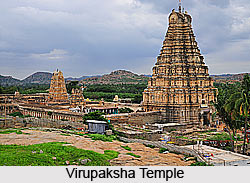
Temples In Hampi
Temples in Hampi are the manifestations of rich religious beliefs and architectural and sculptural abundance.
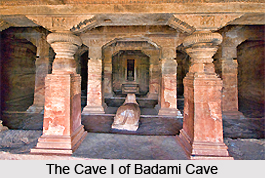
Badami Cave Temples
The Badami Cave Temples, an exemplary production of Indian architecture, are situated in the town of Badami.
Temple Architecture During Rajput Period
Temple architecture during the Rajput period was inclined to the aspect of Bhakti. Rajput kings encouraged this art which is reflected in the grandeur...
Medieval Temples of India
Medieval temples of India vary from each other due to the style and architecture. The impact of the prevalent kingdom is prominent in the style of bui...